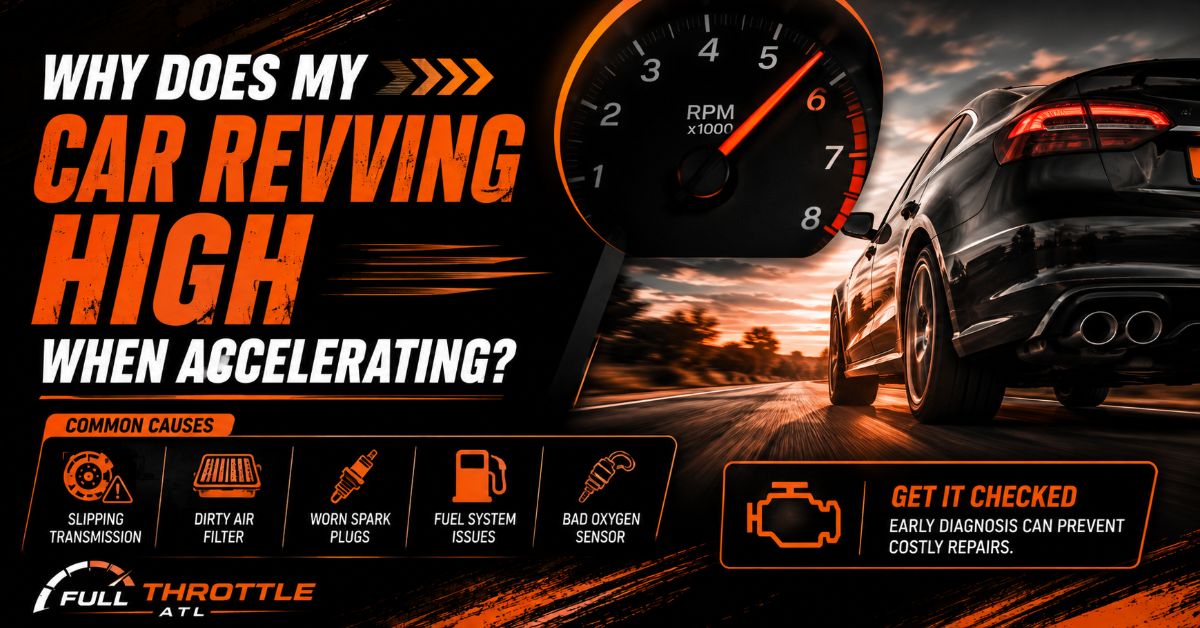
A car revving high without gaining speed indicates a mechanical or hydraulic disconnect between the engine and the drive wheels. This issue is most commonly caused by a slipping automatic transmission, a worn manual clutch disc, low transmission fluid pressure, or distorted electronic sensor signals mismanaging gear selection.
At a Glance
- Automatic Transmissions: A fluid deficit of just 0.5 to 1.0 quart causes hydraulic line pressure to drop below 50 PSI, triggering clutch pack slippage.
- Manual Transmissions: Clutch discs worn below 6.0mm thickness (down from 8.0–9.0mm factory spec) lose clamping force, causing high RPM under acceleration.
- CVT Vehicles: High RPM during acceleration is often normal “rubber-banding” behavior designed to keep the engine in its optimal powerband.
- Driving Risk: Driving with a slipping transmission generates internal fluid temperatures exceeding 240°F (115°C), causing permanent transmission failure within 5 to 10 miles.
Is High Revving During Acceleration Dangerous to Drive With?
No, you should not drive a car that revs high without gaining speed. Continued driving under these conditions causes rapid thermal degradation and secondary damage to mechanical driveline components.
In automatic vehicles, transmission clutch packs slipping against one another generate extreme friction heat. This quickly spikes transmission fluid temperatures above 240°F (115°C). At these elevated temperatures, hydraulic fluid oxidizes instantly, losing its lubrication properties and destroying internal seals, bushings, and solenoids within 5 to 10 miles.
In manual vehicles, a slipping friction disc generates intense heat against the metal pressure plate and engine flywheel. This heat warps the steel surface, causing deep hot spots that turn an inexpensive clutch replacement into a full flywheel replacement job.
How Do You Tell If a Transmission Is Slipping or If It Is an Engine Sensor Issue?
You can differentiate between a mechanical transmission slip and an engine sensor fault by observing your speedometer needle and engine sound during the RPM spike.
A slipping transmission causes the tachometer (RPM gauge) to jump rapidly upward while vehicle acceleration stalls completely or lags significantly behind. The engine engine tone will pitch up higher, but the speedometer needle will climb slowly or stay stationary. Smelling a burnt, sweet, or chemical odor inside the cabin further confirms burnt transmission fluid or scorched clutch friction material.
An engine or sensor issue (such as a faulty Mass Air Flow sensor or throttle position sensor) usually produces stuttering, engine misfires, or abrupt gear hunting. Rather than a smooth, uncoupled RPM flare, the transmission physically shifts down a gear or two unexpectedly due to incorrect sensor inputs, causing high RPM and a sudden engine braking force or jerky forward surge.
What OBD-II Diagnostic Codes Indicate High Revving and Transmission Slipping?
Scanning your vehicle’s Powertrain Control Module (PCM) with an OBD-II scanner reveals specific diagnostic trouble codes (DTCs) that distinguish hydraulic slippage from sensor faults.
| Diagnostic Code | Description | Primary Root Cause |
| P0730 | Incorrect Gear Ratio | Internal transmission slippage detected between input and output speed sensors |
| P0731 – P0735 | Gear [X] Ratio Incorrect | Specific clutch pack or gear circuit slipping under load |
| P0700 | Transmission Control System Malfunction | General TCM request telling the main ECU to illuminate the check engine light |
| P0101 | MAF Sensor Performance Range | Unmetered air leak or dirty sensor sending incorrect engine load data |
| P0121 | Throttle Position Sensor Circuit Range | Electronic drive-by-wire system misinterpreting gas pedal position |
When P0730 series codes appear alongside dark, burnt transmission fluid, mechanical slipping is guaranteed. If sensor codes (P0101, P0121) appear alone, the high RPM issue is likely an electronic command error rather than a ruined transmission.
How Does Low Transmission Fluid Cause an Automatic Car to Rev High?
Low transmission fluid reduces internal hydraulic line pressure, preventing the clutch packs from clamping together tightly enough to transfer engine torque to the wheels.
Automatic transmissions rely on hydraulic fluid pumped under high pressure to engage internal clutch packs and torque converter lockup mechanisms. A standard automatic transmission requires line pressures between 60 and 120 PSI at idle, scaling up to 150 to 300+ PSI under heavy acceleration.
When fluid volume drops by as little as 0.5 to 1.0 quart, the fluid pump draws air into the hydraulic circuit. This aeration causes hydraulic pressure to plummet below 40 to 50 PSI. Without sufficient force pushing the hydraulic pistons, the internal friction plates lose their grip and slide against each other, allowing the engine to rev freely while the vehicle loses forward propulsion.
Why Does a Worn Clutch Slip Specifically Under Hard Acceleration?
A worn manual clutch slips under hard acceleration because peak engine torque overcomes the reduced clamping force of a thinned friction disc.
New manual clutch friction discs feature a thickness between 8.0mm and 9.0mm. As the vehicle accumulates mileage, the friction material gradually wears down toward the retaining rivet heads. Once the disc thickness drops to 6.0mm or less, the diaphragm spring on the pressure plate reaches the limit of its mechanical travel and cannot apply full clamping pressure against the engine flywheel.
[ New Clutch Disc: 8.0mm–9.0mm ]  --->  Full Clamping Pressure  --->  Zero Slip
[ Worn Clutch Disc: ≤ 6.0mm ]     --->  Weak Clamping Pressure  --->  High RPM Slip Under Load
Peak engine torque in modern passenger cars typically occurs between 2,500 and 4,500 RPM. When you depress the accelerator pedal fully within this RPM band, the engine delivers its maximum rotational force. If the friction coefficient of the worn disc is degraded, the engine output overrides the weak clamping force, causing the disc to break traction and spin independently of the flywheel.
Is High Revving During Acceleration Normal in a CVT Transmission?
Yes, high engine RPM during acceleration is often normal behavior in vehicles equipped with a Continuously Variable Transmission (CVT).
CVTs do not use fixed steel gears like traditional automatic or manual transmissions. Instead, they utilize a high-strength steel belt running between two variable-diameter pulleys. Under moderate to heavy acceleration, the CVT adjusts its pulley ratios to instantly jump the engine to its optimal horsepower band—typically between 4,000 and 5,500 RPM—and holds it there continuously while the vehicle steadily increases speed.
This characteristic is known as the “rubber-band effect.” As long as the acceleration feels smooth, the vehicle gains speed continuously, and there are no loud whining noises, shuddering, or dashboard warning lights, high RPM operation during acceleration in a CVT is a intentional design feature rather than a mechanical failure.
Why Does My Car Only Rev High When the Engine Is Cold or Hot?
Engine revving issues that occur exclusively at specific operating temperatures point directly to fluid viscosity changes or thermal expansion of metal transmission components.
Cold Engine High Revs
When an automatic transmission is cold, the hydraulic fluid is thick and viscous. If the internal fluid filter is partially clogged with debris, the thick fluid struggles to pass through the filter element quickly enough, starving the main fluid pump and delaying hydraulic pressure build-up. Additionally, hardened internal rubber seals fail to seal properly until engine heat renders them pliable, causing morning slippage that vanishes once warm.
Hot Engine High Revs
As transmission fluid heats up past 200°F (93°C), its viscosity thins dramatically. If internal clutch plates are already worn, or internal valve body bores are worn out, thin hot fluid leaks past hydraulic seals much faster than cold fluid. This fluid bypass causes hydraulic line pressure to drop under load, leading to high revs only after 15 to 20 minutes of driving.
Why Does High Revving Happen Mainly When Driving Uphill or in High Gears?
High revving occurs predominantly when climbing hills or driving in high gears because those driving conditions impose the highest mechanical load on the vehicle’s driveline.
When driving in 4th, 5th, or 6th gear, the transmission’s gear ratios are tall (overdrive ratios), reducing engine leverage over the wheels. Simultaneously, climbing a 6% to 10% road grade significantly increases rolling resistance and gravitational drag against the vehicle weight.
High Gear / Uphill Grade ---> Maximum Mechanical Resistance ---> Engine Applies Peak Torque ---> Weak Clutch/Pack Slips
To maintain speed uphill, the engine must output maximum torque against this high mechanical resistance. Because the road prevents the wheels from turning easily, the point of least resistance shifts to the internal transmission clutch or manual pressure plate. If either component is weakened, it gives way under the stress, allowing the engine to rev freely upward.
Can a Vacuum Leak or Bad MAF Sensor Cause High RPM Without Speed Gain?
Yes, a split intake hose or a faulty Mass Air Flow (MAF) sensor can cause wild RPM spikes during acceleration while leaving the transmission mechanically intact.
A split rubber air intake boot downstream of the MAF sensor is a classic edge-case diagnostic fault. Under hard acceleration, the engine rotates 5 to 15 degrees on its rubber engine mounts due to torque reaction. This physical movement pulls the flexible intake boot apart, opening up a hidden crack and drawing unmetered air directly into the intake manifold.
Hard Acceleration ---> Engine Flexes 5°–15° ---> Intake Boot Split Opens ---> Unmetered Air Inrush ---> ECU Shifts/Hunting Spike
This sudden influx of unmetered air causes an extreme lean fuel mixture spike. The Engine Control Module (ECM) misinterprets engine load and commands an unprompted, aggressive downshift into a lower gear (such as 2nd gear at highway speeds), sending engine RPM soaring to 5,000+ RPM while the car bogs down from improper air-fuel ratios.
Will Changing or Flushing Transmission Fluid Stop the High Revving?
Topping off low fluid will resolve high revving caused by low line pressure, but performing a complete fluid flush on a worn, severely slipping transmission often makes the problem worse.
If your transmission is low on fluid but the internal fluid is relatively clean and pink/red, adding the correct manufacturer-specified fluid restores hydraulic line pressure and stops the slippage.
However, if a transmission has been slipping for an extended period, the friction material has likely worn completely off the clutch plates. These micro-particles of friction material become suspended in the old, dark transmission fluid, providing the minimum friction needed for the clutches to grab. Flushing away this dirty, particulate-rich fluid and replacing it with slick, new fluid removes those friction particles, frequently causing the transmission to slip completely and render the vehicle immobile immediately after service.
How Much Does It Cost to Fix a Car That Revs High When Accelerating?
The cost to repair a high-revving vehicle ranges from $50 to $4,500+, depending entirely on whether the root cause is a simple fluid top-off, an engine sensor, a manual clutch replacement, or a complete automatic transmission overhaul.
- Low Transmission Fluid Top-Off: $50 – $150 (Includes 1–2 quarts of fluid and a basic leak inspection).
- Mass Air Flow (MAF) Sensor or Intake Hose: $150 – $400 (Includes part replacement and diagnostic clearing).
- Manual Clutch Replacement: $1,200 – $2,200 (Includes new clutch disc, pressure plate, throwout bearing, and labor).
- Automatic Transmission Rebuild / Replacement: $2,800 – $5,000+ (Required when internal clutch packs or hydraulic pumps suffer severe thermal failure).
Getting a proper diagnostic scan and checking fluid levels early prevents a minor fluid leak from cascading into a full transmission replacement.
The Bottom Line
A car revving high during acceleration signals that engine power is losing its physical connection to the road, most frequently due to low automatic transmission fluid, a worn manual clutch disc, or sensor-induced shift errors. Continuing to drive with these symptoms risks severe thermal damage that can destroy a transmission in under 10 miles. Always inspect fluid levels and scan for diagnostic trouble codes before approving major repair work.