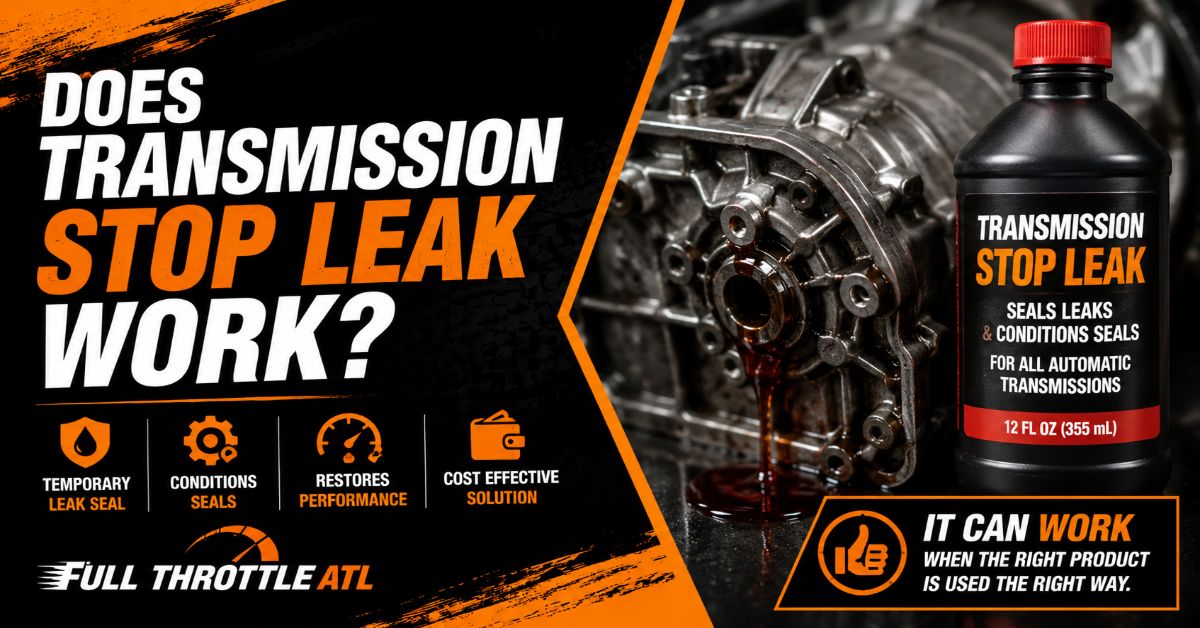
Transmission stop leak works strictly as a temporary fix for minor seepage caused by dried, hardened rubber or nitrile seals. It chemically swells hardened seals by 5% to 15% to stop minor fluid weeping. However, transmission stop leak cannot repair torn gaskets, cracked metal housings, mechanical shaft wobble, or leaks in CVTs.
At a Glance
- Initial Success Rate: 60% to 70% effective on minor, weeping rubber seals (pink drops overnight).
- Failure Rate: 0% success on physical tears, sliced gaskets, or leak gaps larger than 1 millimeter.
- Average Lifespan: Temporary relief lasting 3 to 12 months before chemical swelling degrades.
- Dosage Limit: Never exceed one bottle (11 to 16 ounces) per transmission system to prevent fluid over-concentration.
- CVT Warning: Standard stop leak must never be poured into a Continuously Variable Transmission (CVT).
How Does Transmission Stop Leak Work Chemically?
Transmission stop leak works by treating aging rubber seals with chemical plasticizers and ester-based solvents, such as specialized butyl alcohol compounds. Over time, heat cycles within the transmission cause rubber, nitrile, and neoprene seals to lose their internal elastomers, leading to shrinkage and hardening.
[Hardened Rubber Seal] + [Ester Solvents/Plasticizers] ➔ [Polymer Chain Expansion] ➔ [5%–15% Volume Swell]
When added to fluid:
- Permeation: Solvents soak directly into the degraded, hardened rubber material.
- Polymer Softening: Plasticizers break down stiff bonds in the rubber matrix, restoring flexibility.
- Volume Expansion: The seal swells in total volume by roughly 5% to 15%, forcing it back against its metal mating surface to stop fluid seepage.
What Is the Success Rate of Transmission Stop Leak?
The success rate of transmission stop leak depends entirely on the size of the leak opening and the physical condition of the sealing material.
| Leak Condition | Expected Success Rate | Realistic Outcome |
| Weeping Rubber Seals (< 1 tbsp fluid overnight) | 60% – 70% | High probability of stopping fluid loss within 100 to 500 miles. |
| Major Gaps or Tears (> 1mm opening) | 0% | Cannot bridge physical tears, sliced rubber, or cracked pans. |
| Worn Shaft Bushings (Oscillating shafts) | 0% | Mechanical play repeatedly breaks the seal face contact. |
| Liquid Silicone / RTV Gaskets | 0% | Solvents do not chemically react with synthetic silicone. |
How Long Does Transmission Stop Leak Take to Work?
Transmission stop leak takes between 100 and 200 miles of active driving—or approximately 2 to 3 days of normal vehicle operation—to fully slow down or stop fluid loss.
The chemical reaction requires the transmission fluid to reach full operating temperature ($175^\circ\text{F}$ to $200^\circ\text{F}$) so the ester solvents can circulate, penetrate, and expand the hardened rubber polymer chains. Stop leak additives never stop a leak instantaneously upon pour.
How Long Does a Transmission Stop Leak Repair Last?
A transmission stop leak repair typically lasts between 3 and 12 months. It is engineered exclusively as a temporary bridge rather than a permanent mechanical fix.
Once the active plasticizers break down under repeated high-heat thermal cycles, the chemically swollen rubber seals begin to shrink back down. In many instances, the synthetic rubber degrades further following solvent evaporation, leaving the original seal harder and more brittle than before, causing the leak to return with greater severity.
What Types of Transmission Leaks Can Stop Leak Fix?
Transmission stop leak only works on minor seepage from organic rubber, nitrile, and neoprene dynamic seals.
Dynamic Seals It Can Help
- Front pump (torque converter) seals made of hardened nitrile rubber.
- Rear output shaft seals experiencing minor thermal shrinkage.
- Shift linkage rubber boots and o-rings.
Materials It Cannot Fix
- RTV or Liquid Silicone Flange Seals: Stop leak plasticizers have zero chemical reaction with synthetic silicone materials.
- Cracked Transmission Oil Pans: Metal or plastic structural cracks will not seal.
- Sliced or Blown-Out Gaskets: Any gap exceeding 1mm lets fluid escape regardless of rubber swell.
Can You Use Transmission Stop Leak in a CVT?
No, you must never use standard transmission stop leak in a Continuously Variable Transmission (CVT). CVTs rely on precise static and dynamic friction parameters to allow internal steel belts or chains to grip smooth pulley cones without slipping.
Standard stop leak additives contain friction modifiers and swelling agents that break down CVT-specific fluids. Introducing these chemicals causes the steel belt to slip continuously against the pulleys, generating extreme heat and causing catastrophic failure to a $4,000+ assembly within miles.
Can Transmission Stop Leak Be Used in Manual Transmissions?
No, standard automatic transmission fluid (ATF) stop leak should not be added to a manual transmission. Manual transmissions rely on heavy gear oils (typically SAE 75W-90 or dedicated synchromesh fluids) to protect heavy spur and helical gears under high shear loads.
Adding ATF-formulated stop leak thins out manual gear oil, drastically reducing its load-bearing film strength. This leads to accelerated wear on internal brass synchronizers, bearing pitting, and eventual gear clashing.
Will Stop Leak Fix a Leaking Transmission Pan Gasket?
Transmission stop leak rarely fixes a leaking transmission pan gasket. While an old rubber pan gasket might experience slight swelling, most pan leaks stem from mechanical issues that additives cannot address:
- Warped Pan Flanges: Stamped steel pans bend easily if over-tightened.
- Crushed Gaskets: Over-torqued bolts crush rubber gaskets beyond their elasticity limit.
- RTV Silicone Seals: Modern vehicles frequently use liquid RTV from the factory, which does not react to seal conditioners.
Replacing a transmission pan gasket is a low-cost, straightforward repair; relying on additives for pan leaks introduces unnecessary risk to internal components.
Can Transmission Stop Leak Fix a Slipping Transmission?
Transmission stop leak only stops slipping if the slip is caused directly by low fluid level. When fluid drops too low, the hydraulic pump draws in air, dropping the line pressure needed to engage internal clutch packs.
[Low Fluid Level] ➔ [Hydraulic Pressure Loss] ➔ [Clutch Pack Slippage]
      │
      └─ [Stop Leak Applied] ➔ [Restores System Pressure] ➔ [Temporarily Resolves Slip]
If your transmission fluid dipstick reads full and gear slippage occurs, the friction material bonded to the internal clutch packs is physically worn down. “Stop Slip” additives use heavy viscosity index improvers to artificially boost fluid friction, but this is a short-term intervention that usually yields only a few weeks to months of additional operation before total mechanical loss.
What Are the Dangerous Side Effects of Transmission Stop Leak?
Pouring stop leak into a transmission carries two severe mechanical risks that can cause permanent transmission destruction:
- Valve Body and Solenoid Clogging: Many stop leak products use thick viscosity modifiers to slow down active leaks. Automatic transmissions regulate gear changes using micro-passages inside the hydraulic valve body. Thickened or gunked fluid clogs these valve passages and shift solenoids, causing harsh gear slams, delayed engagement, or complete loss of forward gears.
- Clutch Pack Glue Degradation: The harsh ester solvents intended to soften exterior rubber seals also attack the organic adhesives securing friction linings to internal steel clutch plates. Over extended mileage, these solvents cause friction material to strip off, contaminating the system and destroying internal clutches.
How Much Transmission Stop Leak Should You Add?
You must add no more than one bottle (typically 11 to 16 ounces) per transmission system, ensuring the total fluid volume does not exceed the maximum fill mark on the dipstick.
Over-concentrating transmission fluid with multiple bottles of stop leak accelerates chemical damage. Excess solvents cause rubber seals to over-swell, become spongy, and tear apart under normal hydraulic pressure while severely thinning or thickening the base fluid beyond manufacturer specifications.
Should You Flush Transmission Fluid After Using Stop Leak?
Yes, you should perform a full transmission fluid flush and filter replacement 300 to 500 miles after applying stop leak, provided the additive successfully stopped the leak.
Allowing the vehicle to run for 300 to 500 miles gives the plasticizers sufficient time to penetrate and expand the rubber seals. Flushing the fluid immediately after this window removes residual active solvents and viscosity thickeners from circulation before they dissolve internal clutch adhesives or clog hydraulic valve passages.
When Does Transmission Stop Leak Fail Completely?
Transmission stop leak fails completely in the following five mechanical scenarios:
- Mechanical Shaft Wobble: Worn input or output shaft bushings cause rotating shafts to wobble, breaking continuous seal contact.
- Structural Metal Cracks: Cracks in aluminum or magnesium transmission cases permit fluid pathing that swelling additives cannot close.
- Sliced or Torn Seals: Physical gaps exceeding 1mm wide cannot be bridged by expanded rubber volume.
- Hardened Polyurethane or RTV Gaskets: Non-rubber gasket compounds exhibit no chemical response to ester solvents.
- High-Pressure Line Leaks: Leaks originating from pressurized external cooler lines bypass static seal contact entirely.
The Bottom Line
Transmission stop leak is an effective short-term emergency treatment for minor seepage occurring at hardened, aging rubber or nitrile seals. It carries a 60% to 70% success rate on weeping leaks, taking 100 to 200 miles of warm driving to swell seals by 5% to 15%.
However, it offers zero functionality for mechanical damage, silicone gaskets, or CVTs. If used, limit application to one bottle maximum, and perform a complete fluid flush within 300 to 500 miles to protect internal valve bodies and clutch packs from long-term solvent damage.