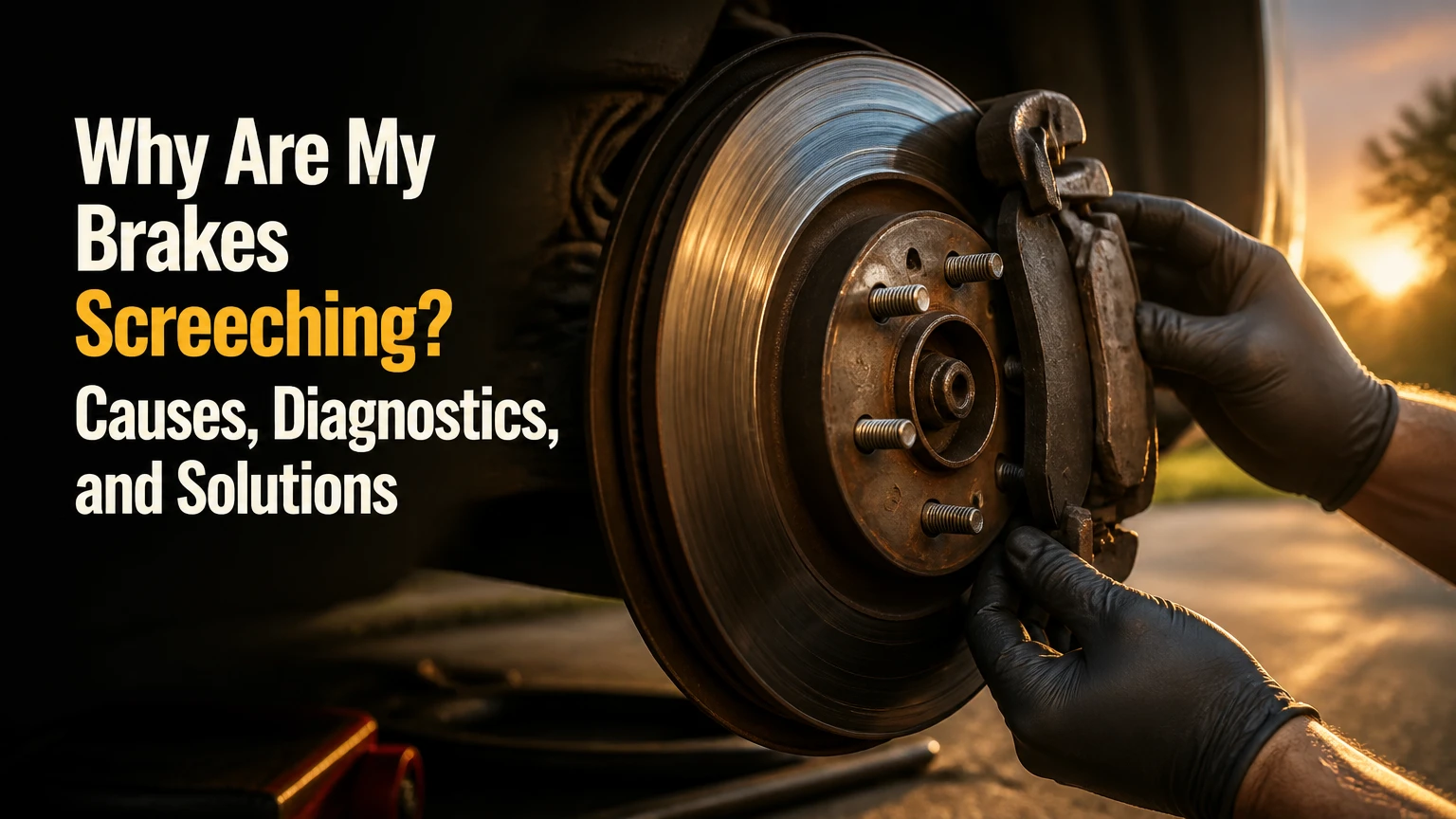
Brake screeching is caused by high-frequency harmonic vibration (typically between 1,000 Hz and 15,000 Hz) generated during stick-slip contact between the brake pad material and the spinning iron rotor. This acoustic resonance is intensified by worn friction material, thermal glazing above 300°C (572°F), moisture, or mechanical alignment failure within the brake caliper assembly.
At a Glance
- Wear Threshold: Mechanical wear indicators screech intentionally when brake pad friction material wears down to 2 millimeters (0.078 inches).
- Thermal Limit: High operating temperatures between 300°C and 400°C (572°F–752°F) cause brake pads to glaze, creating a mirror-smooth, noisy surface.
- Driving Safety Window: Driving with wear-indicator squeal is generally safe for 200 to 500 miles before catastrophic rotor damage occurs.
- Morning Noise: A thin layer of surface flash rust formed overnight causes temporary screeching during the first 3 to 5 brake stops.
- Chemical Hazard: Applying WD-40 or oil lubricants to brake components destroys friction capacity and causes severe brake failure.
How Do Brake Wear Indicators Alert You to Thin Pads?
Brake wear indicators are small, spring-steel metal tabs attached to the backing plate of a brake pad designed to make direct contact with the spinning rotor face when the friction material reaches 2 millimeters (0.078 inches) in thickness. Standard new brake pads feature 10 to 12 millimeters of usable material, making this high-pitched metallic squeal a built-in early warning mechanism.
As illustrated above, a thick new brake pad keeps the curved metal tab safely away from the rotor face. Once 80% to 85% of the pad material wears away, the metal tab scrapes against the outer perimeter of the cast-iron rotor. This contact does not compromise immediate stopping power, but it intentionally creates an audible vibration above 5,000 Hz to prompt replacement before the friction material completely vanishes.
What Causes Brake Pads to Glaze and Screech Under Heat?
Brake pad glazing occurs when repeated hard braking or continuous pedal riding heats the pad surface beyond its thermal threshold of 300°C to 400°C (572°F to 752°F). At these elevated temperatures, binding resins inside organic and semi-metallic friction compounds melt, outgas, and re-crystallize into a slick, hardened layer.
When a glazed brake pad clamps onto a rotor, the smooth glass-like surface cannot generate proper kinetic friction. Instead of smoothly gripping the rotor, the pad skips across the iron surface at microscopic intervals. This stick-slip dynamic generates intense high-frequency resonance across the brake caliper, resulting in a persistent high-pitched screech whenever deceleration is initiated.
Why Do Brakes Screech in the Morning or After Wet Weather?
Morning brake screeching is caused by microscopic flash rust forming on cast-iron brake rotors in humid environments or by the cold friction instability inherent to ceramic brake pads. Cast iron oxidizes within hours when exposed to moisture, creating a fine surface layer of rust.
High Ambient Humidity / Rain ──► Flash Rust Forms on Cast Iron Rotor (Overnight)
                                      │
                                      ▼
Initial 3–5 Brake Applications ──► Pads Scrape Away Surface Rust Layer ──► Temporary Metallic Screech
                                      │
                                      ▼
Rotor Surface Cleansed ──► Normal Acoustic Quiet Restored
This morning noise is benign and resolves after the pads clean the rotor face during initial driving. Similarly, performance ceramic brake pads require higher initial operating temperatures to establish friction stability; when stone cold during early morning stops, ceramic materials naturally produce higher acoustic resonance until warmed up.
Why Do Brakes Screech Continuously Even When the Pedal Is Not Pressed?
Continuous screeching while moving without touching the brake pedal indicates foreign debris, such as a small pebble or road grit, wedged between the rotor shield and the rotor face. Alternatively, a bent dust shield or a stone trapped inside the brake pad expansion slot maintains constant friction against the rotating iron wheel hub.
Because the object remains pinned against the spinning disk independent of hydraulic pressure, it produces a piercing, continuous metallic noise that varies in pitch directly with vehicle speed. Inspecting the brake assembly, gently flexing the thin sheet-metal backing shield away from the rotor, or clearing the pad cleaning slots with compressed air resolves this specific issue without requiring component replacement.
Why Do Brand-New Brake Pads Squeal Right After Installation?
Brand-new brake pads squeal primarily because they have not undergone a proper thermal bedding-in process to transfer a smooth layer of friction material onto the rotor surface. Without this microscopic transfer film, raw pad compounds make uneven contact with raw iron, causing high-frequency chatter.
Unbedded Brake Pads ──► Direct Raw Compound Contact ──► Micro-Chatter Friction ──► Squeal & Glaze
                                      │
                                      ▼
    Bedding Process (5–10 Moderate Decelerations from 40 mph to 10 mph)
                                      │
                                      ▼
  Even Friction Transfer Layer ──► Smooth Surface Contact ──► Silent Operation
In addition to unbedded pads, new brakes squeal if the rotors were re-used without being resurfaced (turned). Flat new pad faces riding on old rotors only contact the raised microscopic ridges of old wear grooves, exciting 10,000 Hz harmonic resonance until the surfaces mate evenly or are properly turned on a brake lathe.
How Do Seized Caliper Pins and Missing Shims Cause Noise?
Mechanical misalignments in the brake caliper force uneven contact angles and remove the dampening media required to absorb acoustic resonance. When secondary caliper components are worn or improperly serviced, even new friction pads produce severe noise.
| Mechanical Defect | Physical Mechanism | Resulting Brake Noise |
| Seized Caliper Slide Pins | Lacks silicone grease lubrication; prevents caliper floating action, forcing one pad to press at an uneven angle. | High-pitched vibrational screech due to edge-loading contact. |
| Missing Harmonic Shims | Omits thin stainless-steel backplate dampener designed to isolate pad vibration from caliper piston. | Direct metal-to-metal harmonic transfer at 8,000 Hz–12,000 Hz. |
| Dried Acoustic Grease | Absence of high-temperature silicone/moly paste on backing plate contact points. | Micro-chatter vibration between caliper piston face and pad steel plate. |
How Does a Brake Screech Differ From a Metallic Grinding Sound?
A high-pitched brake screech is an acoustic warning signal generated by a 2 mm wear tab or surface chatter, whereas a harsh grinding noise indicates complete destruction of the friction material down to 0 mm thickness.
Noise Spectrum Analysis:
[High-Frequency Screech (5,000–15,000 Hz)] ──► 2 mm Material Remaining (Wear Indicator Contact)
[Low-Frequency Grinding (<1,000 Hz)]        ──► 0 mm Material Remaining (Steel Backing Plate on Iron)
A screech signifies that friction material remains on the backing plate, meaning the cast-iron rotor face is still intact. A heavy metallic grinding sound indicates that the pad backing plate is cutting deep grooves into the rotor face, requiring immediate vehicle shutdown and replacement of both pads and rotors.
Is It Safe to Drive With Screeching Brakes, and for How Long?
Driving with screeching brakes caused by a mechanical wear indicator is safe for 200 to 500 miles under normal city driving conditions. This safety window allows sufficient time to schedule professional maintenance before the remaining 2 millimeters of pad material wears completely away.
However, driving becomes unsafe immediately if any of the following critical conditions accompany the screeching:
- Spongy Brake Pedal: Soft, sinking pedal feel indicating hydraulic pressure loss or boiled fluid.
- Vehicle Pulling: Car swerving toward one side during braking, signifying a seized caliper piston.
- Pulsating Pedal: Severe steering wheel or pedal shaking indicative of extreme rotor warpage.
Can You Use WD-40 or Spray Lubricants to Stop Brake Noise?
No, you must never apply WD-40, silicone spray, or petroleum lubricants to brake pads or rotors. Applying lubricants directly to friction surfaces eliminates the friction coefficient required to decelerate the vehicle, resulting in total loss of braking capability and severe accident risk.
WD-40 Applied to Rotor/Pad ──► Friction Coefficient Drops to Near Zero ──► Total Braking Failure
To eliminate squeal safely, specialized lubricants must be applied only to non-friction contact points:
- High-temperature silicone or molybdenum grease applied thinly to the metal backplate of the pad.
- Lubricant applied sparingly to caliper slide pins inside rubber boots.
- Anti-squeal dampening paste spread over the rear interface where the caliper piston contacts the shim.
How Do You Properly Bed In New Brake Pads to Eliminate Noise?
Bedding in new brake pads requires a controlled thermal cycle to transfer a thin, uniform layer of friction material from the pad onto the rotor face without overheating the components. Follow this step-by-step sequence immediately after installing new pads and rotors:
1.Accelerate to 40 mph in a safe, open area:Ensure no trailing traffic before starting thermal cycles.
Drive the vehicle up to 40 mph (64 km/h) on a clear, flat road section. Avoid sudden steering inputs or erratic driving.
2.Perform moderate deceleration down to 10 mph:Apply medium pedal pressure without activating ABS.
Apply firm, steady brake pressure to decelerate smoothly from 40 mph down to 10 mph (16 km/h) over approximately 3 to 5 seconds. Do not bring the vehicle to a complete stop.
3.Drive for 30 seconds to cool components:Allows heat to dissipate evenly across rotor surface.
Accelerate back up to cruising speed and drive for 30 seconds without pressing the brake pedal, allowing ambient airflow to cool the friction surfaces.
4.Repeat the deceleration cycle 5 to 10 times:Builds friction transfer layer incrementally.
Repeat Steps 1 through 3 for a total of 5 to 10 heating cycles. You may notice a mild odor as the new pad resins cure.
5.Drive continuously for 5 minutes without stopping:Prevents pad imprints on hot iron rotors.
Drive for 5 minutes at highway or arterial speeds using minimal braking to allow the entire assembly to cool down completely before parking the vehicle.
Which Type of Brake Pad Material Produces the Least Noise?
Organic (Non-Asbestos Organic – NAO) brake pads produce the least amount of operational noise, followed by premium Ceramic compounds, whereas Semi-Metallic pads generate the highest noise levels.
Noise Generation Comparison:
[Lowest Noise]  Organic (NAO)  <  Ceramic Pads  <  Semi-Metallic Pads  [Highest Noise]
- Organic (NAO) Pads: Constructed from soft rubber, glass, carbon, and Kevlar fibers. They operate almost silently across all temperature ranges, but wear down significantly faster and create higher dust volume.
- Ceramic Pads: Composed of dense ceramic fibers and copper strands. They remain silent during normal operating temperatures, but generate brief, high-pitched squeals when ice-cold.
- Semi-Metallic Pads: Formulated with 30% to 65% steel wool, iron, and copper. High metallic content yields superior heat dissipation and stopping torque, but creates frequent harmonic noise between 3,000 Hz and 8,000 Hz.
How Much Does It Cost to Fix Screeching Brakes?
Fixing screeching brakes costs between $150 and $400 per axle for standard pad replacement, or between $300 and $750 per axle when replacing both pads and rotors at a professional repair facility.
Estimated Repair Cost Breakdown (Per Axle):
┌─────────────────────────────────────────────────────────┐
│ Parts (Pads + Rotors):     $100 – $300                   │
│ Professional Labor:        $150 – $300 (1.5 – 2.0 Hours)  │
├─────────────────────────────────────────────────────────┤
│ Total Service Range:       $250 – $600                   │
└─────────────────────────────────────────────────────────┘
Professional brake service typically takes 1.5 to 2.0 hours of labor. Replacing pads without resurfacing or replacing worn rotors usually results in persistent squealing within 1,000 miles, requiring additional labor to correct surface micro-finish mismatches.
The Bottom Line
Brake screeching is caused by high-frequency harmonic vibration occurring when pads press against iron rotors, often triggered by wear indicators contacting the rotor at 2 mm thickness or surface glazing above 300°C. While benign causes like morning flash rust or cold ceramic pads resolve after a few stops, persistent squealing requires inspecting pad thickness, re-greasing caliper slide pins, or performing a proper bedding procedure on new components. Never apply lubricants to friction surfaces, and replace worn components promptly to avoid costly rotor damage.