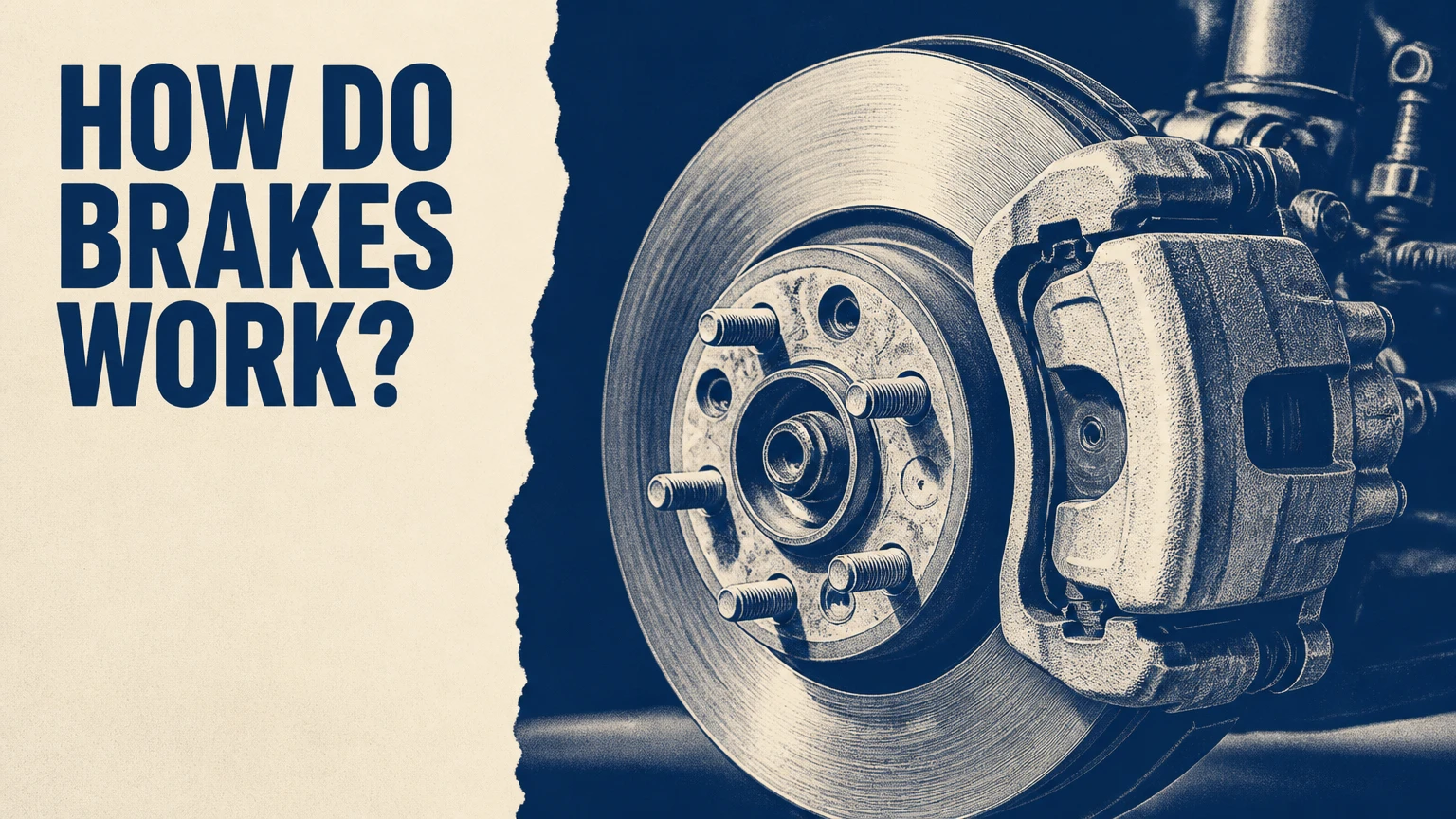
Car brakes work by converting the vehicle’s motion (kinetic energy) into thermal energy (heat) using friction. When a driver presses the brake pedal, mechanical leverage and incompressible hydraulic fluid multiply foot force up to 36 times, driving brake pads against spinning rotors to safely slow or stop the wheels.
At a Glance
- Force Multiplication: Mechanical pedal leverage and hydraulic amplification multiply 10–15 lbs of foot force into over 300–2,000 psi of stopping pressure.
- Energy Conversion: Stopping a 1,500 kg car from 60 mph converts kinetic energy into ~180 kW (240 hp) of heat output within 3 seconds.
- Hydraulics Principle: Pascal’s Law governs braking systems; because liquid cannot be compressed, force transfers instantly across all four wheels.
- System Failure Vulnerability: Water contamination drops brake fluid boiling points by ~80°C, leading to sudden pedal loss under heavy braking.
- Modern Electronics: Systems like ABS and Regenerative Braking override mechanical friction under specific road and battery charge conditions.
How Does a Hydraulic Brake System Work Step-by-Step?
A hydraulic brake system operates through a sequential transfer of force that moves from the driver’s foot to the tire tread. The process uses mechanical advantage, vacuum assistance, hydraulic pressure, and mechanical friction in series.
1.Pedal Press & Mechanical Leverage:Foot force multiplication.
The driver exerts 10–15 lbs of pressure on the brake pedal. The pedal acts as a pivot lever with a 4:1 to 9:1 mechanical ratio, converting initial foot input into 40–135 lbs of force at the pushrod.
2.Vacuum Booster Amplification:Assisted force scaling.
The vacuum power brake booster utilizes engine vacuum or an electric pump to push against a internal diaphragm, further amplifying pushrod force into the master cylinder.
3.Hydraulic Pressure Generation:Pascal’s law in action.
The pushrod drives a piston into the master cylinder filled with incompressible brake fluid. This action pressurizes the brake lines to ~300–500 psi under normal conditions and over 2,000 psi during emergency panic stops.
4.Caliper Piston Actuation:Hydraulic to mechanical force.
Pressurized fluid flows through reinforced steel or Kevlar brake lines to the slave cylinders inside the brake calipers at each wheel hub.
5.Friction Clamping & Thermal Dissipation:Kinetic energy reduction.
Caliper pistons push friction pads against both sides of the cast-iron brake rotor. The resulting surface friction converts vehicle momentum into heat, slowing wheel rotation.
How Much Heat and Energy Do Brakes Generate?
Stopping a typical 1,500 kg (3,300 lb) passenger vehicle from 60 mph in 3 seconds generates approximately 540 kilojoules of kinetic energy, requiring an average braking power of 180 kilowatts (~240 horsepower).
This entire energy load instantly transforms into thermal energy concentrated on the front brake rotors, which handle roughly 70% of a vehicle’s stopping weight. During a single hard highway deceleration, front rotor surface temperatures jump by roughly 50°C (122°F) within seconds. Under aggressive mountain driving or track conditions, rotor temperatures routinely exceed 500°C (930°F), turning cast-iron components bright red.
What Is the Difference Between Disc Brakes and Drum Brakes?
Disc brakes utilize an open caliper to squeeze pads against a spinning rotor, whereas drum brakes use internal hydraulic wheel cylinders to push curved friction shoes outward against the inside of a rotating drum.
| Feature | Disc Brakes | Drum Brakes |
| Primary Mechanism | External caliper squeezes spinning disc | Internal shoes expand against hollow drum |
| Heat Dissipation | Superior (exposed directly to airflow) | Poor (traps heat inside metal drum) |
| Wet Weather Performance | Excellent (centrifugal force sheds water) | Moderate (water can pool inside housing) |
| Manufacturing Cost | Higher | Lower |
| Common Application | Front wheels on all modern cars; rear on modern/performance cars | Rear wheels on budget or light utility vehicles |
How Does Regenerative Braking Work in EVs and Hybrids?
Regenerative braking slows an electric or hybrid vehicle by reversing the electric motor’s magnetic field, turning the motor into a generator that recharges the high-voltage battery using vehicle momentum.
Under typical driving conditions, regenerative braking performs up to 90% of routine speed reductions without engaging mechanical brake pads. However, regenerative braking capacity degrades or shuts off completely under two critical edge cases:
- 100% Battery State of Charge (SoC): When the traction battery is fully charged, the energy management system disables regenerative braking to prevent battery overcharging. The vehicle will suddenly coast freely unless the driver depresses the pedal harder to engage traditional friction brakes.
- Cold Ambient Temperatures: Lithium-ion batteries cannot accept high charge currents when core temperatures drop below freezing. Cold weather severely restricts regenerative power output until the battery pack warms up.
Why Does ABS Increase Stopping Distance on Snow and Gravel?
Anti-lock Braking Systems (ABS) increase stopping distances on loose snow, gravel, or sand because the system prevents the wheels from locking and digging a natural stopping wedge into the loose surface material.
ABS monitors individual wheel speed sensors to detect impending tire lockup, rapidly releasing and reapplying hydraulic caliper pressure up to 20 times per second to preserve steering control. On solid dry asphalt, this maximizing of traction shortens stopping distance. On loose media, however, a fully locked tire naturally pushes snow or gravel forward, forming a physical barrier in front of the tread that stops the car faster than a rotating tire that floats across the top of the loose material.
What Happens When a Car Hydroplanes While Braking?
Hydroplaning occurs when water accumulation on a roadway exceeds the water evacuation capacity of a tire’s tread grooves, forcing the tire to ride on a pressurized wedge of liquid above the road surface.
Once a tire breaks contact with the pavement, coefficient of friction drops to near zero. Applying full brake pressure locks or slows the wheel, but because the tire has no mechanical grip against the road, braking force cannot decelerate the vehicle chassis. Hydraulic and mechanical brake performance becomes entirely ineffective until tire tread pierces the water layer to re-establish road contact.
How Do Common Driver Braking Rules Fail in Real Emergencies?
Standard driving advice often relies on simplified rules that lead to mechanical inefficiency or vehicular instability when applied to modern brake technology or specialized emergencies.
| Common Advice | Emergency Failure Mode | Correct Technical Procedure |
| “Pump the pedal to stop in emergencies.” | Fails on all modern vehicles equipped with ABS. Pumping interrupts the ABS micro-controller algorithms, resetting traction calculations and increasing stopping distance. | Stomp and hold: Press the pedal with maximum force and hold firm. Expect strong pedal pulsation and mechanical grinding noises; do not release pressure. |
| “Brake exclusively in a straight line.” | Fails during unexpected mid-corner obstacle avoidance, where straightening out forces the vehicle off the road or into oncoming traffic lanes. | Trail braking: Maintain partial brake pressure as you initiate steering turn-in, gradually tapering off pressure to keep weight loaded on front tires for turning grip. |
| “Ride the brakes lightly on long downhills.” | Fails on mountain passes by creating continuous friction that superheats pads, glazes friction linings, and boils hydraulic brake fluid. | Engine braking: Shift transmission into a lower gear ratio, forcing engine compression to hold vehicle speed without thermal accumulation in wheel brakes. |
Why Do My Brakes Squeak or Squeal?
Brake squeal stems from high-frequency harmonic vibration occurring between the friction pad, caliper body, and rotating disc assembly during deceleration.
Low-Risk Vibrations ──► High-Metallic Pad Formulations / Cold Temperatures
High-Risk Warnings ──► Wear Indicators Scrape Rotor (Pads < 3mm Remaining)
- Harmless Harmonic Squeal: Semi-metallic brake pads contain dense steel fibres that vibrate against caliper mounting brackets. High performance and heavy-duty towing pads frequently produce light squealing when cold or lightly applied.
- Mechanical Wear Indicator Warning: Brake pads feature a curved steel tab called a wear indicator. When friction material wears down to ~2–3 mm thickness, this steel tab contacts the rotor surface, producing a loud, continuous metallic squeal during driving to alert the owner that pad replacement is required.
- Application Fix: Mechanical vibration is mitigated by applying high-temperature damper paste (silicone or ceramic compound) to the back backing plate of the pad where it contacts caliper pistons. Damper paste must never contact the front friction face or rotor surface.
Do Brake Rotors Actually Warp From Heat?
Steel and cast-iron brake rotors rarely undergo structural bending or lateral warping under street driving conditions.
The sensation of a vibrating brake pedal or shuddering steering wheel during stopping—commonly misdiagnosed as a warped rotor—is typically caused by uneven pad material deposition across the rotor surface.
When a driver brings superheated brake pads to a complete stop and holds the pedal depressed tightly at a standstill, hot friction material transfers unevenly onto the cast iron face. This creates a microscopic high spot on the rotor. As the wheel rotates during future stops, the pad skips across variations in surface thickness (Thickness Variation or DTV), inducing pedal pulsation.
How Often Should Brake Fluid Be Changed?
Brake fluid must be flushed and replaced every 2 years or 24,000 miles, regardless of vehicle mileage driven.
Brake fluid is hygroscopic, meaning it actively absorbs atmospheric moisture through microscopic pores in rubber hydraulic lines and master cylinder reservoir vents. Water contamination dramatically compromises brake fluid boiling points:
- Dry Boiling Point (Fresh DOT 4 Fluid): ~230°C (446°F)
- Wet Boiling Point (3.5% Water Contamination): ~155°C (311°F)
When contaminated brake fluid reaches its lowered boiling point during heavy braking, water trapped inside the hydraulic lines vaporizes into steam bubbles. Because gas is compressible (unlike liquid), pedal application compresses the steam bubbles instead of pushing caliper pistons, causing the brake pedal to sink to the floor with near-total loss of stopping power.
What Are the Signs of a Hydraulic Brake Leak?
A leak within the sealed hydraulic brake system leads to rapid pressure drop, severe pedal travel extension, and dangerous deceleration failure.
- Spongy or Soft Pedal: The brake pedal feels squishy and offers little mechanical resistance, requiring the driver to push it nearly to the floor pan to engage stopping force.
- Low Brake Fluid Reservoir: The brake fluid level inside the translucent plastic master cylinder reservoir drops below the indicated “MIN” line.
- Dashboard Warning Light: The red dedicated brake warning light illuminates on the instrument cluster due to a fluid level pressure differential switch trigger inside the master cylinder.
- Fluid Residue Inside Wheel Wells: Clear to amber-colored fluid (which feels slick and has a distinct chemical smell) collects around inner tire sidewalls, caliper banjo bolts, or frame-mounted rubber brake lines.
The Bottom Line
Vehicle braking relies on transforming kinetic energy into intense heat through mechanical leverage and incompressible hydraulic fluid. While modern systems like ABS, traction control, and EV regenerative braking enhance directional safety and efficiency, the underlying mechanics remain bound by thermal limits and hydraulic integrity. Maintaining fresh brake fluid every two years and inspecting friction components ensures your braking system develops the extreme hydraulic pressures required to stop safely under all driving conditions.