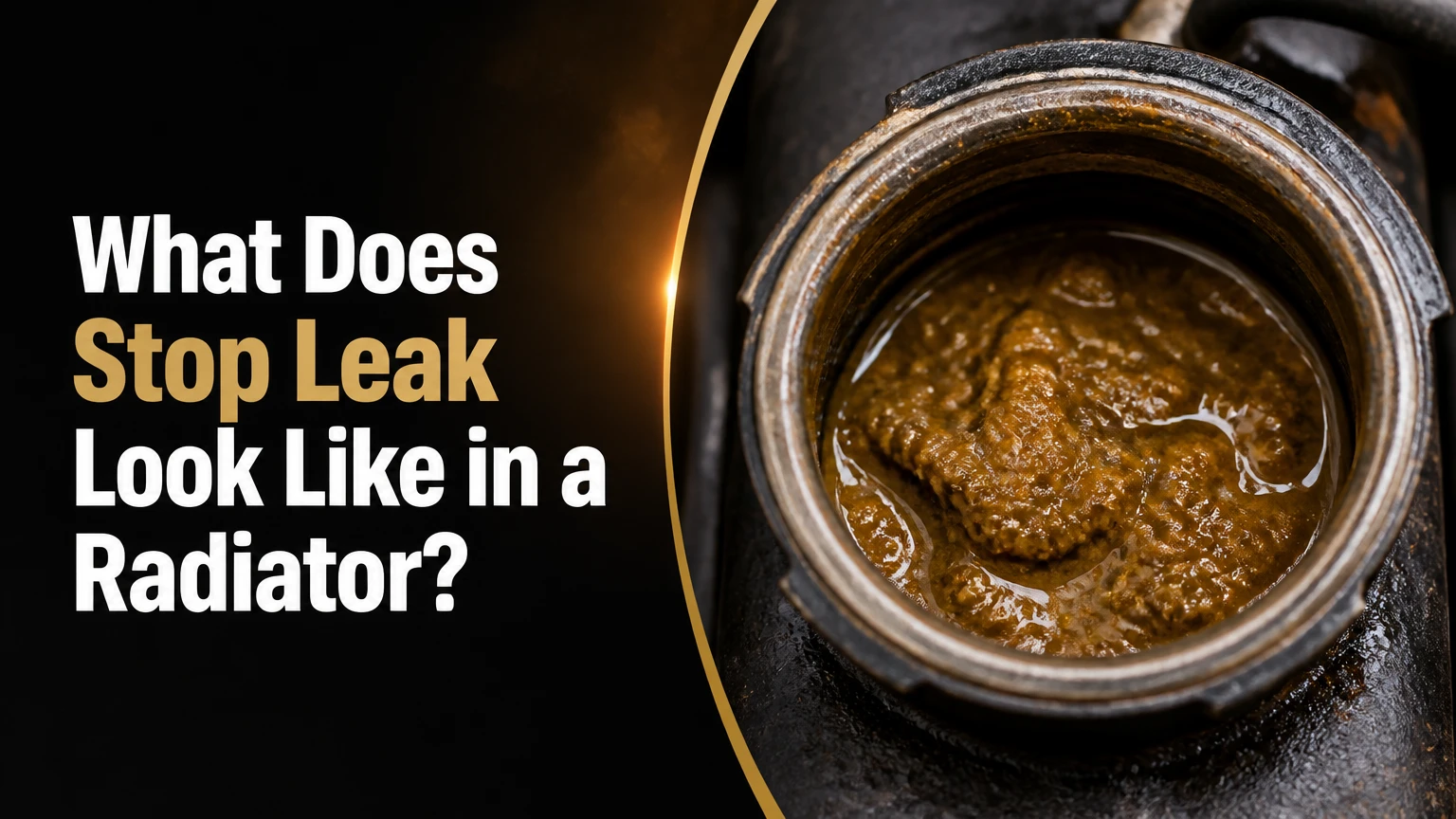
Radiator stop leak typically looks like a thick, gritty sludge, fibrous brown muck, or shimmering metallic slurry inside the radiator filler neck or overflow tank. Depending on the formula used, it appears as dark brown organic granules, floating copper or silver flakes, semi-clear gelatinous globs, or a crusty paste along the sealing surfaces.
At a Glance
- Powder/Pellet Form: Appears as brown, granular mud resembling wet coffee grounds settling at the bottom of the filler neck.
- Liquid/Metallic Form: Presents as a shimmering slurry containing suspended copper, silver, or gold metallic flakes.
- Liquid/Gel Form: Manifests as a thick, gelatinous mucus coating internal plastic and metal cooling passages.
- Invisible Glass Sealants: Sodium silicate flows as a clear liquid but cures into a hard, white crystalline crust upon air exposure.
- Head Gasket Distinction: Stop leak settles into gritty particles without exhaust odors, whereas blown head gasket oil creates a floating, frothy “chocolate milkshake” paste.
What Are the Physical Types and Textures of Radiator Stop Leak?
Radiator stop leak varies significantly in visual appearance depending on whether the manufacturer utilizes organic fibers, metallic particles, or polymer gels. Identifying the exact texture and visual signature allows you to determine what additive was previously introduced into the cooling system.
+-------------------+------------------------------------+----------------------------------+
| Stop Leak Type    | Visual Appearance                  | Primary Ingredients              |
+-------------------+------------------------------------+----------------------------------+
| Powder / Pellet   | Dark brown mud, coffee grounds     | Ginger root, cashew shells       |
| Liquid Metallic   | Shimmering slurry, bright flakes   | Micro-fine copper, aluminum      |
| Liquid Gel        | Thick, semi-clear or colored mucus | Soluble polymer gums             |
| Liquid Glass      | Clear liquid; hard white crust     | Sodium silicate                  |
+-------------------+------------------------------------+----------------------------------+
- Powder and Pellet Formulations: These products look like dark brown, granular mud or wet coffee grounds resting at the bottom of the radiator neck. They rely on organic fibers such as ground ginger root, walnut shells, or cashew nut husks to bridge mechanical gaps.
- Liquid Metallic Formulations: These appear as a shimmering liquid slurry filled with visible silver, copper, or gold micro-flakes suspended within the coolant solution.
- Liquid Polymer and Gel Formulations: These look like thick, semi-clear or tinted gelatinous mucus. They coat the inner walls of plastic expansion tanks, rubber hoses, and metal filler necks with a slick residue.
What Is the Particle Size and Viscosity of Radiator Stop Leak?
Active plugging particles in commercial stop leak additives range from 10 to 500 microns in size, enabling them to bridge minor cracks without immediately blocking the primary radiator tubes. Introducing these solids fundamentally alters the physical metrics of standard engine coolant.
Normal Coolant Viscosity:  ~1 cP (similar to water)
Stop Leak Contaminated:    >5 to 15 cP (slimy, noticeable drag between fingers)
Deposit Crust Thickness:   1 mm to 3 mm along radiator neck and overflow walls
Uncontaminated automotive coolant maintains a low viscosity of approximately 1 centipoise (cP) at room temperature, flowing effortlessly like water. Coolant heavily contaminated with stop leak exhibits an elevated viscosity exceeding 5 to 15 cP, creating a noticeable slimy or gritty drag when rubbed between two fingers. Along the inner radiator neck and overflow tank walls, these particles build up a crusty, paste-like deposit ranging from 1 to 3 millimeters in thickness.
How Do You Identify Invisible Chemical Sealants Like Sodium Silicate?
Sodium silicate, commonly known as “liquid glass,” is completely invisible while suspended inside the engine coolant. Unlike particulate-based stop leak products, sodium silicate remains a clear liquid until it comes into direct contact with ambient air at a leak site.
[Sodium Silicate in System] ---> (Escapes via Leak Point) ---> [Exposed to Air & Heat] ---> (Cures into Glassy White Crust)
To identify sodium silicate contamination, inspect the external surfaces of the engine block, radiator seams, and hose connections rather than looking into the fluid itself. When sodium silicate escapes through a crack, the combined heat and atmospheric exposure cause it to rapidly dry and polymerize. It leaves behind a distinct, rock-hard, white or light-grey crystalline glass crust surrounding the leak perimeter.
How Can You Tell the Difference Between Stop Leak and a Blown Head Gasket?
To distinguish between radiator stop leak and a blown head gasket, sample the fluid using a clear turkey baster or fluid siphon when the engine is completely cold. Fluid mixed with engine oil due to a blown head gasket forms a light-brown, frothy emulsion resembling a chocolate milkshake that floats at the top of the coolant and smells strongly of raw fuel or exhaust gases.
+---------------------+-------------------------------+-----------------------------------+
| Diagnostic Feature  | Radiator Stop Leak            | Blown Head Gasket (Oil Mixture)   |
+---------------------+-------------------------------+-----------------------------------+
| Texture / Density   | Gritty or fibrous; sinks      | Frothy, creamy paste; floats      |
| Visual Appearance   | Brown flecks or metal shimmer | Light-brown "chocolate milkshake" |
| Odor                | Mild, chemical, or sweet      | Strong exhaust or fuel smell      |
| Hydrocarbon Test    | Negative                      | Positive (turns fluid yellow/green|
+---------------------+-------------------------------+-----------------------------------+
Conversely, organic or metallic stop leak consists of dense, gritty, or fibrous particles that sink toward the bottom of the container over time. Stop leak retains the standard sweet odor of ethylene glycol without any petroleum scent. If uncertainty remains, perform a chemical combustion leak test; head gasket failures yield positive hydrocarbon gas readings in the radiator neck, whereas stop leak additives do not.
Why Does Severe Engine Rust Mimic Organic Stop Leak?
Severe engine rust mimics organic pellet-style stop leak because neglected cast-iron engine blocks shed granular, reddish-brown iron oxide particles into the circulating coolant. Over time, these metallic rust flakes break down into a dark brown, gritty sludge that accumulates inside the radiator filler neck.
Cast Iron Corrosion ---> Iron Oxide Flakes ---> Granular Brown Mud (Visually Identical to Organic Stop Leak)
To differentiate rust contamination from organic stop leak, run a strong magnet along the outside of a clear container holding a coolant sample. Heavy rust particles are ferro-magnetic and will immediately pull toward the magnet against the container wall. Organic stop leak particles, such as ground ginger root or nut shells, are non-magnetic and will remain suspended or suspended at the bottom of the sample.
How Does Stray Current Electrolysis Create a False Stop Leak Appearance?
Stray current electrolysis occurs when damaged or missing electrical ground wires force electric currents to travel through the engine coolant to return to the battery. This electrical flow rapidly strips aluminum from the radiator core, cylinder head, and water pump housing through localized galvanic corrosion.
Degraded Ground Wire ---> Current Flows Through Coolant ---> Aluminum Stripped ---> Grey/Black Oxide Paste
This rapid electrolytic destruction generates a soft, gritty, grey-to-black aluminum oxide paste that settles inside the cooling passages. To the naked eye, this grey oxide paste perfectly mimics the shimmering grey or silver slurry produced by liquid aluminum stop leak additives. Testing the coolant with a digital multimeter (DC voltage reading above 0.3 volts between the fluid and the negative battery terminal) confirms active electrolysis rather than an intentional sealant application.
Why Does Stop Leak Settle Invisibly at the Bottom of the Radiator?
Radiator stop leak particles settle invisibly at the bottom of the radiator cores because active sealing materials possess a higher specific gravity than the surrounding water-glycol coolant mixture. When the engine is turned off and coolant circulation ceases, gravitational forces pull these suspended metallic flakes and organic fibers downward into the lowest cooling passages.
[Engine Running]  ---> Fluid Circulation Suspends Particles Throughout System
[Engine Off]      ---> Particles Settle by Gravity ---> Hidden 2–4 Inch Sludge Bed in Lower Core
As a result, inspecting only the top of the radiator neck or the plastic expansion tank often reveals perfectly clear, translucent coolant. Meanwhile, a dense, 2-to-4-inch bed of heavy particulate sludge sits trapped inside the lower radiator tank, silently restricting fluid flow through the bottom horizontal cooling tubes without leaving visible evidence at the filler cap.
Can Stop Leak React With OAT/HOAT Coolant to Cause Gelatinous Gel?
Yes, certain stop leak formulas chemically react with Organic Additive Technology (OAT) and Hybrid Organic Additive Technology (HOAT) coolants, causing the fluid to undergo rapid polymerization and gelation. Modern OAT and HOAT coolants utilize organic carboxylate acids that can destabilize when mixed with non-compatible silicone, silicate, or borate additives.
OAT/HOAT Coolant + Incompatible Polymer/Silicate Stop Leak = Polymerization Failure (Liver-like Gel)
Instead of remaining finely suspended in the fluid, the additive triggers a cascading chemical precipitation. This transforms the entire volume of liquid coolant into a thick, liver-like gelatinous mass. This gel coats every internal engine passage, instantly eliminating thermal transfer capabilities and locking up the thermostat assembly.
Can Radiator Stop Leak Ruin a Car’s Heater Core?
Yes, radiator stop leak frequently ruins a vehicle’s heater core by permanently clogging its narrow internal fluid passages. Heater cores utilize micro-channel aluminum tubes that measure less than 1.5 millimeters in diameter—substantially narrower than the primary tubes inside an engine radiator.
Stop Leak Particles (10–500 Microns) + Micro-Channel Core (<1.5 mm) = Total Passage Blockade
Because stop leak additives seal gaps mechanically by lodging solid particles into tight restrictions, they cannot distinguish between an unwanted exterior leak and a narrow heater core tube. The additive builds up rapidly inside the heater core inlet, blocking coolant circulation entirely and leaving the cabin with zero heating capacity.
Will Flushing a Radiator Completely Remove Stop Leak Sludge?
No, a standard low-pressure garden-hose flush will not remove all hardened or wedged stop leak sludge from a cooling system. Stop leak products are specifically engineered to expand, cross-link, and wedge securely into tight crevices under system heat and pressure.
+-----------------------+-----------------------------+------------------------------------+
| Removal Method        | Removal Efficacy            | Mechanical Impact                  |
+-----------------------+-----------------------------+------------------------------------+
| Garden Hose Flush     | Low (10%–30%)               | Clears loose surface debris only   |
| Chemical Radiator Flush| Moderate (40%–60%)          | Softens organic gums and gels      |
| Professional Mechanical| High (80%–100%)             | Involves rod-cleaning or core swap|
+-----------------------+-----------------------------+------------------------------------+
While high-acid chemical flushes can dissolve soft organic gels and break down minor sodium silicate deposits, hardened particulates tightly packed into blocked radiator tubes remain undisturbed. Removing 100% of severe stop leak contamination typically requires a professional reverse-flush machine, manual rod-cleaning by a radiator specialist, or total replacement of the radiator and heater core assemblies.
How Long Can Radiator Stop Leak Safely Stay in a Cooling System?
Radiator stop leak should not remain in a cooling system for more than 30 to 90 days or 1,000 driving miles. Stop leak is engineered strictly as a short-term emergency temporary patch to allow a vehicle to reach a repair facility, not as a permanent cooling system component.
0–30 Days: Safe emergency operational window.
30–90 Days: Additives degrade; suspended particles begin clumping and settling.
90+ Days: High risk of thermal isolation, heater core clogging, and water pump seal failure.
Allowing stop leak to circulate long-term causes the suspended particles to clump together as anti-corrosion inhibitors in the base coolant deplete. Over extended operational cycles, the abrasive particulates erode the delicate mechanical carbon-ceramic seals inside the water pump, causing premature pump failure and localized engine overheating.
How Much Stop Leak Is Safe to Add to a Radiator?
The maximum safe dosage of radiator stop leak is a single bottle (typically 11 to 16 fluid ounces) per 12 quarts of cooling system capacity. Exceeding the manufacturer’s specified concentration ratio introduces too many suspended solids into the fluid volume.
Standard Passenger Vehicle (6–8 Qt Capacity):  1/2 Bottle (~6–8 fl oz)
Light Truck / SUV (10–12 Qt Capacity):         1 Full Bottle (11–16 fl oz)
Over-dosage (>15% total fluid volume):        Immediate thermal clogging hazard
If a single standard dosage fails to seal a cooling system leak, adding a second bottle will not fix the issue. Pouring additional stop leak into the system increases solid particulate density past the threshold of suspension, forcing the excess material to drop out of solution and form dense sludge deposits in the heater core and cylinder head water jackets.
When Should You Never Use Radiator Stop Leak?
You should never use radiator stop leak if your vehicle exhibits a major structural leak, a blown head gasket, or if it utilizes modern micro-channel aluminum heat exchangers. Attempting to seal large structural failures with chemical additives invariably results in severe engine damage.
[NEVER USE STOP LEAK IF:]
├── Leak Rate Exceeds 1 Quart per 15 Minutes (Structural Breach)
├── Coolant is Entering the Combustion Chamber or Oil Pan (Head Gasket Failure)
├── Vehicle Uses Micro-Channel / Cross-Flow Aluminum Radiator Architecture
└── Vehicle Features an Auxiliary Turbocharger Coolant Circuit
- High-Volume Leaks: If the cooling system loses more than one quart of coolant every 15 minutes, the crack is too wide for micro-particles to bridge.
- Internal Oil/Combustion Leaks: If coolant is escaping into the crankcase or combustion chambers, stop leak will contaminate the engine oil or bake onto piston crowns.
- Modern Micro-Channel Systems: Vehicles equipped with ultra-thin modern heat exchangers or turbocharger cooling lines will experience immediate line blockage, leading to catastrophic thermal failure.
The Bottom Line
In a radiator, stop leak looks like a thick, muddy sludge, metallic copper or silver flakes, or semi-clear gelatinous globs that alter the clarity and texture of your coolant. While these additives can temporarily seal small, emergency leaks, their solid particles inevitably settle into low-flow areas, presenting a high risk of clogging heater cores and narrow radiator passages. If your coolant shows signs of gritty settlement, shimmering flakes, or gel formation, perform a thorough diagnostic check to differentiate stop leak from engine rust or head gasket failure before replacing compromised cooling components.