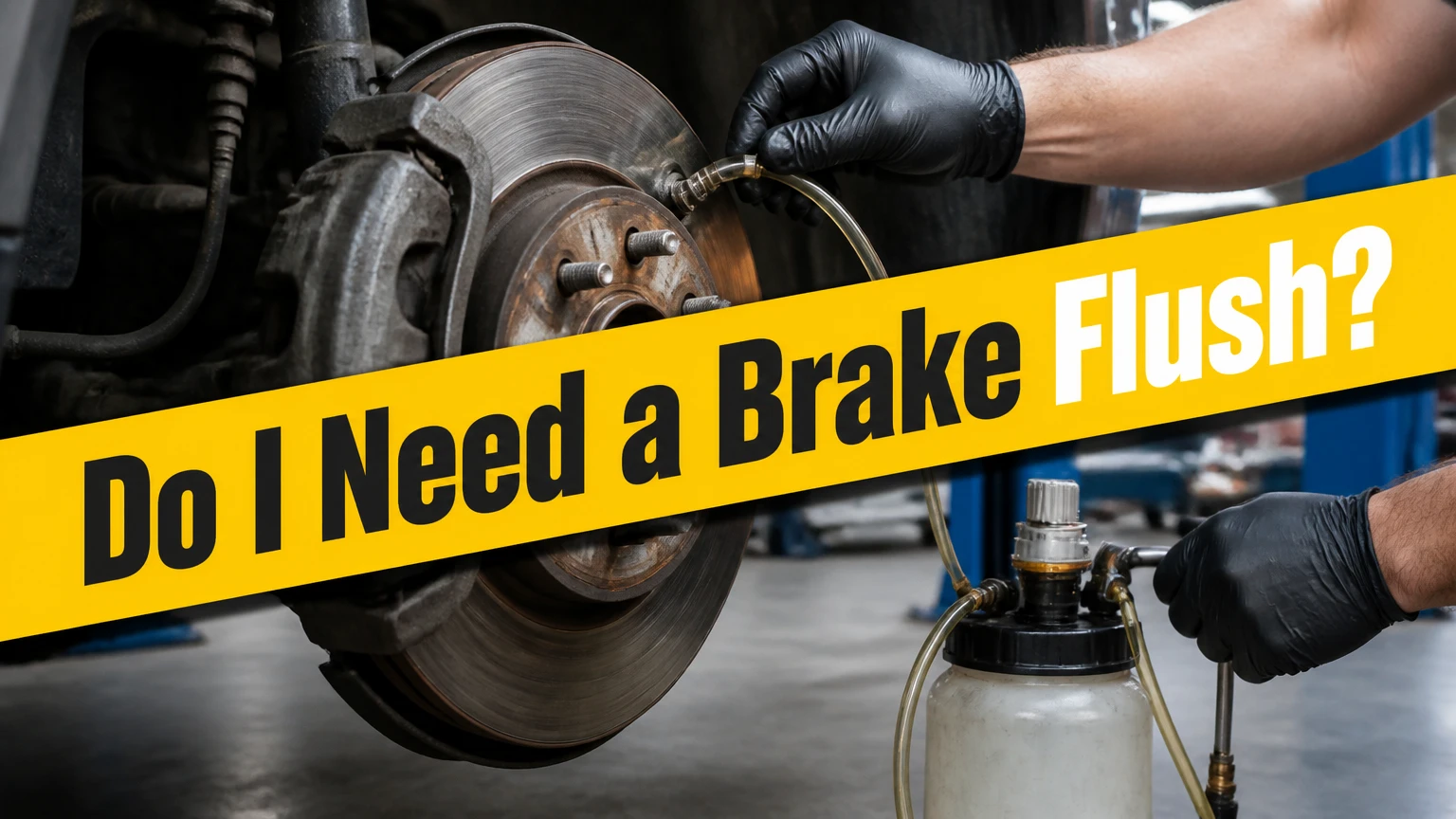
Yes, you need a brake flush every two years or 24,000 miles because brake fluid is hygroscopic and continuously absorbs moisture from ambient air. Accumulated water lowers the fluid’s boiling point, creates vapor pockets that cause sudden brake pedal failure, and corrodes internal ABS modules, calipers, and master cylinders.
At a Glance
- Standard Interval: Every 2 years or 24,000 miles, whichever occurs first.
- Failure Threshold: Mandatory flush when fluid moisture reaches 3% or copper contamination exceeds 200 ppm.
- Average Cost: Preventative flush costs $100–$150; replacing corrupted ABS components costs $800–$2,500.
- EV & Hybrid Rule: Time-based intervals (2 years) strictly apply to EVs regardless of low mileage due to unevaporated moisture accumulation.
- Critical Risk: Water lowers DOT 4 boiling points from 446°F (230°C) down to 311°F (155°C), leading to complete pedal fade during hard stops.
What Are the Early Warning Signs That You Need a Brake Flush?
Brake fluid degradation manifests through pedal feel, physical fluid appearance, and system warnings. You need a brake flush immediately if you experience any of the following four symptoms:
- Spongy or Soft Pedal: The brake pedal feels mushy or pushes closer to the floorboard than usual before engaging.
- Brake Fade under Hard Use: Stopping power drops noticeably during prolonged downhill driving, heavy towing, or spirited braking.
- Dark or Murky Reservoir Fluid: Fresh brake fluid is clear to light amber; dark brown or black fluid indicates severe thermal breakdown and rubber hose degradation.
- Illuminated ABS or Brake Warning Light: Internal moisture corrosion can trigger hydraulic valve delays within the anti-lock braking system.
How Often Do You Need a Brake Flush?
For standard passenger vehicles, brake fluid must be flushed every 2 years or 24,000 miles under normal driving conditions.
Brake fluid absorbs roughly 1% to 1.5% water per year through microscopic pores in rubber flexible lines and reservoir seals. Once moisture content hits 3%, the fluid is considered end-of-life and unsafe for operation.
| Driving Environment / Vehicle Type | Recommended Flush Interval | Primary Degradation Driver |
| Standard Commuter Driving | 2 Years / 24,000 Miles | Ambient moisture absorption |
| High-Humidity / Coastal Regions | 12 to 18 Months | Accelerated atmospheric humidity ingress |
| Track Days / Heavy Mountain Towing | 6 Months (or post-event) | Extreme heat & fluid thermal oxidation |
| Electric & Hybrid Vehicles (EVs) | 2 Years (Strictly Time-Based) | Low heat generation preventing natural evaporation |
| Classic Cars with DOT 5 Silicone | Bleed lower calipers annually | Water pooling at lowest points |
Why Does Brake Fluid Absorb Water If the Braking System Is Sealed?
Automotive braking systems are closed, but they are not hermetically sealed against atmospheric gases. Brake fluid absorbs moisture because glycol-ether compounds (DOT 3, DOT 4, and DOT 5.1) are inherently hygroscopic, meaning their molecular structure chemically attracts and binds water molecules.
Water enters the system through three primary pathways:
- Microscopic rubber porosity: Brake hoses flex continuously, allowing air humidity to pass through the rubber at a molecular level.
- Reservoir venting: The brake fluid reservoir cap includes a breather vent or membrane to compensate for fluid displacement as brake pads wear down.
- Temperature cycles: Rapid heating and cooling inside the lines pull ambient air into the reservoir during cool-down periods, causing micro-condensation.
What Is the Moisture and Boiling Point Threshold for Bad Brake Fluid?
Brake fluid requires immediate replacement when its moisture content reaches 3% or higher, or when its wet boiling point drops below safety minimums.
Brake fluid has two rating metrics: the Dry Boiling Point (100% pure fluid) and the Wet Boiling Point (tested with roughly 3.7% water saturation).
$$\text{Wet Boiling Point Safety Threshold} \le 311^\circ\text{F } (155^\circ\text{C})$$
Brake Fluid Degradation Curve
-----------------------------------------------------------------------
New Dry DOT 4 Fluid       :  446°F (230°C) [0% Water]  | SAFE
Acceptable Used Fluid     :  375°F (190°C) [1.5% Water]| SAFE
Critical Flush Limit      :  311°F (155°C) [3.7% Water]| DANGEROUS (Vapor Lock Risk)
-----------------------------------------------------------------------
When contaminated fluid reaches high temperatures during heavy braking, trapped water turns to steam. Because gas compresses under pressure while liquid does not, stepping on the brake compresses the steam pockets instead of pushing the brake pads—resulting in immediate pedal loss.
How Do Mechanics Test Brake Fluid Health Beyond Looking at Color?
Mechanics test brake fluid health using quantitative diagnostic tools because color alone is an unreliable indicator of performance. Clear fluid can carry dangerous moisture levels, while dark fluid may simply contain harmless dye breakdown or non-corrosive carbon particles.
Professional shops use two primary testing methods:
- Electronic Boiling Point / Conductivity Testers: Digital probes submerge into the reservoir to measure electrical resistance or heat small samples directly to determine exact water percentage and boiling points.
- Chemical Copper Test Strips: Strips measure copper levels in parts per million (ppm). When protective anti-corrosion additives deplete, internal copper brazing on metal brake lines dissolves into the fluid. A reading over 200 ppm of copper dictates an immediate flush.
How Much Does a Brake Flush Cost vs. Component Repairs?
A professional brake flush costs between $100 and $150 at most independent shops and dealerships.
Neglecting this maintenance allows acidic, water-laden fluid to pit internal iron and aluminum surfaces, leading to system failure:
- ABS Hydraulic Control Unit Replacement: $1,200 – $2,500
- Brake Caliper Replacement (Pair): $400 – $900
- Master Cylinder Replacement: $350 – $700
How Do Track Days, Towing, or High Humidity Change Your Flush Schedule?
Severe operating conditions accelerate thermal degradation or moisture absorption, rendering standard 2-year maintenance windows obsolete.
- Track Days and Towing: Heavy loads generate severe friction heat, raising brake fluid temperatures above 400°F (204°C). This heat degrades chemical corrosion inhibitors long before water builds up. Enthusiasts should flush brake fluid every 6 months or right after track sessions using high-boiling racing fluids (e.g., DOT 4 Racing formulations).
- High-Humidity Climates: Drivers in humid or coastal zones experience faster atmospheric moisture diffusion through flexible hoses. Moisture levels often cross the critical 3% barrier in just 12 to 18 months.
Why Do Electric Vehicles Need Brake Flushes If They Use Regenerative Braking?
Electric vehicles (EVs) require brake flushes strictly on a 2-year time interval regardless of low mileage because their friction brakes are rarely used.
Regenerative braking handles up to 90% of deceleration in EVs, generating minimal friction heat in the mechanical calipers. In traditional gas vehicles, daily braking heat helps evaporate minor condensation out of the reservoir area. Because EV brake lines remain cold, absorbed water accumulates without evaporating, accelerating internal corrosion of hydraulic valves even if the car has driven fewer than 5,000 miles.
Why Do Classic Cars with Silicone DOT 5 Fluid Require a Different Process?
Classic cars and military vehicles running DOT 5 silicone-based fluid do not undergo standard flushes because silicone is hydrophobic (it completely repels water).
Instead of mixing with the fluid, moisture entering a DOT 5 system settles at the lowest physical points—typically inside the brake calipers and wheel cylinders. This creates isolated pockets of pure water that cause rapid localized rust and boiling under light heat.
DOT 5 systems do not need frequent full fluid replacement; instead, they require annual bleeding from the lowest caliper bleed screws to purge pooled water droplets.
Can You Just Top Off Brake Fluid Instead of Flushing It?
No, you cannot just top off brake fluid to fix maintenance issues. Adding fresh fluid to the master cylinder reservoir only dilutes top-level fluid; it does not purge trapped air, oxidized debris, heavy copper contaminants, or water trapped deep inside the calipers and ABS valving.
Top-offs are only appropriate as a temporary emergency measure when fluid levels drop due to pad wear or minor leaks.
What Is the Difference Between Bleeding and Flushing Brakes?
The difference between bleeding and flushing lies in the scope and objective of the service:
- Brake Bleeding: A brief procedure designed to purge trapped air bubbles from specific lines. Technicians open caliper bleed screws briefly until clear liquid flows without air pockets. It is performed after replacing brake pads, lines, or individual calipers.
- Brake Flushing: A complete system overhaul that pushes out 100% of the old fluid across all hydraulic lines, the master cylinder, and the ABS module using a pressure bleeder, replacing it entirely with fresh, uncontaminated fluid.
Can You Mix Different Types of Brake Fluid?
You can mix DOT 3, DOT 4, and DOT 5.1 fluids together, but you can never mix DOT 5 with any other fluid.
Brake Fluid Compatibility Matrix
--------------------------------------------------------------------------
Fluid Type   Base Chemical     Can Mix With?        Compatibility Notes
--------------------------------------------------------------------------
DOT 3        Glycol Ether      DOT 4, DOT 5.1       Lowers system boiling point
DOT 4        Glycol Ether/Borate DOT 3, DOT 5.1     Standard modern fluid
DOT 5.1      Borate Ester      DOT 3, DOT 4         High performance glycol
DOT 5        Silicone          NEVER MIX WITH ANY   Creates solid gel/sludge
--------------------------------------------------------------------------
Mixing glycol-based fluids (DOT 3, 4, 5.1) is safe in emergencies, though it drops the overall performance rating to the lowest fluid mixed. However, combining silicone-based DOT 5 with glycol fluids triggers a chemical reaction that forms a thick, jelly-like sludge, clogging ABS valves and causing total system failure.
Can a Brake Flush Fix a Soft or Spongy Brake Pedal?
Yes, a brake flush will fix a soft or spongy brake pedal if the symptom is caused by trapped air bubbles or boiled moisture vapor in the lines. Flushing restores firm hydraulic pressure by replacing compressible gas pockets with non-compressible fluid.
However, a flush will not fix a spongy pedal if the root cause is a mechanical failure, such as an internal master cylinder seal bypass, leaking brake lines, or a failing brake booster.
When Is a Brake Flush Unnecessary or a Waste of Money?
A brake flush is unnecessary if your fluid has been tested with digital diagnostic tools showing under 2% moisture and under 100 ppm of copper, provided it is within the manufacturer’s 2-year time frame.
Be cautious when quick-lube facilities recommend a flush based solely on visual dark color without running chemical strip or boiling-point diagnostic tests. Replacing clean fluid early yields no safety benefit and wastes maintenance budgets.
The Bottom Line
You need a brake flush every 2 years or 24,000 miles to eliminate water buildup, protect critical ABS components, and prevent dangerous pedal fade. Never rely on fluid color alone; insist on quantitative moisture or copper testing before approving service. While extreme driving, high humidity, and EV designs adjust your maintenance frequency, routine $100–$150 flushes remain the most effective protection against multi-thousand-dollar hydraulic repairs.