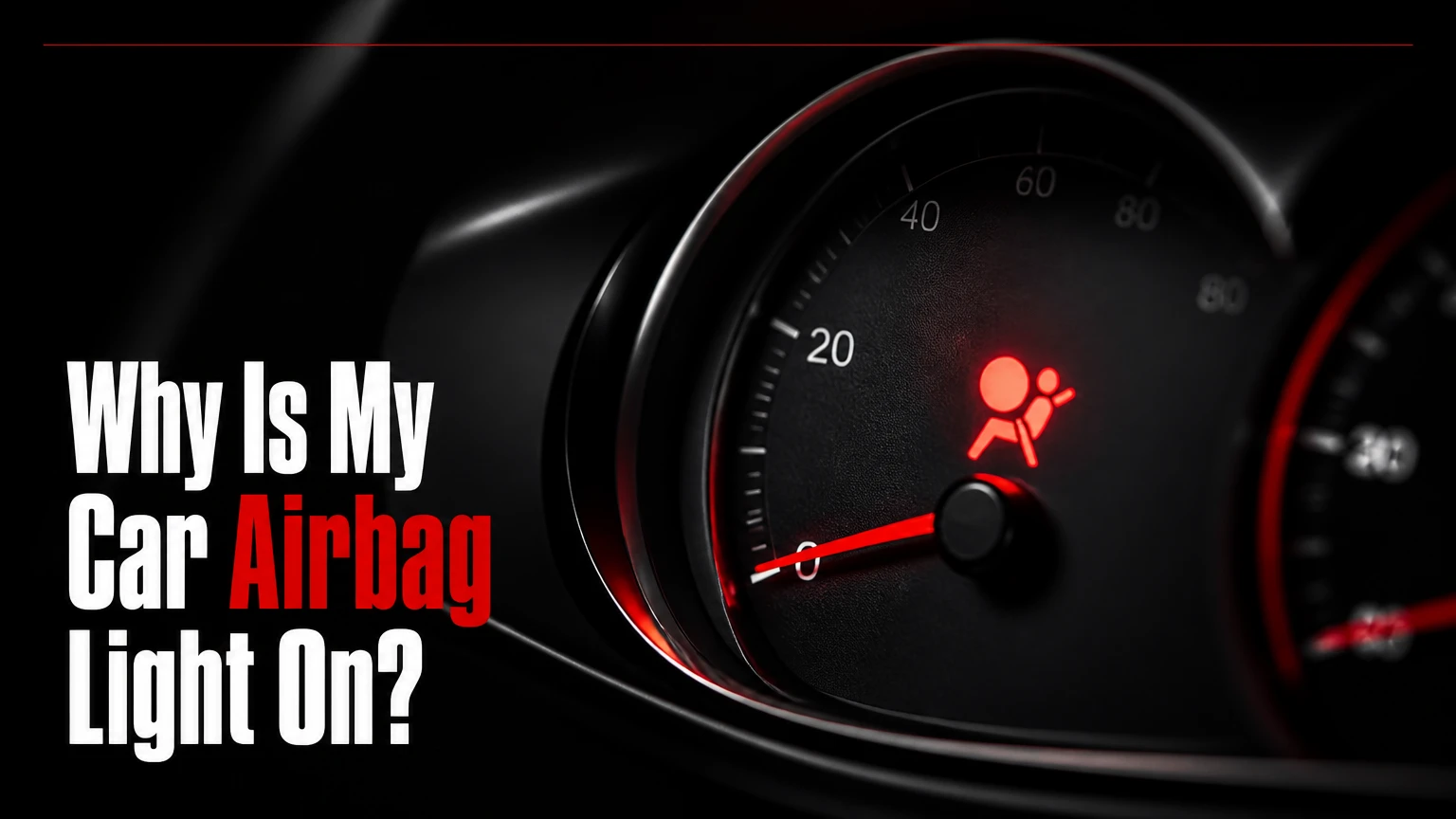
An illuminated airbag light indicates that the vehicle’s Airbag Control Unit (ACU) has detected an electrical fault within the Supplemental Restraint System (SRS). When this warning light activates, the ACU disables the entire safety system, preventing driver, passenger, and side airbags from deploying during a collision.
At a Glance
- An active SRS warning light completely disables all airbag deployments across the vehicle.
- The Airbag Control Unit triggers a fault code if electrical resistance strays outside the 2.0 to 3.0 Ohm threshold for over 100 milliseconds.
- Standard $20 OBD2 code readers cannot access airbag diagnostics; an advanced reader capable of scanning Body (B) and Chassis (C) codes is required.
- Disconnecting the car battery will not clear airbag codes because SRS fault data is stored in Non-Volatile RAM (NVRAM).
- Repair costs range from $50 for a loose under-seat wiring harness to $1,500 for a central control module replacement.
How Does the Airbag Control Unit Detect System Faults?
The Airbag Control Unit (ACU) monitors system integrity by continuously running low-voltage resistance tests through every igniter, sensor, and wiring loop in the vehicle. It registers a fault whenever electrical parameters deviate from factory safety tolerances.
The ACU evaluates system health using four main electrical threshold metrics:
- Resistance Window (2.0–3.0 Ohms): Standard operating resistance for airbag squibs (explosive pyrotechnic igniters) and seatbelt pretensioners falls within 2.0 to 3.0 Ohms.
- Deviation Trigger (±0.5 Ohms): If circuit resistance drops below 1.5 Ohms (short circuit) or rises above 3.5 Ohms (open circuit/high resistance) for 100 to 500 milliseconds, the ACU latches a fault code and turns on the light.
- 12-Volt Power Threshold: The SRS module requires stable system voltage. If battery voltage drops below 10.5 Volts during engine cranking, the ACU logs a low-voltage error, freezing the light on even after the alternator restores voltage to 14.2 Volts.
- 60-Second Weight Timeout: Occupant Detection Systems (ODS) in the passenger seat require 60 seconds of steady, uninterrupted sensor input before changing passenger airbag status from disabled to active.
What Are the Most Common Mechanical Causes for an Airbag Light?
The five primary mechanical causes for an illuminated SRS light are clockspring failure, disturbed under-seat wiring, corroded impact sensors, tripped seatbelt pretensioners, and prior minor collisions.
| Component / Trigger | Primary Failure Mechanism | Typical Diagnostic Code | Repair Complexity |
| Clockspring | Flex ribbon ribbon snaps behind steering wheel | B0001 / B0002 (Driver Airbag Circuit) | Moderate |
| Under-Seat Harness | Snagged clips or pin corrosion under front seats | B00A0 / B0028 (Occupant Sensing) | Low |
| Impact Sensor | Water intrusion or road salt corrosion | B0090 / B0091 (Frontal Crash Sensor) | Moderate |
| Seatbelt Pretensioner | High resistance in buckle microswitch or pyrotechnic circuit | B0071 / B0072 (Pretensioner Resistance) | Moderate |
| Previous Collision | Pyrotechnic retractor fired without deploying main bags | B1193 (Crash Data Stored) | High |
How Does a Failing Steering Wheel Clockspring Trip the Light?
A steering wheel clockspring contains a spiraled ribbon cable that maintains electrical contact between the stationary steering column and the rotating steering wheel. Over tens of thousands of turns, the copper traces inside the ribbon fatigue and crack.
When an internal ribbon ribbon trace snaps, resistance spikes to infinity (open circuit), exceeding the 3.5 Ohm limit. A failing clockspring often exhibits intermittent behavior: the airbag light may turn off when driving straight but illuminate when the steering wheel is turned 45 degrees left or right.
Why Do Under-Seat Wiring Harnesses Frequently Trigger SRS Codes?
Under-seat wiring harnesses link the central SRS computer to side airbags, seatbelt pretensioners, and occupant weight mats. Because these bright yellow wiring harnesses are exposed beneath the driver and passenger seats, sliding seats back and forth, vacuuming, or storing items under the seat easily tugs on the quick-disconnect clips. This physical movement loosens connector pins or creates micro-corrosion, pushing circuit resistance above 3.5 Ohms.
How Do Seatbelt Pretensioners and Buckle Switches Affect the SRS Circuit?
Seatbelt pretensioners contain pyrotechnic charges designed to instantly retract seatbelt webbing during a crash. These pretensioners share the primary SRS monitoring circuit. If dust, small coins, or spilled liquids coat the internal microswitch inside the seatbelt receiver buckle, the switch fails to send a “latched” signal, or its internal resistance drifts outside the 2.0 to 3.0 Ohm baseline, triggering an immediate dashboard error.
What Edge Cases Trigger the Airbag Light Without a Broken Part?
Unexpected environmental and electrical edge cases can trigger an SRS warning light even when no physical airbag components are broken.
- Occupant Weight Mat Confusion: Capacitive and pressure-sensitive passenger mats get confused by non-human loads. Placing a heavy backpack, a laptop plugged into a 12V vehicle charging port (which emits electromagnetic interference), or a wet pet onto the front seat creates a hybrid weight-electrical signature, prompting the ACU to register an occupant sensing error.
- Aftermarket Radio Harness Interference: Older European vehicles (such as 1990s-2000s Volkswagens and BMWs) share diagnostic communication lines (K-Line or CAN-Bus networks) between the factory radio wiring harness and the SRS module. Splicing an aftermarket head unit incorrectly can ground the diagnostic communication line, locking the SRS module into a fail-safe warning state.
- Clogged Sunroof Drain Flooding: Sunroof drain tubes pass down the A-pillars. When these drains clog with debris, rainwater overflows down the firewall and pools beneath the floor carpet. Because manufacturers bolt the main SRS Control Module to the lowest floor point beneath the center console, water accumulates around the module, shorting its pins and causing permanent hardware failure.
Will Airbags Deploy in a Crash if the Airbag Light Is On?
No, airbags will not deploy in a crash while the SRS warning light is illuminated. When the Airbag Control Unit detects a circuit fault or low voltage event, it intentionally disables the entire safety system to prevent unpredictable, accidental pyrotechnic deployments while driving.
Driving with an active airbag light leaves vehicle occupants relying solely on the mechanical seatbelt assemblies for collision protection, increasing the risk of severe injury in an impact.
Is It Safe and Legal to Drive With an Illuminated SRS Warning Light?
It is mechanically safe to drive with an illuminated SRS light because engine, braking, and steering systems function normally, but it is physically dangerous due to the loss of crash protection.
From a legal and operational standpoint:
- Vehicle Inspection: In most jurisdictions with safety inspection programs, an illuminated airbag light results in an automatic inspection failure.
- Resale Legality: Selling a vehicle with a active safety warning light without written disclosure may violate consumer protection statutes.
- Insurance Implications: Insurance companies cover collisions regardless of dashboard warning lights, but driving with a known disabled safety system exposes occupants to preventable bodily injury.
Why Won’t Disconnecting the Battery or Using a Cheap OBD2 Scanner Reset the Light?
Standard OBD2 code readers and battery disconnections fail to clear airbag lights due to scanner protocol limitations and non-volatile memory architecture.
- Scanner Protocol Mismatch: Budget $20 OBD2 code readers only communicate via Powertrain (“P”) protocols to diagnose engine and emission faults. Airbag faults are stored under Body (“B”) or Chassis (“C”) protocols, requiring a diagnostic scanner explicitly equipped with SRS software capabilities.
- Non-Volatile RAM (NVRAM) Storage: The Airbag Control Unit saves crash data and circuit faults to NVRAM chips. Unlike engine ECU codes that clear when unpowered, NVRAM retains fault memory indefinitely without power. Disconnecting the negative battery terminal overnight will never clear an active SRS light; it must be cleared using a scanner after repairing the physical fault.
How Do You Diagnose and Fix an Airbag Light at Home?
Diagnosing and fixing an airbag light requires systematic testing using specialized equipment and safety precautions.
- Connect an SRS-Capable Diagnostic Tool: Plug a bi-directional scanner with SRS capabilities into the OBD2 port beneath the driver’s dashboard. Read the specific diagnostic trouble code (e.g., B0015 – Passenger Seatbelt Pretensioner High Resistance).
- Disconnect the Vehicle Battery: Before touching any yellow SRS wiring or components, disconnect the negative battery terminal and wait at least 15 minutes to allow the SRS backup power capacitors to fully discharge.
- Inspect the Targeted Circuit: Locate the component specified by the DTC code. Check for unclipped connectors under the seat, corroded impact sensor housing bolts, or damaged clockspring ribbons.
- Clean and Reseat Connectors: Spray electrical contact cleaner into the harness plug terminals to remove oxidation. Reconnect the locking clips firmly.
- Clear Codes via Scan Tool: Reconnect the battery, turn the ignition key to ON, and use the diagnostic tool to execute an “SRS Code Clear” command. If the underlying fault is resolved, the light will turn off and remain off.
How Much Does It Cost to Fix an Airbag Light?
Fixing an airbag light costs between $50 and $1,500+, depending on whether the issue is a loose connection, a worn mechanical component, or a flooded central control module.
- Minor Fixes ($50 – $150): Repairing loose under-seat harness clips, cleaning corroded seatbelt receiver buckle switches, or clearing transient low-voltage battery codes.
- Mid-Range Repairs ($200 – $500): Replacing a steering wheel clockspring ($150–$300 part + labor) or swapping out a damaged exterior impact sensor ($100–$250 part + labor).
- Major Repairs ($800 – $1,500+): Replacing a failed Occupant Detection System passenger seat weight mat ($600–$1,000) or replacing and reprogramming a flooded central SRS Airbag Control Module ($800–$1,500+).
Can Cleaning the Seatbelt Buckle or Electrical Connections Turn Off the Light?
Cleaning electrical connections can turn off the airbag light if the initial fault was caused by high resistance from dirt, dust, or light corrosion on contact pins.
Do not spray standard WD-40 or multi-purpose oil lubricants into seatbelt buckles or harness clips. WD-40 leaves a non-conductive, petroleum-based coating that attracts dirt, exacerbating resistance issues over time. Instead, flush seatbelt buckles and harness terminals using a fast-evaporating Electronic Contact Cleaner spray. Once dry, cycle the seatbelt latch 10 to 15 times to clear internal debris from the microswitch contacts.
The Bottom Line
An illuminated airbag light indicates that your vehicle’s safety system is completely disabled due to an electrical resistance fault, low voltage, or component failure. Disconnecting the car battery will not reset the warning light because fault data is permanently saved in the module’s non-volatile memory. To resolve the issue, scan the vehicle using an SRS-capable diagnostic tool to locate the specific fault code, repair the affected connector or sensor, and clear the system memory using the scan tool.