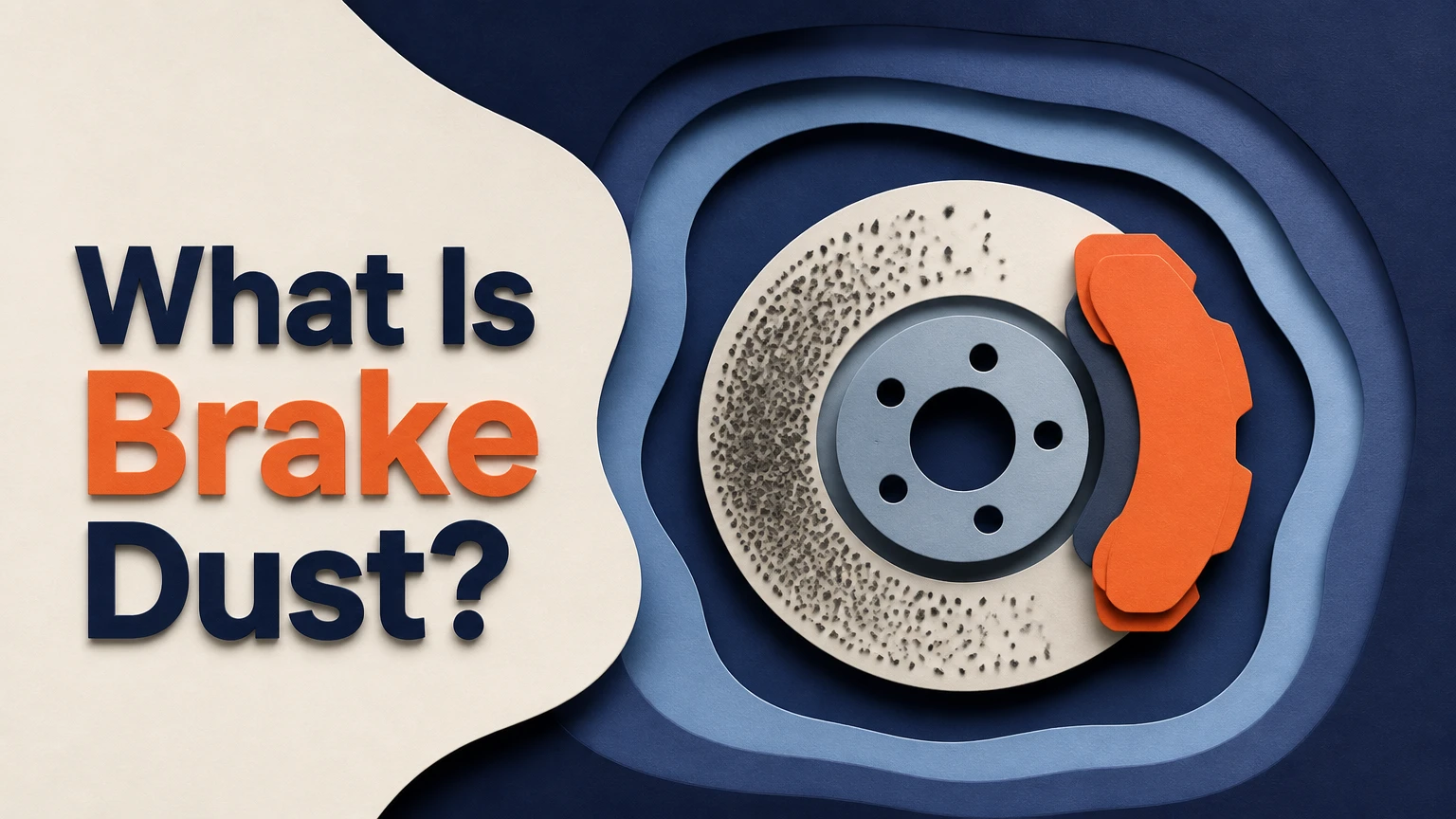
Brake dust is a dark, highly adhesive particulate residue created by mechanical friction between vehicle brake pads and iron rotors during stopping. It consists of elemental iron, carbon, copper, friction modifiers, and burned polymer resins that electrostatically bond to vehicle wheels and surrounding components under high operating temperatures.
At a Glance
- Primary Composition: Up to 60% to 90% of brake dust weight is metallic iron shredded directly from brake rotors.
- Thermal Binding: Braking temperatures ($300^\circ\text{C}$ to $800^\circ\text{C}$) melt pad resin binders, making dust sticky and highly corrosive to wheel clear coats.
- Environmental Impact: Brake wear generates 40% to 50% of non-exhaust urban traffic fine particulate matter ($PM_{2.5}$ and $PM_{10}$).
- EV Reduction: Electric vehicles generate up to 80% less brake dust than gas vehicles due to regenerative braking systems.
- Ceramic Misconception: Ceramic pads still produce dust, but it is lighter in color, non-adhesive, and less visible on wheels.
How Does Friction Create Brake Dust?
Brake dust forms when kinetic energy converts into intense thermal energy during vehicle deceleration, physically shearing particles off the braking components.
Kinetic Energy (Motion) ➔ Thermal Friction (300°C–800°C) ➔ Resin Melt & Shearing ➔ Sticky Metallic Dust
When you depress the brake pedal, the caliper forces the brake pads against the spinning iron rotor. Friction slows the vehicle, generating extreme surface temperatures ranging from $300^\circ\text{C}$ to $800^\circ\text{C}$ ($572^\circ\text{F}$ to $1472^\circ\text{F}$). This thermal environment causes microscopic iron fragments to shear off the rotor while simultaneously degrading the brake pad’s organic resin binders. The melted polymers, combined with static charge generated during friction, cause the hot metallic particles to cling tightly to nearby alloy wheels, suspension linkages, and body panels.
What Is Brake Dust Made Of?
Brake dust is a complex mixture of fine metals, carbon compounds, and synthetic binders, dominated by elemental iron sheared from the rotor core.
| Component Category | Percentage by Weight | Primary Source Material | Primary Characteristics |
| Elemental Iron | 60% – 90% | Cast iron brake rotors | Magnetic, rusts orange-brown, electrostatically charged |
| Carbon & Graphite | 10% – 20% | Pad friction modifiers | Dark pigment, lubricants, soft particulate |
| Polymer Resins | 5% – 15% | Phenolic pad binders | Thermally degraded, sticky adhesive matrix |
| Non-Ferrous Metals | 1% – 5% | Copper, brass, zinc additives | Thermal conductivity, structural friction control |
When exposed to ambient humidity and atmospheric oxygen, the raw iron particles in brake dust oxidize rapidly, turning a characteristic rusty orange-brown color on neglected wheels.
Is Inhaling Brake Dust Dangerous to Your Health?
Yes, inhaling brake dust poses significant health risks because it consists of ultra-fine respirable particles ($PM_{2.5}$) and heavy metals that cause oxidative lung damage.
Airborne brake dust particles typically measure between 0.1 and 10 micrometers in diameter. Fine particulates smaller than 2.5 micrometers easily bypass natural nasal filtration and penetrate deep into the pulmonary alveoli. Inhaling these airborne transition metals (iron, copper, and zinc) triggers localized tissue inflammation and cellular oxidative stress.
While asbestos was largely phased out of friction materials by late-1990s regulations, vintage vehicles and unverified aftermarket brake pads may still contain chrysotile asbestos fibers. Technicians and DIYers should always use a NIOSH-approved $N95$ respirator and wet-cleaning techniques when working on brake assemblies or power-washing heavy wheel accumulation.
Does Brake Dust Permanently Damage or Ruin Wheels?
Yes, brake dust will permanently ruin wheel finishes through galvanic corrosion and clear-coat pitting if left untreated for extended periods.
Hot iron particles from brake dust land on the wheel’s protective clear coat and cool down, becoming embedded in the porous surface. When water, road salt, or humidity hits these embedded particles, iron oxidation begins. This triggers galvanic corrosion—a chemical reaction between the raw iron fragment and the underlying aluminum alloy rim.
Embedded Hot Iron Particle + Water/Oxygen ➔ Rust Expansion ➔ Clear Coat Pitting ➔ Permanent Wheel Etching
Over time, expanding rust pits through the transparent protective lacquer, causing bubbling, peeling, and permanent black-spot etching into the structural aluminum beneath.
How Long Can Brake Dust Remain on Rims Before Pitting Starts?
Brake dust begins causing permanent clear-coat pitting within 4 to 8 weeks in dry climates, and as quickly as 1 to 2 weeks in high-humidity or ocean-coastal environments.
The speed of destruction depends directly on moisture exposure and ambient salt levels. In dry weather, raw iron particulates sit passively on top of the clear coat. However, adding moisture or road de-icing agents acts as a catalyst, rapidly accelerating oxidation. Once iron oxide forms, it expands up to six times its original volume, fracturing the surrounding paint boundary within days of severe atmospheric exposure.
Why Do European Cars Produce More Brake Dust Than US Cars?
European vehicles generate significantly heavier, stickier brake dust because European automotive standards prioritize high-speed stopping power over cosmetic wheel cleanliness.
- European OEM Specs (Low-Metallic): European automakers (such as BMW, Mercedes-Benz, and Audi) equip vehicles with Low-Metallic (Low-Met) friction pads. These pads contain 10% to 30% steel wool and iron powder mixed with soft carbon, providing immediate initial bite and fade resistance at autobahn speeds. The trade-off is rapid rotor wear and heavy dark dust.
- US & Asian OEM Specs (Ceramic/NAO): Domestic US and Japanese manufacturers primarily use Non-Asbestos Organic (NAO) or Ceramic pads designed to meet customer preference for quiet operation and clean rims, sacrificing a degree of aggressive thermal bite for longevity.
How Do Ceramic Brake Pads Compare to Low-Metallic Pads for Dust?
Ceramic brake pads reduce visible wheel dust by up to 80% compared to low-metallic pads while generating non-adhesive, lighter-colored particles.
Low-Metallic Pads  ➔  Dark, Sticky, Iron-Heavy Dust (Highly Visible)
Ceramic Pads       ➔  Light Tan, Non-Adhesive Dust (Barely Visible)
| Performance Feature | Low-Metallic Friction Pads | Ceramic Friction Pads |
| Dust Color & Visibility | Dark grey/black; highly visible | Light grey/tan; matches road grime |
| Dust Adhesiveness | High (sticky melted resin) | Low (powdery, non-adhesive) |
| Rotor Wear Rate | High (aggressive metallic shear) | Low (gentle ceramic-dense matrix) |
| Stopping Bite (Cold) | Superior immediate bite | Moderate initial bite |
| High-Temp Fade Resistance | Exceptional ($>600^\circ\text{C}$) | Good ($<450^\circ\text{C}$) |
Ceramic friction materials replace metallic fibers with dense ceramic compounds and soft copper/brass filaments. The resulting dust does not stick electrostatically to clear coats and rinses away with simple water pressure.
Do Electric and Hybrid Vehicles Generate Brake Dust?
Yes, electric vehicles (EVs) and hybrids produce brake dust, but at a rate up to 80% lower than traditional internal combustion engine vehicles.
EVs rely primarily on regenerative braking to slow down, reversing the electric drive motor to act as a generator and capture kinetic energy back into the battery. Physical friction brake pads only engage during hard emergency stops or at speeds below 5 mph ($8\text{ km/h}$). Because mechanical pads rarely touch the rotors during normal commute driving, dust generation drops drastically.
However, because EV brakes are underutilized, their primary mechanical issue shifts from rapid wear to surface rust accumulation on the unused iron rotors.
Are Carbon-Ceramic Brakes Completely Dust-Free?
No, carbon-ceramic brakes (CCBs) are not 100% dust-free, but they produce virtually zero visible dust under normal street driving conditions.
Carbon-ceramic rotors are manufactured from a high-strength composite matrix of carbon fibers fused with silicon carbide. Unlike cast iron rotors, CCBs do not shred metallic flakes during operation. The microscopic dust created by carbon-ceramic systems consists of non-magnetic carbon and silicon particles that are extremely lightweight and fail to bond to rim surfaces.
Because carbon-ceramic rotors can cost over $10,000 to replace, they remain exclusive to high-performance supercars, track-focused sports cars, and luxury heavy SUVs.
Why Do Brakes Squeal When Heavy Dust Accumulates?
Brake squeal from dust buildup occurs when trapped debris restricts pad motion inside the caliper hardware, forcing the pad to vibrate at a high frequency against the rotor face.
Dust Accumulation in Caliper Slots ➔ Restricted Pad Movement ➔ Micro-Vibration ➔ Audible Brake Squeal
As friction material wears, particulate matter collects in the caliper carrier slides, pad backing plate contact points, and the pad’s center expansion slots. This compacted debris prevents the pad from retracting cleanly away from the rotor when you release the pedal. The uneven, dragging contact triggers high-frequency resonance—heard audibly as a sharp squeal or squeak.
Cleaning the caliper assembly with aerosol brake cleaner spray and re-greasing metal contact points eliminates this dust-induced noise.
How Do You Safely Clean Embedded Brake Dust Off Wheels?
To safely clean embedded brake dust, you must use a pH-neutral, iron-dissolving spray followed by mechanical agitation with a dedicated wheel brush.
1. Apply Iron Remover ➔ 2. Dwell & Color-Change ➔ 3. Agitate with Soft Brush ➔ 4. Rinse Thoroughly
1.Apply Color-Changing Iron Decontaminant:Do not apply in direct sunlight or to hot wheels.
Spray a dedicated pH-neutral iron remover containing sodium thioglycolate directly onto dry, cool wheels. The active chemical breaks the bond between embedded iron particles and the paint layer, turning bright purple as it reacts with raw iron.
2.Allow Dwell Time for Chemical Reaction:Target 3 to 5 minutes dwell time.
Let the spray sit on the surface without letting it dry. Watch for the full purple bleeding effect to take place across all contaminated areas, especially around lug nuts and behind spoke recesses.
3.Agitate Surface with Soft Synthetic Brushes:
Use a soft microfiber wheel wand or boar’s-hair brush to work the loosened slurry into a light lather. Agitation forces the chemical solution deeper into severe brake dust deposits.
4.Pressure Rinse and Apply Synthetic Sealant:
Rinse the rim thoroughly with high-pressure water to clear all chemical residues and suspended iron sludge. Once dry, apply a high-temp synthetic wheel sealant or ceramic spray to block future dust adhesion.
For severe microscopic contamination that remains after washing, rub a dedicated auto-detailing clay bar with lubricant over the clear coat to pull embedded metallic specs completely out of the paint pores.
Why Do Acidic Wheel Cleaners Ruin Certain Wheel Finishes?
Acidic wheel cleaners destroy sensitive wheel finishes because strong acids etch into unsealed metals, stripped clear coats, and delicate anodized coatings.
Many legacy wheel cleaners rely on aggressive hydrofluoric or phosphoric acid formulas to rapidly dissolve iron rust. While effective on factory clear-coated cast aluminum, acid eats rapidly into bare polished aluminum, anodized lips, custom powder-coat finishes, and matte paint finishes. The chemical reaction leaves behind permanent white staining, cloudy hazing, and clear-coat peeling.
Always select non-acidic, pH-neutral cleaners utilizing sodium gluconate or sodium thioglycolate chemistry for safe, effective cleaning across all rim types.
How Do You Stop or Reduce Brake Dust Buildup?
You can significantly reduce brake dust buildup through friction material upgrades, chemical protective barriers, and smooth driving habits.
- Switch to High-Performance Ceramic Pads: Swap factory low-metallic friction pads for premium ceramic options. Ceramic formulas cut visible dust by up to 80% without sacrificing everyday stopping power.
- Apply High-Temperature Ceramic Coatings: Coat your rims with a dedicated silica ($SiO_2$) or professional ceramic coating rated to $1000^\circ\text{F}$ ($537^\circ\text{C}$). The slick hydrophobic layer stops hot metallic dust from fusing to the clear coat, allowing dust to wash off with simple pressure spraying.
- Smooth Deceleration and Engine Braking: Avoid late, hard braking stops from high speeds. Smooth coasting and downshifting reduce peak friction temperatures, lowering pad wear rates and particulate release.
The Bottom Line
Brake dust is an inevitable byproduct of vehicle stopping power, composed primarily of metallic iron shredded from rotors under extreme heat. While high-performance European vehicles and low-metallic pads generate aggressive, corrosive dust, switching to ceramic brake pads and applying protective silica coatings drastically reduces wheel maintenance. To prevent permanent pitting and galvanic clear-coat damage, clean your rims every 2 to 4 weeks using pH-neutral, iron-dissolving chemical formulas.