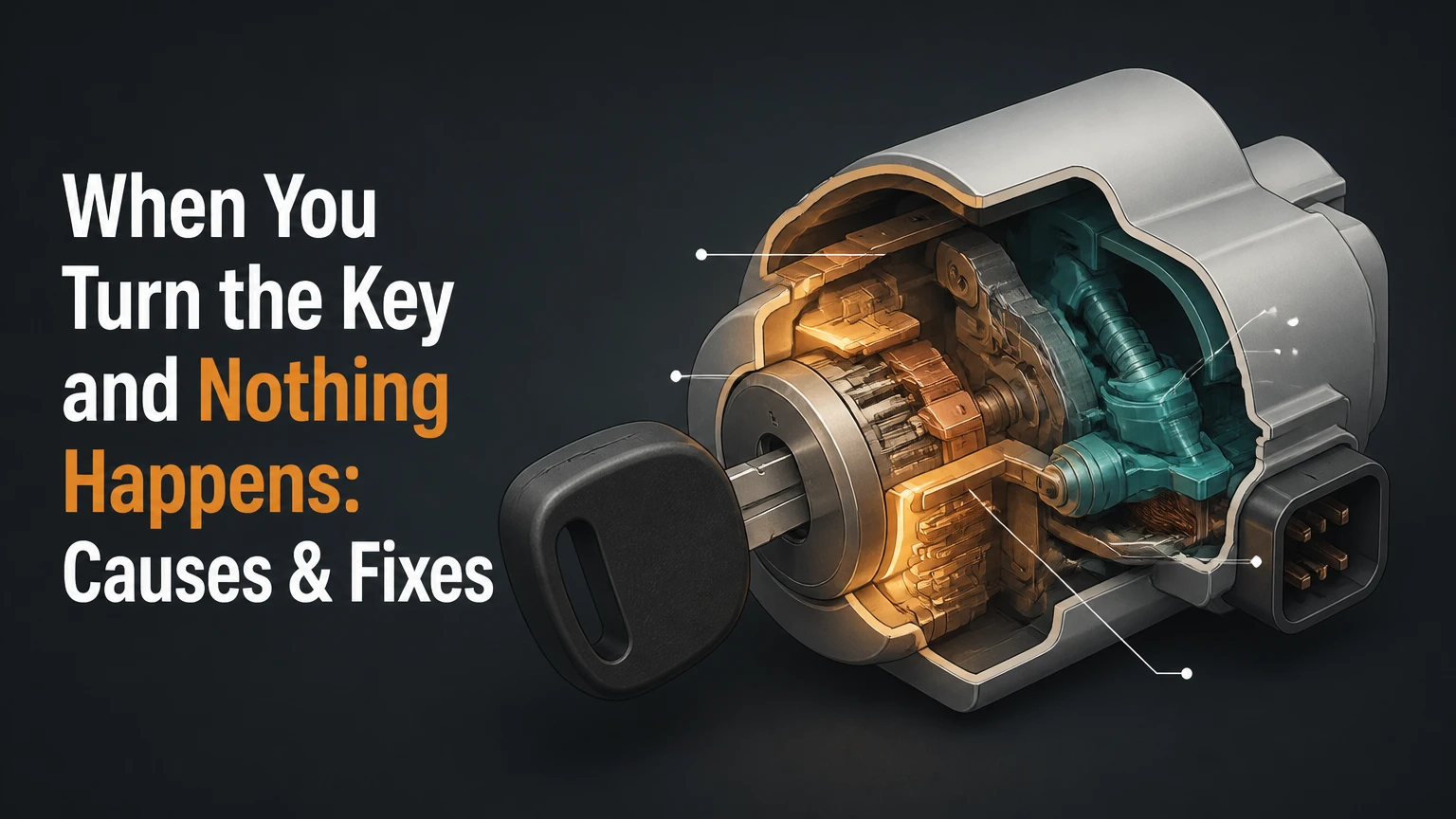
When you turn the ignition key and hear absolute silence—no cranking, no clicking, and no starter engagement—the high-current electrical circuit triggering the starter motor is completely open or electronically blocked. This symptom points directly to a depleted battery, severe terminal resistance, a failed starter solenoid, a blown main fusible link, or an active safety switch lockout.
At a Glance
- Primary Culprit: A resting battery voltage below 12.0 Volts prevents electronic control units (ECUs) from attempting an engine start.
- Fast Safety Check: Wiggling an automatic transmission shifter in Park or shifting into Neutral often bypasses a misaligned neutral safety switch.
- Critical Voltage Drop: Corrosion creating more than 0.2 Volts of resistance between the battery post and terminal clamp halts high-amp current delivery.
- Ground Cable Bypass: Connecting a single jumper cable clamp from the negative battery terminal to clean engine metal instantly tests for a severed ground strap.
- Fuse Inspection: A melted main fusible link (typically rated between 80A and 150A) cuts off all electrical power to the starter circuit and cabin.
What does absolute silence mean when turning the ignition key?
Absolute silence upon turning the key to the “Start” position indicates that zero electric current is passing through the starter motor windings. Unlike a rapid clicking sound—which signals low power—complete silence means the starter circuit is completely open, or the engine control module has electronically prohibited the start sequence.
[Ignition Key / Push Button]
             │
             ▼
[Safety Switches & Security] ──(Blocked?)──► [Total Silence: Starter Disabled]
             │ (Valid Signal)
             ▼
[Main Fuse & Starter Relay] ───(Blown?)───► [Total Silence: Circuit Open]
             │ (12V Signal)
             ▼
[Starter Solenoid & Motor]  ───(Failed?)──► [Total Silence: No Engagement]
Under normal conditions, turning the key sends a 12-volt signal through the ignition switch, neutral safety switch, and starter relay to energize the starter solenoid. The solenoid then closes heavy-duty copper contacts, pulling up to 300 Amps directly from the battery to spin the starter motor. When turning the key yields no sound whatsoever, this chain of electricity is interrupted before the starter solenoid can physically actuate.
Why is the car completely silent when turning the key?
A car remains completely silent during an ignition attempt due to four primary power delivery failures: severe battery discharge, starter solenoid coil failure, terminal oxidation, or a blown main line fuse.
How do you test if a dead battery is causing total silence?
To confirm a dead battery is causing total silence, measure the open-circuit voltage across the battery terminals using a digital multimeter set to DC volts. A healthy, fully charged automotive battery reads 12.6V to 12.8V at rest.
┌─────────────────────────┬──────────────────────────────────────────┐
│ Battery Voltage Reading │ Circuit State & Vehicle Behavior         │
├─────────────────────────┼──────────────────────────────────────────┤
│ 12.6V – 12.8V           │ Fully charged; normal system operation   │
│ 12.0V – 12.4V           │ Partially discharged; may fail ECU boot  │
│ Below 10.5V             │ Severely discharged or dead cell; silent │
└─────────────────────────┴──────────────────────────────────────────┘
If resting voltage drops below 12.0V, sensitive modern Engine Control Units (ECUs) often abort the starting process entirely to prevent low-voltage software corruption. If resting voltage falls below 10.5V, the battery has suffered severe internal discharge or a shorted cell, leaving insufficient energy to trigger the starter relay coil.
How can starter motor or solenoid failure cause zero cranking?
A starter motor causes zero cranking when its internal solenoid pull-in coil burns out, or when its internal carbon brushes wear down past their operational limit. The starter requires a 12-volt trigger signal at its control terminal (the “S” terminal) to engage.
If a multimeter confirms 12 Volts at the starter “S” terminal while the key is turned to the start position, but the motor fails to actuate or click, the solenoid windings or internal motor brushes have failed. Modern starters pull between 100A and 300+ Amps under load; open internal windings permanently prevent this current from flowing.
Can dirty battery terminals stop the starter entirely?
Dirty or oxidized battery terminals can completely block current flow by creating excessive electrical resistance at the power connection points. Lead-acid batteries routinely off-gas hydrogen, reacting with lead terminals to form white or blue lead sulfate corrosion.
Performing a voltage drop test pinpoints this issue: place the positive multimeter probe on the center of the actual battery post and the negative probe on the surrounding metal cable clamp. While attempting to start the vehicle, any voltage drop reading exceeding 0.2 Volts indicates high resistance that must be eliminated by scrubbing the contacts with a wire brush.
How do you identify a blown main fuse or fusible link?
A blown main fuse or fusible link appears as a visibly melted or fractured metal strip inside the engine bay fuse box (under-hood power distribution center). Main fusible links are high-amperage circuit protectors typically rated between 80 Amps and 150 Amps.
[Battery Positive] ───► [Main Fusible Link (80A-150A)] ───► [Cabin & Ignition Switch]
                                 │
                          (If Melted = Open)
                                 │
                                 ▼
                         [Complete Electrical Silence]
When this primary fuse blows—often caused by reversed jumper cable connections or an internal starter dead-short—current cannot reach the ignition switch or cabin distribution panel. Testing both top pins of the fuse with a 12V test light confirms continuity; illumination on only one side indicates an open fuse.
Which safety cutoffs and electronic glitches prevent the engine from turning over?
Safety switches and electronic immobilizers prevent the engine from turning over by deliberately opening the starter relay control circuit when safety conditions are not met.
                      ┌─── Park / Neutral Position? (Automatic)
                      ├─── Clutch Fully Depressed? (Manual)
Ignition Switch ────► ├─── Transponder Key Verified? (Anti-Theft)
                      └─── Engine Ground Circuit Intact?
                                      │
                                (All YES)
                                      │
                                      ▼
                           [Starter Relay Closes]
How do you bypass a faulty neutral safety switch or clutch pedal switch?
To temporarily bypass a misaligned neutral safety switch on an automatic transmission, firmly push the gear selector lever into Park (P) or shift the vehicle into Neutral (N) while turning the key.
On manual transmission vehicles, check whether a displaced floor mat is blocking the clutch pedal from reaching its last 0.5 inches of travel, where the clutch safety switch plunges. If the switch internally fails, the ECU assumes the transmission is engaged in gear and suppresses the 12V signal to the starter relay for safety.
What does a flashing security light mean when turning the key?
A flashing key-shaped or padlock-shaped light on the dashboard indicates that the engine immobilizer system has rejected the transponder chip inside your key fob. When the immobilizer fails to authenticate the digital security token, the body control module (BCM) immediately disables fuel injection and interrupts the starter signal line.
This issue frequently occurs after a vehicle battery completely drains, causing the immobilizer control module to lose synchronization with the key. Using a spare, factory-programmed master key or performing a key-relearn sequence often clears this security lockout.
How do you perform a jumper cable engine ground test?
To test for a damaged negative engine ground wire without specialized meters, attach one black clamp of a standard jumper cable directly to the negative (-) battery post, and attach the clamp on the opposite end to a clean, unpainted metal surface on the engine block.
[Negative Battery Post (-)] ═════════════════════════ [Clean Metal on Engine Block]
                             (Black Jumper Cable)
If the vehicle turns over normally with the jumper cable attached, the primary engine ground strap—which completes the electrical circuit from the starter motor back to the frame—is rusted, broken, or severed.
Why does a car fail to start even with a brand-new battery?
A vehicle fails to start with a brand-new battery when parasitic current draw drains the new unit overnight, or when a Smart Junction Box (SJB/BCM) imposes an electronic lockout after an electrical short.
- Parasitic Battery Drain: Excessive off-state current draw drains new batteries rapidly. While an acceptable off-state draw is below 50 milliamperes (0.05A), a stuck glovebox light, shorted alternator diode, or malfunctioning telemetry module can pull over 1.0 Amp, depleting a new battery’s reserve capacity in under 12 hours.
- Smart Junction Box Lockout: Modern vehicles utilize solid-state field-effect transistors (FETs) within the Smart Junction Box rather than standard mechanical fuses. If a short circuit occurs during installation, the SJB electronically disables the starter driver circuit. This state persists until cleared via an advanced OBD-II diagnostic scanner.
- Hydro-locked Engine: Fluid accumulation inside the engine cylinders physically locks the crankshaft. If liquid coolant (from a failed head gasket), excess fuel (from a stuck injector), or water fills a cylinder, the piston cannot complete its compression stroke because liquids cannot compress. The starter remains completely silent because it lacks the mechanical force to rotate a hydro-locked assembly.
How do you tell the difference between total silence, a single click, and rapid clicking?
Differentiating between start-up sounds narrows down whether the fault lies in high-voltage supply, mechanical starter movement, or low system power.
| Sound Observed | Most Likely Physical Cause | Primary Diagnostic Step |
| Absolute Silence | Open circuit, security lockout, blown main fuse, or dead switch. | Check resting battery voltage and safety switch positions. |
| Single Loud Click | Starter solenoid actuates fully, but starter motor lacks high amp power or is seized. | Inspect battery connections for high resistance (voltage drop test); tap starter casing. |
| Rapid Machine-Gun Clicking | Battery voltage drops rapidly under load, causing the starter relay to continuously engage and disengage. | Jump-start vehicle; replace or recharge low battery. |
What should you do if your push-button start vehicle won’t turn over?
If a push-button start vehicle yields total silence when pressing the Engine Start button, physically touch the top edge of the key fob directly against the Start button while depressing the brake pedal firmly.
Keyless entry fob batteries (typically CR2032 lithium cells) degrade over time. When the fob battery dies completely, its active radio frequency transmission fails. Holding the key fob directly against the Start button allows the vehicle’s passive Near Field Communication (NFC) backup antenna to read the transponder chip without relying on fob battery power. Additionally, verify that the brake pedal light switch functions; if the ECU does not register that the brake pedal is depressed, it will toggle accessory modes rather than cranking the starter.
How much does it cost to fix a car that won’t crank or start?
Repair costs for a car that will not crank depend entirely on which component in the starter circuit has failed:
- Battery Replacement: $120 – $250 for standard AGM or flooded lead-acid batteries.
- Battery Cable / Ground Strap Replacement: $50 – $150 including parts and labor.
- Starter Solenoid / Motor Replacement: $250 – $650, depending on engine bay accessibility.
- Neutral Safety Switch Replacement: $100 – $250.
- Main Fusible Link Replacement: $20 – $80 for parts; up to $150 if diagnostic tracing is required.
The Bottom Line
When turning your key results in absolute silence, the issue is an open starter circuit or an active electronic safety lockout, rather than a mechanical engine failure. Always start diagnostics by measuring resting battery voltage (12.6V target) and cleaning terminal corrosion to eliminate high electrical resistance. If testing the engine ground wire with a jumper cable or shifting into Neutral does not restore starter operation, inspect the main 80A–150A fusible link or test for proper 12V signaling at the starter solenoid trigger terminal.