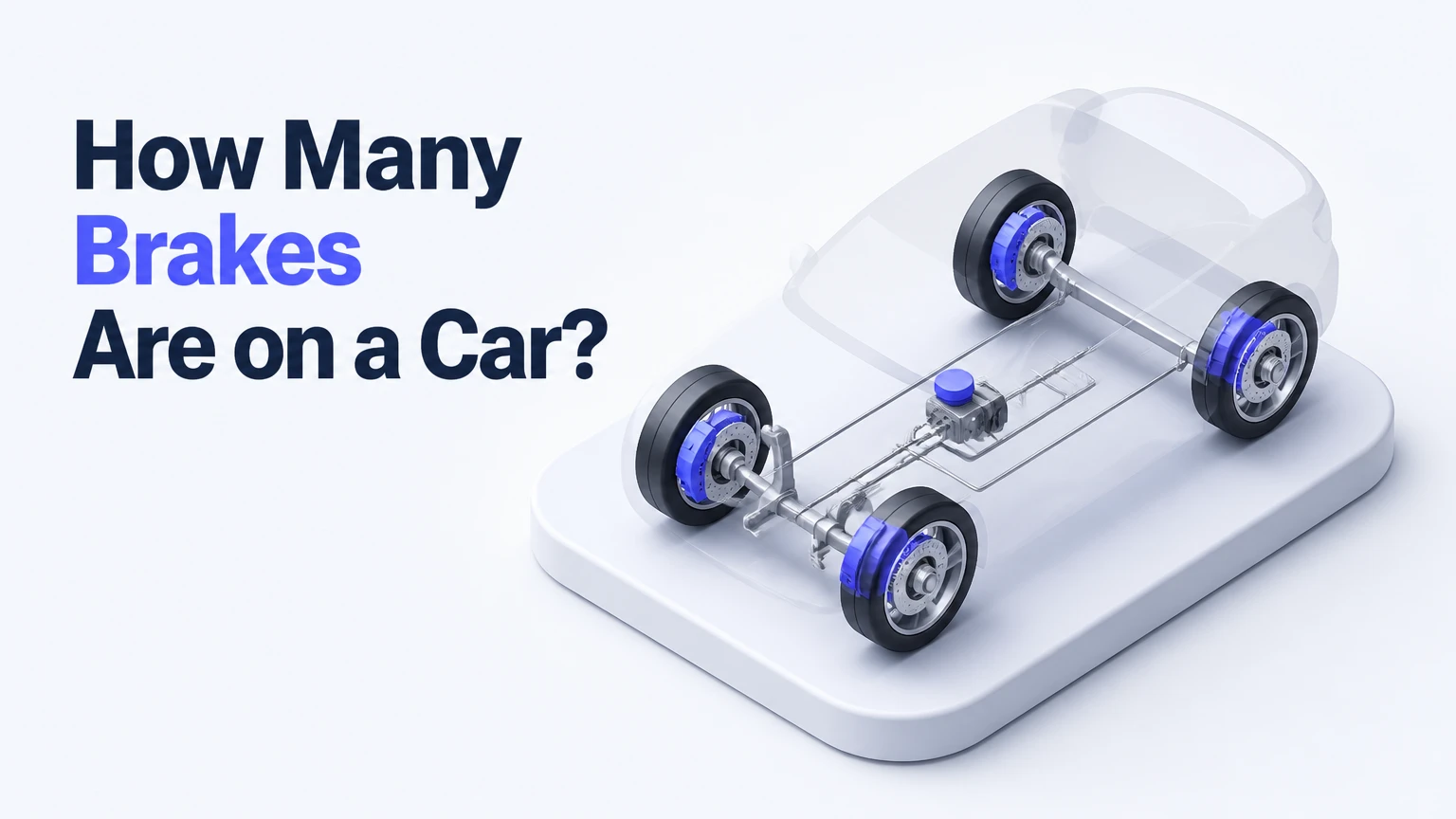
A standard passenger car has five individual brakes: four primary service brakes located at each wheel (used while driving) and one secondary parking brake (also called an emergency brake or handbrake). While the four wheel brakes operate together via a hydraulic system controlled by the foot pedal, the parking brake functions independently via a mechanical cable or electronic actuator.
At a Glance
- Standard vehicles feature four primary hydraulic brakes and one independent secondary parking brake.
- Front wheels utilize disc brakes, while rear wheels use either disc or drum brake assemblies.
- A complete four-wheel brake system incorporates eight individual brake pads (two per wheel caliper).
- Electric vehicles utilize the same five mechanical brakes alongside an electronic regenerative braking system.
- Hydraulic line failure does not disable all brakes because modern master cylinders separate front and rear circuits.
What Are the Two Main Braking Systems in a Vehicle?
Every passenger vehicle operates using two distinct braking systems: the primary service brake system and the secondary parking brake system. The service brake system slows or stops the vehicle during regular driving using hydraulic pressure, whereas the parking brake holds the vehicle stationary when parked or acts as a mechanical backup during primary system failure.
+-----------------------------------------------------------------------+
|                         TOTAL VEHICLE BRAKES                          |
+---------------------------------------------------+-------------------+
|               Primary Service Brakes              | Secondary System  |
|                   (Hydraulic)                     |   (Mechanical)    |
+-------------------------+-------------------------+-------------------+
|  Front Left Wheel Brake | Front Right Wheel Brake |   Parking Brake   |
|   Rear Left Wheel Brake |  Rear Right Wheel Brake | (Hand/E-Brake)    |
+-------------------------+-------------------------+-------------------+
The primary service brake engages when the driver depresses the brake pedal. This action forces hydraulic fluid through lines to calipers or wheel cylinders at all four wheels simultaneously. In contrast, the secondary parking brake bypasses the hydraulic system entirely. It uses a steel cable or an electric motor to lock the rear wheels physically, ensuring structural redundancy if hydraulic fluid leaks.
How Do the Four Wheel Brakes Work Together?
The four wheel brakes work in tandem through a dual-circuit hydraulic system engineered to distribute stopping force proportionally between the front and rear axles. When the brake pedal is pushed, a dual-piston master cylinder pushes fluid to all four wheel assemblies, typically applying 60% to 70% of the stopping force to the front wheels.
Hydraulic Disc Brake System Operation. Source: Graphic_BKK1979 / Getty Images
Front wheels carry more braking responsibility because kinetic weight transfers forward during deceleration. To maintain stability and prevent skidding, an Anti-lock Braking System (ABS) module monitors each wheel’s speed via individual sensors. If a wheel begins to lock up, the ABS pump pulses hydraulic pressure to that specific brake up to 15 times per second.
How Many Brake Pads Does a Car Have in Total?
A standard car equipped with four-wheel disc brakes contains eight brake pads in total, configured as two pads per wheel caliper. If a vehicle uses disc brakes on the front wheels and drum brakes on the rear wheels, it uses four brake pads on the front and four curved brake shoes inside the rear drums.
| Vehicle Axle | Friction Material Type | Total Pieces Required |
|---|---|---|
| Front Axle (Left & Right) | Disc Brake Pads | 4 pads (2 inner, 2 outer) |
| Rear Axle (Disc Setup) | Disc Brake Pads | 4 pads (2 inner, 2 outer) |
| Rear Axle (Drum Setup) | Drum Brake Shoes | 4 shoes (2 primary, 2 secondary) |
| Total System | Pads and/or Shoes | 8 Friction Elements |
Brake pads operate in inner and outer pairs inside a brake caliper. When hydraulic pressure pushes the caliper piston forward, the inner pad contacts the spinning rotor directly, while the sliding caliper body pulls the outer pad against the opposite side of the rotor, sandwiching the metal disc to generate friction.
How Many Brake Rotors or Drums Does a Car Use?
A standard four-wheel automobile uses four brake rotors (or a combination of rotors and drums), with exactly one attached to each wheel hub. Modern passenger cars typically feature four smooth metal brake rotors, whereas economy cars and older models frequently pair two front rotors with two rear brake drums.
Comparison of Drum and Disc Brake Setups. Source: Graphic_BKK1979 / Getty Images
Brake rotors are heavy steel or cast-iron discs that rotate alongside the vehicle’s wheels. Brake drums are hollow, bowl-shaped metal cylinders that enclose internal brake shoes. Both components serve as the heat-sink surface against which friction material presses to convert kinetic motion into thermal energy.
What Is the Purpose of the Parking Brake or Emergency Brake?
The parking brake serves to keep a stationary vehicle locked in place and acts as a mechanical emergency stopping mechanism if the primary hydraulic system fails. Located between the rear wheels, it operates independently of brake fluid, vacuum boosters, and engine power.
Drivers activate the parking brake using a hand lever, a floor-mounted foot pedal, or an Electronic Parking Brake (EPB) switch on the center console. When engaged, steel cables or electric motors pull the rear brake pads or internal parking shoes directly against the rear rotors or drums, preventing movement even on steep inclines.
Does the Parking Brake Control All Four Wheels?
No, the parking brake on almost all passenger cars controls only the two rear wheels. Operating the handbrake lever or electronic parking brake switch mechanically locks the rear brake mechanisms while leaving the front wheel assemblies completely free.
- Standard Rear-Wheel Locking: Focuses cable tension exclusively on rear calipers or dedicated internal parking brake shoes inside the rear rotors.
- Front-Wheel Exceptions: A few historical vehicles (such as classic Saab models and older Subaru cars) routed mechanical cables to the front calipers, but modern safety engineering standardizes rear-wheel locking.
- Emergency Drag: Applying the parking brake while driving causes deceleration solely through rear traction, which requires gentle application to avoid spinning the vehicle.
How Many Brakes Do Electric and Hybrid Cars Have?
Electric and hybrid vehicles have five traditional friction brakes plus one electronic regenerative braking system. While EV wheels still retain physical rotors, calipers, and a parking brake, the electric drive motor doubles as a generator to slow the vehicle down without physical friction.
When an EV driver lifts off the accelerator or presses the brake pedal lightly, the vehicle reverses its electric motor current. This process converts kinetic momentum back into stored battery energy. Regenerative braking handles up to 90% of daily deceleration, which drastically reduces wear on the four physical wheel brakes and extends brake pad lifespan beyond 80,000 miles.
What Is the Difference Between Disc Brakes and Drum Brakes?
The primary difference is that disc brakes use external calipers to squeeze flat pads against an exposed rotating disc, whereas drum brakes use internal wheel cylinders to push curved shoes outward against the inside of a hollow cylinder.
DISC BRAKE SYSTEM                      DRUM BRAKE SYSTEM
+-----------------------+              +-----------------------+
| [Caliper]             |              |      /---------\      |
|   |                   |              |     |  [Shoe]   |     |
| [Pad] -> |ROTOR| <-[Pad]             |  [Wheel Cyl]    |     |
|   |                   |              |     |  [Shoe]   |     |
| [Caliper]             |              |      \---------/      |
+-----------------------+              +-----------------------+
(Exposed, Superior Cooling)            (Enclosed, Retains Heat)
Disc brakes deliver superior stopping power, handle high heat without fading, and shed water quickly, making them ideal for front wheels. Drum brakes cost less to manufacture and integrate cleanly with mechanical parking cables, which is why auto manufacturers often install them on the rear axles of entry-level vehicles.
How Many Brake Calipers Are Fitted to a Passenger Car?
A vehicle equipped with four-wheel disc brakes has four brake calipers, with one caliper mounted over each rotor. If a vehicle utilizes rear drum brakes instead of discs, it has only two front calipers, replacing the rear calipers with two hydraulic wheel cylinders.
Each caliper houses one or more hydraulic pistons. Floating (sliding) calipers use one or two pistons on the inboard side to pull the entire assembly tight, while fixed calipers feature static pistons on both sides (ranging from 2 to 6 pistons per caliper) to clamp the rotor with extreme pressure.
How Long Do Car Brakes Typically Last Before Replacement?
Car brake pads typically last between 25,000 and 70,000 miles, while brake rotors usually last between 50,000 and 70,000 miles. Actual lifespan depends on driving habits, vehicle weight, terrain, and friction material composition.
- Organic Brake Pads: Last 25,000 to 35,000 miles; soft, quiet, but wear rapidly.
- Semi-Metallic Pads: Last 30,000 to 50,000 miles; excellent stopping power but generate noticeable brake dust.
- Ceramic Brake Pads: Last 50,000 to 70,000 miles; durable, quiet, and low-dust, making them standard on modern sedans and SUVs.
What Are the Signs That One of Your Car Brakes Is Failing?
The most common signs of a failing brake assembly include high-pitched squealing, harsh grinding noises, steering wheel vibration during deceleration, or a soft, spongy brake pedal feel.
- Squealing or Chirping: Built-in metal wear indicators on the brake pads contact the rotor to warn that pad thickness has dropped below 3 millimeters.
- Metal-on-Metal Grinding: Indicates friction pads are completely worn through, causing the steel backing plate to gouge the brake rotor surface directly.
- Vehicle Pulling to One Side: Suggests a seized caliper piston or contaminated brake line on one specific wheel.
- Spongy Pedal Travel: Signals air bubbles trapped inside the hydraulic lines or low brake fluid caused by a system leak.
Can You Drive a Car If One Brake Stops Working?
No, you should never drive a car if one of its wheel brakes stops working. Driving with a compromised brake assembly causes severe pull toward the operational side during emergency stops, dramatically increases stopping distance, and risks complete loss of hydraulic pressure.
Modern passenger cars utilize a dual-circuit master cylinder split diagonally (front-left with rear-right) or front-to-back. If a line bursts, the remaining two wheels can still stop the car in an emergency, but pedal force drops dramatically and stopping distance doubles. Transport the vehicle immediately via tow truck to a certified repair facility.
How Much Does It Cost to Replace Brakes on a Car?
Replacing brake pads and rotors costs between $150 and $400 per axle for standard vehicles, bringing the total cost for all four wheels to between $300 and $800.
| Service Level | Cost Per Axle (2 Wheels) | Complete System Cost (4 Wheels) |
|---|---|---|
| DIY Pads Only | $40 – $90 | $80 – $180 |
| Professional Pads Only | $115 – $250 | $230 – $500 |
| Professional Pads + Rotors | $250 – $450 | $500 – $900 |
| Caliper Replacement (If Needed) | $150 – $300 per caliper | N/A (Replaced as needed) |
Labor accounts for roughly 40% to 50% of professional shop bills, while specialized performance or luxury ceramic systems can elevate total replacement expenses beyond $1,200.
The Bottom Line
A standard automobile relies on five total brakes: four primary hydraulic wheel brakes and one independent secondary parking brake. While the four wheel brakes work in harmony through a dual-circuit hydraulic system to bring your car to a safe stop while driving, the mechanical parking brake ensures the car remains stationary when parked or acts as a final backup. Replacing worn friction pads every 30,000 to 50,000 miles preserves this essential safety system.