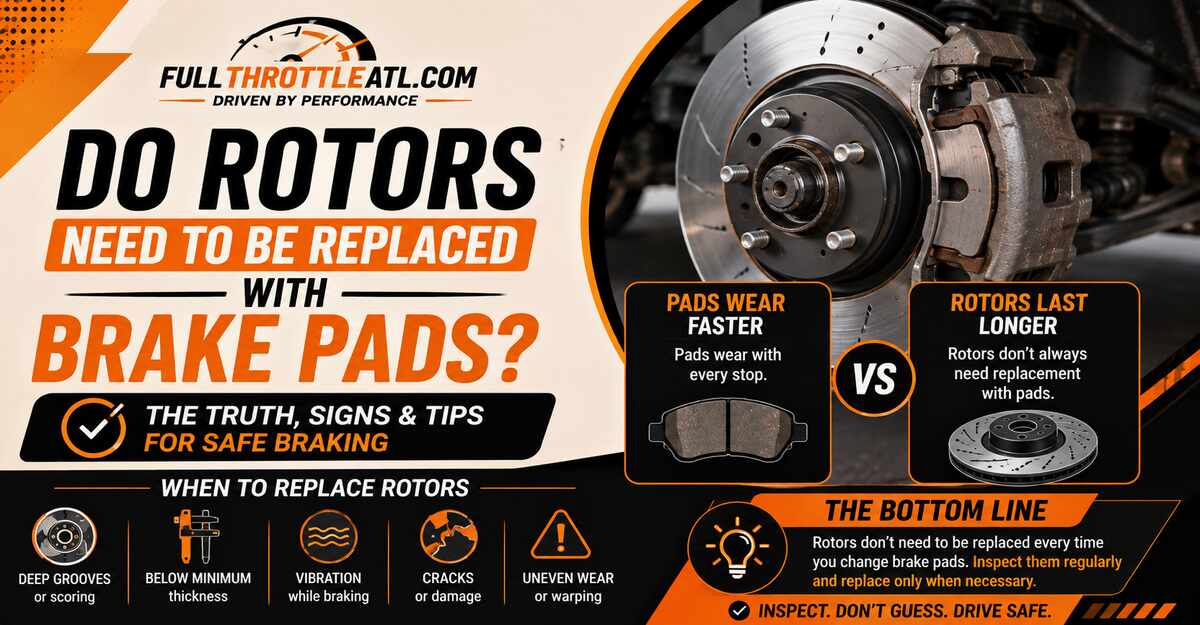
Brake rotors do not automatically need to be replaced when changing brake pads. If the existing rotor meets the manufacturer’s minimum thickness specification, exhibits no lateral runout (warping), and has a smooth surface free of deep grooves, you can safely install new brake pads onto the old rotors. However, severely worn, rusted, or heat-damaged rotors require immediate replacement or professional resurfacing.
Key Facts / At a Glance
- Replacement Threshold: Rotors must be replaced if worn below the “Minimum Thickness” (Discard Spec) stamped on the hub, typically after 60,000 to 100,000 miles.
- The “Pad Slap”: Installing new pads on deeply grooved rotors reduces stopping power by up to 30% and causes premature pad wear.
- Resurfacing Limits: Machining a rotor costs $20 to $45, but modern OEM rotors are often too thin to legally resurface.
- Warping Tolerance: Lateral runout exceeding 0.002 inches (0.05 mm) will cause steering wheel vibration and requires rotor replacement.
- Pad Minimums: Brake pads require replacement when the friction material reaches 3 mm (1/8 inch) thick.
When Must You Replace Rotors with Brake Pads?
You must replace brake rotors with your brake pads if the iron discs fail any of three strict mechanical tolerances: minimum thickness, surface flatness, or lateral runout. A visual inspection alone is insufficient; verifying these metrics requires physical measurement.
1. The Minimum Thickness Specification (Discard Spec)
Every brake rotor has a manufacturer-mandated minimum thickness, usually cast or stamped directly into the central hub (e.g., “MIN THK 22.0mm”). As the brake pads clamp against the spinning rotor, friction slowly shaves microscopic layers of iron off the disc. If a rotor is measured with a micrometer and falls below this number, it lacks the thermal mass to safely dissipate heat. Undersized rotors will rapidly overheat the brake fluid, leading to sudden hydraulic failure and a soft brake pedal during emergency stops.
2. Deep Grooving and Surface Scoring
Rotors should have a smooth, flat face to maximize contact with the brake pad. Over time, debris, metallic pad compounds, or fully depleted pads (metal-on-metal grinding) will carve deep concentric grooves into the iron. Use the “fingernail test”: drag your fingernail outward from the center of the rotor. If your nail catches heavily on ridges or a deep outer lip, the rotor is too scored to reuse. New flat pads placed on grooved rotors will only contact the high spots, severely reducing your braking capability.
3. Lateral Runout and Warped Rotors
Lateral runout refers to the side-to-side wobble of a spinning rotor. When rotors are subjected to excessive heat from aggressive braking, the iron can distort, or uneven layers of brake pad material can bake onto the surface (cementite buildup). If a dial indicator shows runout exceeding 0.05 mm (0.002 inches), the rotor will violently kick the brake pads back and forth. This translates to severe pedal pulsation and steering wheel shaking when braking at highway speeds.
Can You Just Put New Brake Pads on Old Rotors?
Yes, you can safely put new brake pads on old rotors, provided the rotors pass the thickness and flatness inspections outlined above. This practice is colloquially known as a “pad slap.”
However, doing this successfully requires a mandatory “bed-in” procedure. Brake pads don’t just rely on abrasive friction; they deposit a microscopic transfer layer of friction material onto the rotor. When you install new pads, they must overwrite the old transfer layer. To do this, perform 5 to 7 aggressive decelerations from 40 mph down to 10 mph without coming to a complete stop. This mates the new pads to the old iron. Skipping this step often results in high-pitched squealing and glazed brake pads.
Resurfacing vs. Replacing Brake Rotors
Resurfacing (or “turning”) a rotor means mounting it on a specialized lathe and shaving off a microscopic layer of iron to create a perfectly flat, fresh surface. Replacing means discarding the old disc and mounting a factory-new unit.
| Criteria | Resurfacing (Turning) Old Rotors | Replacing with New Rotors |
|---|---|---|
| Definition | Machining a thin layer off the rotor face to restore a flat surface. | Removing the old disc entirely and installing a brand-new factory unit. |
| Financial Cost | $20 to $45 per rotor at a local machine shop. | $60 to $200 per standard rotor, plus labor if applicable. |
| Structural Impact | Thins the rotor, reducing its total heat capacity and mass. | Provides maximum safety margin and optimal heat dissipation. |
| Future Risk | Thinner metal is highly prone to future warping and heat damage. | Zero old-stress metal; guaranteed factory flat surface. |
| Best Used For | Thick, lightly grooved rotors on heavy-duty trucks or older vehicles. | Warped, thin, rusted rotors, or modern lightweight economy cars. |
The Expert Verdict: While resurfacing saves money upfront, many modern vehicle manufacturers utilize lightweight, high-carbon rotors built very close to their discard specifications to save weight and improve fuel economy. Once these rotors develop a lip, machining them often pushes them below the legal minimum thickness. For modern daily drivers, replacing the rotor is usually safer and more cost-effective long-term.
How Do Pad and Rotor Materials Dictate Replacement?
The materials on your vehicle determine how aggressively the rotors wear down. Different brake setups alter the lifespan expectations of both components.
- Ceramic Pads on Blank Rotors: Made from ceramic fibers and copper, these pads are incredibly gentle on smooth iron rotors. If you run ceramic pads, your rotors will typically survive through two complete sets of pads (up to 100,000 miles) before needing replacement.
- Semi-Metallic Pads on Slotted Rotors: Composed of 30% to 65% steel and iron, semi-metallic pads offer massive stopping power for towing, but they act like sandpaper on the rotor. Paired with slotted rotors (which scrape away dust), semi-metallic pads often wear out the rotor at the exact same rate they wear themselves out, requiring a simultaneous replacement.
- Electric Vehicles (EVs) and Hybrids: Because EVs rely heavily on regenerative engine braking, the physical brake pads and rotors are rarely used. In these vehicles, rotors almost never wear thin; instead, they fail due to severe rust and corrosion on the inner hub faces and must be replaced to pass safety inspections, regardless of thickness.
What Are the Critical Measurements and Replacement Costs?
Brake replacement costs scale significantly based on whether you attempt the job yourself or hire a professional shop, as well as the axle type (front brakes do 70% of the stopping and wear faster).
Typical Professional Costs (Per Axle):
- Brake Pads Only: $30 to $100 for parts, plus $100 to $200 for 1 to 1.5 hours of labor.
- Pads and New Rotors: $90 to $300 for parts, plus $150 to $300 for 1.5 to 2.5 hours of labor.
Critical Measurement Tools: If you are inspecting these yourself, do not use a standard caliper to measure rotor thickness. The outer rust lip will prevent the caliper from reaching the inner friction surface. You must use a specialized brake rotor micrometer. To check lateral runout, secure a magnetic base dial indicator to the steering knuckle and rotate the hub manually.
How to Tell if Your Rotors Are Bad Without Taking the Wheel Off
You can diagnose failing rotors through tactile feedback and audible warnings while driving.
- Steering Wheel Vibration: If the steering wheel shakes aggressively only when you press the brake pedal at highway speeds, your front rotors are warped (excessive lateral runout).
- Brake Pedal Pulsation: If the steering wheel is steady, but the brake pedal kicks back against your foot rhythmically, your rear rotors are warped or possess uneven pad deposits.
- Deep Metallic Grinding: If braking sounds like metal dragging on concrete, the friction material on your pad has fully disintegrated. The steel backing plate is cutting directly into the rotor face. Both components are destroyed and require immediate replacement.
- High-Pitched Squealing: This is usually the mechanical wear indicator (a small metal tab on the pad) lightly scraping the rotor to tell you pad life is at 3mm. If addressed immediately, the rotors might still be saved.
Frequently Asked Questions (FAQ)
How long do brake rotors typically last? Brake rotors typically last between 60,000 and 100,000 miles (96,000 to 160,000 km) under normal driving conditions. Their lifespan depends heavily on your driving style, the vehicle’s weight, and whether you use gentle ceramic pads or aggressive semi-metallic pads.
Can I replace rotors on just one side of the car? No, you must always replace brake rotors and pads in pairs across a single axle (both front wheels, or both rear wheels). Replacing only one side creates a severe friction imbalance, causing the vehicle to pull violently to one side during hard braking.
Do new rotors come with brake pads? New rotors do not automatically come with brake pads unless you specifically purchase an “axle brake kit.” Rotors and pads are usually sold as separate line items because owners frequently choose different brands or material compounds for each component.
Should I clean new brake rotors before installing them? Yes, you must thoroughly clean new rotors with aerosol brake cleaner before installation. Manufacturers coat blank iron rotors in a protective shipping oil to prevent rust in the warehouse. If this oil is not stripped off, it will permanently contaminate and ruin your new brake pads.
What happens if I ignore a deeply grooved rotor? Ignoring a grooved rotor drastically increases your stopping distance. Because the new flat pad cannot contact the recessed valleys of the grooved iron, friction is concentrated only on the high ridges, causing the pad to overheat, glaze over, and lose its stopping capability.