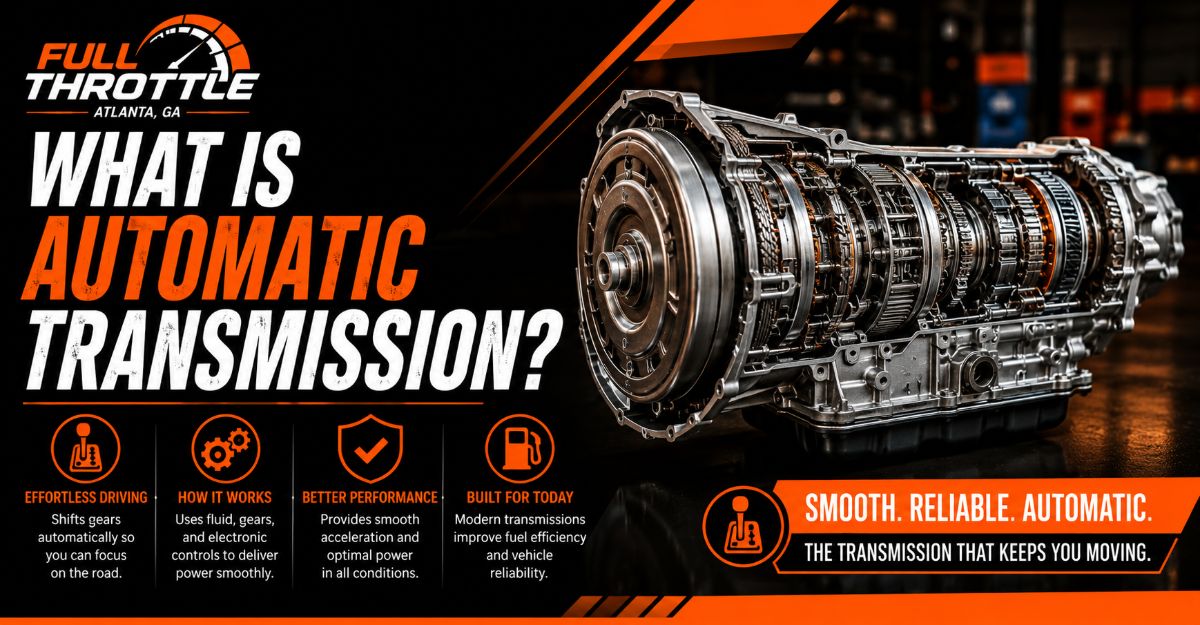
An automatic transmission is an automated multi-speed vehicle gearbox that changes gear ratios as the vehicle moves, eliminating the need for a manual clutch pedal or manual gear lever adjustments. It uses hydraulic pressure, a torque converter, and planetary gearsets to match engine speed to vehicle velocity seamlessly.
At a Glance
- Core Function: Automatically alters engine-to-wheel torque ratios using internal hydraulic pressure and computer modules.
- Key Mechanism: Uses a fluid-filled torque converter instead of a mechanical foot clutch to decouple the engine at idle.
- Dominant Designs: Modern automatics range from 6 to 10 speeds, led by systems like the ZF 8HP and Ford/GM 10R80.
- Thermal Limit: Optimal operating fluid temperature is 79°C to 93°C (175°F to 200°F); heat above 105°C (220°F) rapidly destroys fluid.
- Maintenance Metric: Real-world fluid service is required every 80,000 to 120,000 km (50,000 to 75,000 miles) despite “lifetime” claims.
How Does an Automatic Transmission Work Step-by-Step?
An automatic transmission works by transferring mechanical rotational power from the engine flywheel through a fluid coupling to internal gearsets that select appropriate drive ratios based on speed and engine load.
[ Engine Crankshaft ] ➔ [ Torque Converter (Fluid Coupling) ] ➔ [ Hydraulic Pump / Valve Body ] ➔ [ Planetary Gearsets & Clutches ] ➔ [ Drive Shaft / Wheels ]
- Torque Transfer: The engine crankshaft spins the impeller inside the torque converter, pressurizing transmission fluid to turn the turbine shaft.
- Hydraulic Pressurization: An internal oil pump pressurizes transmission fluid between 100 and 300 PSI, routing it through the hydraulic valve body.
- Electronic Control: The Transmission Control Module (TCM) monitors vehicle speed, throttle position, and engine RPM to trigger specific solenoid valves.
- Clutch Engagement: High-pressure fluid clamps multi-plate clutch packs, locking or unlocking specific members of the planetary gearsets.
- Ratio Output: The resulting rotation passes through the output shaft to drive the vehicle’s differential and drive wheels.
What Is the Role of the Torque Converter in an Automatic Transmission?
The torque converter acts as a fluid coupling that connects the engine to the transmission inputs, allowing the engine to idle while the vehicle is stopped in gear.
Inside the torque converter housing, an engine-driven impeller throws hydraulic fluid against a turbine attached to the transmission input shaft. A central stator redirects returning fluid back to the impeller to multiply torque during hard acceleration. At highway speeds above 32 to 48 km/h (20 to 30 mph), an internal lockup clutch mechanically clamps the impeller and turbine together. This lockup creates a direct 1:1 mechanical connection, eliminating fluid slippage and reducing fuel consumption.
How Do Planetary Gearsets Achieve Multiple Gear Ratios?
Planetary gearsets produce different gear ratios within a single compact shaft assembly by holding one component stationary while driving another.
A standard planetary gearset consists of three central components: a central sun gear, multiple planet gears mounted on a rotating carrier, and an outer ring gear. By applying hydraulic pressure to internal clutch packs and brake bands, the transmission control system holds one component fixed (such as the sun gear) while driving another (such as the planet carrier).
| Locked Component | Input Component | Output Component | Resulting Drive Ratio |
| Ring Gear | Sun Gear | Planet Carrier | Low Gear (High Torque / Underdrive) |
| Sun Gear | Planet Carrier | Ring Gear | High Gear (Overdrive / High Speed) |
| Planet Carrier | Sun Gear | Ring Gear | Reverse Rotation |
| None (All Free) | Engine Input | None | Neutral (No Power Transfer) |
What Are the Main Types of Automatic Transmissions?
The four main types of automatic transmissions are traditional torque-converter automatics, continuously variable transmissions (CVT), dual-clutch transmissions (DCT), and automated manual transmissions (AMT).
- Torque-Converter Automatics (Hydramatic/Planetary): The industry standard for heavy loads and smooth shifting. Uses fluid couplings and planetary gears (e.g., ZF 8HP 8-speed, GM/Ford 10R80 10-speed).
- Continuously Variable Transmissions (CVT): Uses a steel belt riding between two variable-diameter cone pulleys instead of fixed gears. Offers infinite ratio adjustments for optimized fuel efficiency in commuter cars like the Honda Civic and Nissan Altima.
- Dual-Clutch Transmissions (DCT / DSG): Features two separate mechanical gear shafts—one for odd gears (1, 3, 5) and one for even gears (2, 4, 6)—each controlled by its own clutch. Enables ultra-fast shifts under 10 milliseconds in performance vehicles like Porsche (PDK) and Volkswagen (DSG).
- Automated Manual Transmissions (AMT): A traditional manual gearbox where an electromechanical actuator operates the clutch and gear forks. Found primarily in budget entry-level cars and commercial semi-trucks.
How Does a Traditional Automatic Differ from a CVT and a DCT?
Traditional automatics rely on fluid torque converters for seamless torque transfer, CVTs use continuous pulley adjustments for steady engine RPM, and DCTs use dual mechanical clutches for rapid gear changes.
| Feature | Torque-Converter Automatic | Continuously Variable (CVT) | Dual-Clutch (DCT) |
| Primary Coupling | Fluid Torque Converter | Torque Converter or Dampener | Dual Wet/Dry Mechanical Clutches |
| Internal Mechanism | Planetary Gearsets | Pulley & Steel Belt | Parallel Manual-Style Shafts |
| Shift Speed | Moderate (100–300 ms) | Seamless (No discrete shifts) | Extremely Fast (8–50 ms) |
| Towing Capacity | High (Up to 14,000+ lbs) | Low (Generally under 1,500 lbs) | Moderate |
| Best For | Trucks, SUVs, Luxury Cars | Economy Commuter Cars | Sports & Performance Cars |
What Is the Normal Operating Temperature for Automatic Transmission Fluid?
The optimal operating temperature for automatic transmission fluid (ATF) is between 79°C and 93°C (175°F to 200°F).
Operating within this thermal range maintains appropriate fluid viscosity and protects internal rubber seals. If severe driving conditions—such as heavy towing or steep mountain climbing—cause fluid temperatures to exceed 105°C (220°F), the fluid begins to oxidize rapidly. For every 11°C (20°F) rise above 105°C, the usable lifespan of the fluid is reduced by 50%. Thermal breakdown leads to varnish deposits on valve bodies, hardening of internal seals, and friction plate burning.
Should You Flush or Drain and Fill High-Mileage Transmission Fluid?
You should perform a gentle “drain and fill” rather than a high-pressure flush if an automatic transmission has exceeded 150,000 kilometers (90,000 miles) without prior maintenance.
[ High-Mileage Neglected ATF ] ➔ Contains Suspended Clutch Friction Particles
         │
         ├──► High-Pressure Flush ➔ Washes Away Suspended Grit ➔ Clutches Slip Immediately
         │
         └──► Drain & Fill (Low Pressure) ➔ Retains Partial Friction Base ➔ Safe Fresh Fluid Mix
In neglected, high-mileage transmissions, worn clutch friction material becomes suspended directly in the old transmission fluid. A mechanical high-pressure flush forces high-velocity fluid through delicate internal passages, washing away this grit and clearing out sludge that may be keeping worn seals tight. Without these suspended friction particles, worn clutch plates lose their ability to grip, causing the transmission to slip immediately after service. A gravity drain-and-fill replaces only 40% to 60% of the fluid capacity at low pressure, keeping enough friction material in circulation to maintain clutch grip.
Is Automatic Transmission Fluid Truly “Filled for Life”?
Automatic transmission fluid is not “filled for life” for vehicle owners aiming to keep their vehicles beyond the manufacturer warranty period.
Automakers classify fluid as “lifetime” to reduce advertised ownership costs over standard 5-year or 100,000-mile warranty intervals. Independent transmission manufacturers—such as ZF, which manufactures the 8HP transmission used by BMW, Audi, and Stellantis—contradict vehicle brand guidelines by recommending fluid and filter replacement every 80,000 to 120,000 kilometers (50,000 to 75,000 miles). Over time, heat cycles break down fluid viscosity and deplete anti-wear additives, accumulating metallic wear particles that damage the hydraulic valve body.
Does Coasting in Neutral Actually Save Fuel in an Automatic Car?
Coasting downhill in Neutral (N) does not save fuel in modern fuel-injected automatic vehicles and increases mechanical wear.
When coasting in Drive (D) down a hill, modern engine computers activate Deceleration Fuel Cut-Off (DFCO). The vehicle’s forward momentum turns the wheels, driving the transmission and engine, allowing the ECU to turn off fuel injection entirely. In contrast, shifting into Neutral disconnects the wheels from the engine, forcing the engine to burn fuel at idle (typically 0.2 to 0.5 gallons per hour) to avoid stalling. Furthermore, re-engaging Drive at high vehicle speeds subjects internal clutch packs to sudden hydraulic shock loads.
Why Does an Automatic Car Roll Backward on a Steep Hill?
An automatic car rolls backward on a steep hill when gravitational pull on the vehicle exceeds the forward torque generated by the torque converter at engine idle speed.
At idle (around 600 to 800 RPM), the torque converter’s internal impeller generates minimal fluid pressure. On steep inclines, the gravitational force pushing the car downhill is greater than this low-level hydraulic force. To prevent rollback without raising engine idle speeds, modern vehicles use electronic Hill Start Assist (HSA). HSA maintains brake line pressure for 2 to 3 seconds after the driver releases the brake pedal, holding the vehicle until the accelerator is depressed.
What Do the Low Gear Shift Options (L, 2, M) Do on an Automatic Shifter?
Low gear shift options (marked as L, 2, 1, or M on automatic shifters) lock the transmission into lower gear ratios, preventing it from upshifting into higher overdrive gears.
- “L” or “1” (Low Gear): Locks the transmission strictly in 1st gear. Provides maximum engine torque for pulling heavy loads out of mud or snow and delivers strong engine braking down steep mountain roads.
- “2” (Second Gear): Locks the transmission into 2nd gear or restricts upshifts beyond 2nd. Useful for starting on slippery ice to limit wheelspin or maintaining speed on moderate slopes.
- “M” (Manual Mode): Gives the driver sequential control over gear shifts via paddle shifters or gear lever taps (+/-), while internal safety overrides prevent engine over-revving.
Is It Safe to Shift from Drive to Reverse While Moving Slowly?
Shifting an automatic transmission from Drive to Reverse while the vehicle is still in motion causes severe mechanical damage to internal clutches and the parking pawl.
If a vehicle is moving, its internal transmission shafts are spinning under vehicle momentum. Shifting into Reverse before reaching a complete stop forces internal friction clutches or reverse brake bands to arrest the vehicle’s kinetic energy—a job designed exclusively for the braking system. Doing this repeatedly shears off clutch material, overheats the fluid, and can snap the steel parking pawl inside the gear housing.
What Are the Early Symptoms of Automatic Transmission Failure?
The early symptoms of automatic transmission failure include delayed gear engagement, erratic shifting, high-RPM slipping, and fluid leaks beneath the vehicle.
- Delayed Engagement: A 2-to-4 second pause between moving the shifter into Drive or Reverse and feeling the gear engage, caused by low fluid pressure or worn seals.
- Transmission Slipping: The engine RPM spikes sharply during acceleration, but the vehicle fails to gain speed proportionally, indicating worn clutch friction plates.
- Harsh or Jerky Shifts: Loud clunking or abrupt jolts during gear changes, pointing to sticking solenoid valves inside the hydraulic valve body.
- Burnt Fluid Odor: Transmission fluid that appears dark brown or black with a distinct burnt smell, signaling severe internal thermal breakdown.
How Long Does an Automatic Transmission Last and What Does Replacement Cost?
A well-maintained automatic transmission typically lasts between 240,000 and 320,000 kilometers (150,000 to 200,000 miles), while total replacement costs range from $2,500 to $6,500 depending on vehicle make and component type.
| Replacement Option | Average Total Cost (Parts + Labor) | Best Suited For |
| Used / Junkyard Unit | $1,200 – $2,200 | Older vehicles near end-of-life |
| Rebuilt Transmission | $2,500 – $4,200 | Out-of-warranty daily drivers |
| Remanufactured (OEM) | $4,000 – $6,500+ | Luxury models, heavy trucks, newer cars |
The Bottom Line
An automatic transmission relies on fluid dynamics and computer-controlled planetary gearsets to select gear ratios without manual driver input. Prolonging its operational lifespan requires maintaining fluid temperatures below 93°C (200°F) and servicing fluid every 80,000 to 120,000 kilometers regardless of manufacturer “lifetime” marketing claims. For high-mileage vehicles with neglected fluid history, always choose a gentle low-pressure drain and fill over a high-pressure flush to avoid sudden clutch slipping.