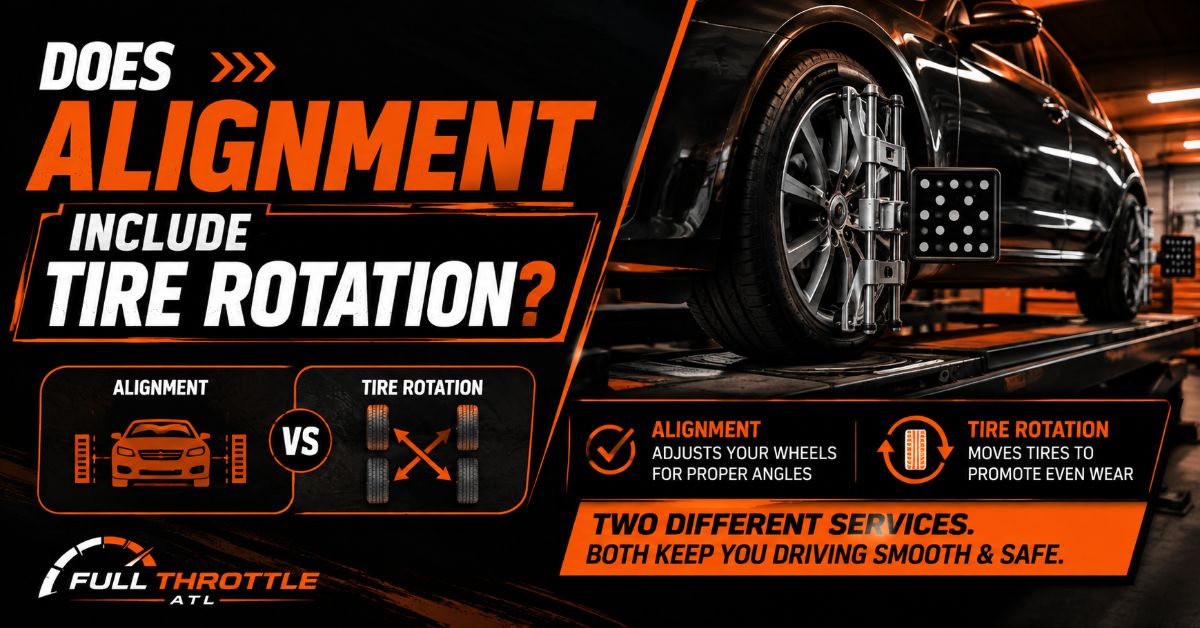
A standard wheel alignment does not include a tire rotation. They are two distinct mechanical services targeting different vehicle components. Alignment adjusts suspension angles to ensure wheels are perpendicular to the ground and parallel to each other. Tire rotation physically changes the position of wheels on the vehicle to equalize tread wear. Auto repair facilities bill them separately unless sold within a combined maintenance bundle.
At a Glance
- Standard Policy: Wheel alignments and tire rotations are separate services billed as distinct line items.
- Alignment Function: Adjusts suspension geometry (camber, caster, toe) to fix vehicle pulling and uneven tire wear.
- Rotation Function: Moves wheels between axles or sides to balance physical tread depth reduction over time.
- Average Costs: Wheel alignments cost $100 to $200; tire rotations cost $20 to $50 (frequently free with new tire purchases).
- Service Order: When performed concurrently, technicians rotate the tires before calibrating suspension alignment.
What Is the Mechanical Difference Between an Alignment and a Rotation?
A wheel alignment recalibrates the angles of your vehicle’s suspension components, whereas a tire rotation repositioning the physical wheels across the vehicle’s hubs.
                                VEHICLE SERVICE COMPARISON
┌─────────────────────────┬───────────────────────────────────┬───────────────────────────────────┐
│ Feature                 │ Wheel Alignment                   │ Tire Rotation                     │
├─────────────────────────┼───────────────────────────────────┼───────────────────────────────────┤
│ Target Component        │ Suspension linkage (tie rods, etc.)│ Wheels and tires                  │
│ Primary Goal            │ Correct vehicle direction & angles│ Equalize tread wear rates         │
│ Measurable Variables    │ Camber, Caster, Toe               │ Tread Depth (32nds of an inch)    |
│ Standard Duration       │ 45 to 60 minutes                  │ 15 to 20 minutes                  │
│ Average Service Cost    │ $100 – $200                       │ $20 – $50 (often bundled/free)    │
└─────────────────────────┴───────────────────────────────────┴───────────────────────────────────┘
An alignment modifies three primary angles on the suspension system:
- Camber: The tilt of the tire inward or outward when viewed from the front of the vehicle.
- Caster: The angle of the steering pivot when viewed from the side, which dictates straight-line stability.
- Toe: The degree to which the tires point inward or outward relative to each other when viewed from above.
A tire rotation leaves suspension settings unchanged. Instead, the technician unbolts the wheel assemblies and relocates them—such as moving front tires to the rear axle or switching side-to-side—to balance the different wear stresses experienced by drive-axle versus non-drive-axle positions.
How Do Alignment and Tire Rotation Costs, Time, and Schedules Compare?
A standard wheel alignment costs between $100 and $200 and takes 45 to 60 minutes to complete. A tire rotation typically costs between $20 and $50, taking 15 to 20 minutes. Auto shops frequently offer free tire rotations if the tires were originally purchased from their location.
                             SERVICE FREQUENCY AND COST TIMELINE
  Tire Rotation ($20-$50)                                       Tire Rotation ($20-$50)
  (15-20 minutes)                                               (15-20 minutes)
   │                                                             │
───┴─────────────────────────────────────────────────────────────┴───────────────────────────►
   0 Miles                           5,000–7,500 Miles                          10,000–12,000 Miles
                                                                                 │
                                                                                Wheel Alignment ($100-$200)
                                                                                (45-60 minutes)
Manufacturers recommend rotating tires every 5,000 to 7,500 miles. Because drive axles, steering forces, and engine weight put unequal stress on front tires, frequent rotation ensures all four tires wear down at equal rates.
Wheel alignments operate on a longer schedule, typically recommended every 10,000 to 12,000 miles or once a year. However, immediate alignments are necessary if the vehicle strikes a major road obstacle, gets involved in a collision, or shows symptoms like steering wheel off-center errors or vehicle pulling.
Do Shops Ever Bundle Wheel Alignments and Tire Rotations Together?
Yes, national service chains and dealership service departments regularly bundle wheel alignments and tire rotations inside routine maintenance packages. While technically distinct operations, shops package them together under names like “Comprehensive Steering & Suspension Care” or “Lifetime Alignment Plans” to streamline maintenance visits.
When purchasing a lifetime alignment plan (usually priced between $180 and $300), shops frequently perform a complimentary tire rotation alongside the alignment every 6,000 miles. Always review your itemized invoice before authorizing service: if a quote lists only “Four-Wheel Alignment,” tire rotation is not automatically included unless explicitly stated as an add-on item or package feature.
Should You Do a Tire Rotation or an Alignment First?
When performing both services in a single shop visit, technicians must execute the tire rotation before placing the vehicle on the alignment rack. Rotating the tires first puts every wheel in its final operational position, allowing the technician to calibrate the suspension geometry around the actual tread depth variations and physical tire placement for that driving cycle.
If an alignment is calibrated first and the tires are subsequently rotated, minor differences in tread wear between front and rear tires can subtly alter the effective rolling radius and contact patch. This dynamic shift can result in the steering wheel sitting slightly off-center when driven out of the service bay.
How Do Staggered Fitments and Directional Tires Limit Rotations?
Vehicles equipped with directional tires or staggered wheel setups cannot follow traditional cross-pattern tire rotation procedures. These specialized configurations restrict how tires move around the vehicle, altering routine rotation methods.
- Directional Tread Patterns: Designed to rotate in only one direction to evacuate water effectively. They can only be rotated straight front-to-back on the same side of the vehicle. To cross-rotate directional tires side-to-side, a technician must physically unmount the rubber from the wheel rim, flip the tire direction, remount, and rebalance—incurring additional labor fees.
- Staggered Fitments: Performance vehicles (such as a BMW M3 or Chevrolet Corvette) feature wider wheels and tires on the rear axle than on the front axle. These tires cannot be rotated front-to-back. If the tires are non-directional, they can only be rotated side-to-side across the same axle.
- Staggered AND Directional: If a vehicle features both staggered wheel dimensions and directional tire treads, conventional rotation is impossible without dismounting the tires from the rims.
Do Modified Suspensions Alter Alignment and Rotation Rules?
Yes, vehicles with aftermarket lift kits, lowering springs, or altered control arms require custom alignment procedures and non-standard tire rotation patterns. Factory alignment specifications do not apply once suspension geometry is modified.
Lowered vehicles often introduce negative camber, causing accelerated wear on the inner tire shoulders. Lifted trucks change the steering knuckle angles and drive-axle angles, accelerating heel-toe tread wear. Technicians servicing modified suspensions must adjust custom camber bolts or adjustable control arms to stabilize the contact patch. Rotation schedules on modified vehicles must often be shortened to every 3,000 to 4,000 miles to counter aggressive wear angles.
When Should You Replace Severely Damaged Tires Instead of Rotating Them?
Tires with severe “cupping,” “scalloping,” or deep diagonal feathering caused by prolonged misaligned suspension should be replaced rather than rotated to a new axle. Rotating heavily damaged tires spreads severe mechanical vibrations and stability issues across the vehicle.
                      TIRE CONDITION DECISION TREE

                 Are tread wear patterns irregular?
                                 │
                   ┌─────────────┴─────────────┐
                  YES                          NO
                   │                           │
     Is cupping/feathering severe?      Proceed with standard
                   │                    5,000-mile rotation
           ┌───────┴───────┐
          YES              NO
           │               │
  REPLACE TIRES;    Rotate tires & align
  Align suspension  suspension immediately
When a severely cupped tire is moved from a rear axle to a front steering axle, the irregular tread peaks create severe cabin noise, steering wheel shaking, and reduced braking contact. If the tread depth variation across a single tire exceeds 3/32nds of an inch or shows deep physical cupping, correct the underlying alignment failure and replace the damaged tires immediately.
Why Can Rotating Uneven Tires Damage an All-Wheel Drive (AWD) Drivetrain?
Rotating tires with significant tread depth differences on an All-Wheel Drive (AWD) vehicle can physically destroy the center differential or transfer case. AWD transfer cases rely on all four wheels spinning at identical rotational speeds.
If front tires have worn down to 4/32nds of an inch while rear tires remain at 8/32nds of an inch, the front tires have a smaller overall circumference and must spin faster to cover the same road distance. Moving these uneven tires across axles during a rotation forces the transfer case viscous coupling or clutch packs to constantly slip to accommodate the speed differential. Most AWD manufacturers (such as Subaru, Audi, and BMW) specify that tread depth across all four tires must remain within 2/32nds of an inch of each other to prevent mechanical failure.
Do You Need an Alignment After Buying New Tires?
Yes, getting an alignment when installing new tires is highly recommended to protect your financial investment and secure warranty coverage. New tires do not mechanically alter suspension angles, but installing fresh rubber on a misaligned suspension will rapidly destroy the new tread.
Many tire manufacturers require proof of proper suspension alignment to honor treadwear mileage warranties. Aligning the vehicle alongside a new tire installation ensures the fresh rubber wears evenly from day one, maximizing tire longevity and vehicle fuel efficiency.
Why Does a Vehicle Pull to One Side After a Tire Rotation?
A vehicle pulling to one side immediately following a tire rotation is usually caused by a “radial pull,” not an alignment failure. A radial pull occurs when an individual tire develops a coned wear pattern from prolonged operation in its previous position on the vehicle.
When moved to a new corner, the coned shape forces the tire to roll at a slight angle, driving the vehicle toward the curb or centerline. If the vehicle drove straight prior to the tire rotation, the alignment geometry remains intact; the issue is localized to the wear pattern on that specific tire. Technicians diagnose radial pulls by swapping the two front tires side-to-side; if the pull direction reverses, the tire construction or wear pattern is confirmed as the root cause.
Can a Bad Alignment Cause Steering Wheel Vibration?
No, a bad wheel alignment rarely causes steering wheel vibration. Alignment misconfigurations cause the vehicle to pull to one side, produce an off-center steering wheel, or generate rapid tread wear, but they do not induce rotational shake.
Steering wheel vibration is almost exclusively caused by dynamic balance issues or structural defects in the wheel assembly:
- Unbalanced Wheel and Tire: Missing wheel weights create an uneven distribution of mass that oscillates at high speeds.
- Bent Wheel Rim: Impact damage creates vertical or lateral runout that translates into steering vibration.
- Tire Separation or Flat Spotting: Internal belt failure or prolonged hard braking creates uneven tread height that shakes the vehicle cabin.
How to Inspect Your Tires for Alignment vs. Rotation Needs
You can identify whether your vehicle requires an alignment, a tire rotation, or both by conducting a physical and visual tread inspection using a standard tread depth gauge or a penny.
┌───────────────────────────┬───────────────────────────────┬───────────────────────────────┐
│ Visual / Physical Symptom │ Root Cause                    │ Corrective Action             │
├───────────────────────────┼───────────────────────────────┼───────────────────────────────┤
│ Smooth, uniform wear      │ Normal axle-weight imbalance  │ Tire Rotation                 │
│ across all 4 tires        │ over time                     │                               │
├───────────────────────────┼───────────────────────────────┼───────────────────────────────┤
│ Inner or outer edge       │ Incorrect Camber or Toe alignment angle       │ Wheel Alignment               │
│ wearing faster than center│                               │                               │
├───────────────────────────┼───────────────────────────────┼───────────────────────────────┤
│ Diagonal dips or "cups"   │ Worn shocks/struts or severe  │ Replace shock absorbers,      │
│ scooped out of tread      │ toe miscalibration            │ replace tires & align         │
└───────────────────────────┴───────────────────────────────┴───────────────────────────────┘
- Check Inner vs. Outer Edge Wear: Run your hand flat across the width of the tire tread. If the inner shoulder is worn smooth while the outer shoulder retains deep tread, the suspension has incorrect camber or toe settings—request an alignment.
- Measure Front-to-Rear Tread Depth Difference: Place a tread depth gauge in the center groove of each tire. If the front tires measure 5/32nds of an inch and the rear tires measure 8/32nds of an inch, the physical rubber is wearing unevenly across axles—request a tire rotation.
- Feel for Feathered Edges: Slide your fingers along the block edges of the tread. If the tread blocks feel sharp in one direction and smooth in the other (like saw teeth), the toe alignment angle is dragging the tire sideways down the road—request an alignment.
The Bottom Line
A wheel alignment adjusts suspension angles, while a tire rotation physically swaps wheel positions—making them separate services that auto repair shops bill individually. To maximize tire lifespan, rotate your tires every 5,000 to 7,500 miles and perform an alignment every 10,000 to 12,000 miles or whenever installing new tires. When performing both services together, always ensure the shop rotates the tires prior to calibrating the suspension alignment.