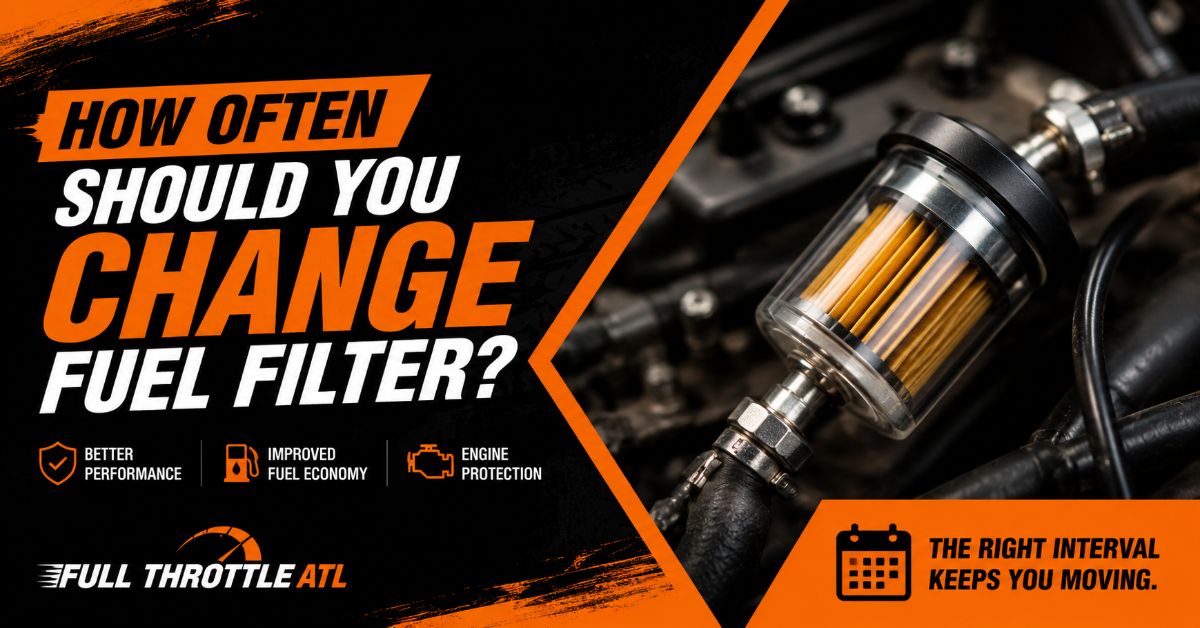
Most vehicle manufacturers recommend changing a gasoline fuel filter every 20,000 to 40,000 miles (32,000 to 64,000 km) or every 2 years, whichever comes first. However, this replacement interval varies drastically depending on your fuel type, vehicle age, and driving conditions. Modern vehicles with in-tank filters often extend this interval to 60,000 to 100,000 miles, while diesel engines require replacement every 10,000 to 20,000 miles.
At a Glance
- Gasoline Vehicles (Post-2005): Replace every 60,000 to 100,000 miles.
- Older Gasoline Vehicles (Pre-2005): Replace every 10,000 to 15,000 miles.
- Diesel Engines: Replace every 10,000 to 20,000 miles due to water and bacterial risks.
- E85 / Biofuel Users: Cut standard replacement intervals in half (every 10,000 to 15,000 miles).
- Severe Failure Mode: A fully blocked filter causes fuel pump overheating and engine stalling under load.
How Often Do You Change Fuel Filters on Older vs. Modern Cars?
Older vehicles built before 2005 require fuel filter replacement every 10,000 to 15,000 miles, whereas modern vehicles manufactured after 2005 require filter replacement every 60,000 to 100,000 miles.
Pre-2005 Vehicles  : [10,000 - 15,000 miles] -> External Inline Filter
Post-2005 Vehicles : [60,000 - 100,000 miles] -> Integrated In-Tank Module
This massive difference in maintenance frequency stems directly from engineering shifts in fuel system design:
- Pre-2005 Vehicles: Rely primarily on external inline fuel filters mounted along the frame rail or inside the engine bay. These filters catch larger surface particulates, feature smaller surface areas, and sit exposed to environment-induced debris, requiring frequent routine service.
- Post-2005 Vehicles: Integrate dense, pleated filter strainers directly into the fuel pump assembly inside the gas tank. These modules utilize synthetic media with significantly larger surface areas designed to trap sub-micron contaminants over extended operational lifespans.
How Often Should a Diesel Fuel Filter Be Replaced?
A diesel fuel filter must be replaced every 10,000 to 20,000 miles or at every second oil change. Diesel fuel maintenance intervals are strictly shorter than gasoline intervals because diesel fuel actively absorbs atmospheric water and fosters microbial growth inside storage tanks.
Unlike gasoline systems, diesel engines rely on a two-stage filtration system: a primary filter that separates water from the fuel and a secondary filter that removes fine particulate matter down to 2–5 microns.
Critical Warning: If water bypasses a neglected diesel fuel filter, it causes severe corrosion, destroys high-pressure common rail (HPCR) fuel injectors, and causes precision fuel pump seizure—repairs that frequently exceed $4,000 in mechanical damage.
How Does E85 or Biofuel Affect Fuel Filter Replacement Intervals?
Using E85 flex-fuel or biodiesel requires shortening your fuel filter replacement interval by 50%, servicing the filter every 10,000 to 15,000 miles.
Ethanol and biodiesel act as powerful chemical solvents inside your fuel system. When you switch to high-ethanol blends, the alcohol strips accumulated varnish, gum, and rust scale off the inner walls of older fuel tanks and lines. This dissolved debris flows directly downstream, clogging a clean filter membrane within just a few thousand miles of switching fuel types.
What Is a “Lifetime” Fuel Filter and Do You Ever Need to Change It?
A “lifetime” fuel filter is an integrated in-tank filter designed to last the duration of the vehicle’s factory warranty—typically 100,000 miles or 10 years—but it is not a permanent component that lasts forever.
Automakers classify in-tank filters as non-serviceable items because servicing them requires dropping the fuel tank or accessing the fuel pump through the rear seat floor. However, if you plan to operate a vehicle past 120,000 miles, these filters eventually accumulate fine sediment, restrict fuel volume to the engine, and must be replaced to prevent premature fuel pump failure.
How Can You Tell If Your Fuel Filter Is Clogged?
You can identify a clogged fuel filter by observing engine performance loss under high fuel demand, such as hard acceleration, towing, or uphill driving.
Look for these five specific diagnostic symptoms:
- Engine Sputtering Under Acceleration: The engine stumbles or cuts out when pushing the gas pedal because restricted fuel delivery starves the combustion chamber.
- Hard Starting or Long Cranking: The fuel system struggles to build adequate line pressure prior to ignition.
- Rough Idling That Clears at Higher RPM: The engine shakes violently at a stoplight due to uneven fuel flow through restricted line pressure.
- Loud Fuel Pump Whining: The electric pump in the gas tank emits a high-pitched hum or buzz while forcing fuel through a blocked filter.
- Sudden Drop in Fuel Economy: The engine control unit (ECU) compensates for pressure drops by forcing injectors to stay open longer, wasting fuel.
How Do Mechanics Test for a Clogged Fuel Filter?
Mechanics test for a clogged fuel filter by performing a fuel pressure test and a fuel volume flow test at the engine fuel rail using an inline pressure gauge.
Fuel Rail Gauge Connection --> Measure Static Pressure (PSI) --> Perform Volume Test (Pint / 30 sec)
To diagnose fuel restriction accurately:
- Check Static Pressure: Attach a fuel pressure gauge to the Schrader valve on the fuel rail. Turn the key on without starting the engine to verify if pressure meets manufacturer specifications (typically 35–65 PSI for gasoline engines).
- Check Dynamic Pressure Under Load: Rev the engine or place it under load. If fuel pressure drops dramatically as engine speed increases, a clogged fuel filter is preventing volume replenishment.
- Perform Volume Flow Test: Disconnect the fuel line into a graduated container and prime the pump for 30 seconds. A healthy system yields approximately 1 pint of fuel in 30 seconds. A clogged filter yields significantly less despite normal pressure readouts.
What Happens to Your Engine If You Never Change the Fuel Filter?
If you never change your fuel filter, the restricted flow forces the electric fuel pump to work at maximum load continuously, causing the pump motor to overheat and burn out prematurely.
Beyond ruining the fuel pump, a neglected fuel filter causes severe secondary engine damage:
| Component Damaged | Physical Mechanism of Failure | Estimated Repair Cost |
|---|---|---|
| Fuel Pump | Overheating due to lack of cooling fuel flow and excess backpressure | $400 – $1,200 |
| Fuel Injectors | Debris bypassing torn filter media clogs microscopic injector nozzles | $600 – $1,800 |
| Engine Pistons / Valves | Lean air-fuel mixture under load causes extreme cylinder temperatures and detonation | $2,500 – $6,000+ |
Can a Bad Batch of Gas Clog a Brand-New Fuel Filter Instantly?
Yes, pumping a single batch of severely contaminated gasoline or diesel can instantly clog a brand-new fuel filter, making mileage intervals entirely irrelevant.
Gas stations with aged underground storage tanks or stations that have recently received a tanker delivery often have suspended rust scale, water, and sediment in their fuel supplies. If this heavy debris enters your vehicle’s tank, it coats the microscopic pores of the filter membrane within miles of driving, causing immediate engine stalling and requiring an immediate filter replacement and tank flush.
Where Is the Fuel Filter Located on Most Vehicles?
A fuel filter is located either along the underbody frame rail, inside the engine compartment, or inside the gas tank attached to the fuel pump assembly.
[ Fuel Tank (In-Tank Filter) ] ---> [ Underbody Frame Rail ] ---> [ Engine Bay ]
- Underbody Frame Rail: Common on trucks and pre-2005 passenger cars. Mounted inline along the fuel supply pipe beneath the driver or passenger side floorboards.
- Engine Compartment: Common on diesel trucks and older Japanese imports. Mounted to the firewall or main engine bracket for easy top-side service.
- Inside the Fuel Tank: Standard on most modern vehicles (post-2005). Snapped directly onto the body of the plastic fuel pump reservoir module submerged inside the gas tank.
Can You Replace a Fuel Filter Yourself at Home?
You can replace an external inline fuel filter yourself using basic hand tools in under an hour, but you should leave in-tank fuel filter replacements to professional mechanics.
Replacing an external filter involves relieving fuel pressure, unscrewing two quick-connect or threaded fittings, and swapping the canister. Conversely, replacing an in-tank fuel filter requires removing the rear seats, unscrewing a pressurized locking ring, or dropping a dirty, heavy gas tank entirely from beneath the vehicle—a process involving significant fire hazards and specialized equipment.
What Safety Steps Prevent Fuel Spray During Fuel Filter Replacement?
To prevent high-pressure fuel spray during filter replacement, you must depressurize the fuel system before disconnecting any fuel line fittings.
Follow these four critical safety steps:
- Pull the Fuel Pump Fuse: Locate the main fuse panel and remove the electrical fuse or relay dedicated to the fuel pump.
- Depressurize the Lines: Start the engine and let it run at idle until it starves of fuel and dies on its own, then crank it for an additional 5 seconds.
- Disconnect the Battery: Disconnect the negative (-) battery terminal to eliminate any risk of electrical sparks near exposed fuel vapors.
- Wear Eye Protection & Wrap Fittings: Wear safety goggles and wrap a shop rag tightly around the filter connection while releasing the retention clip to catch residual line drips.
How Much Does Fuel Filter Replacement Cost?
Replacing a fuel filter costs between $50 and $500, depending primarily on whether the filter is mounted externally or built inside the fuel tank.
External Inline Filter : $15 - $50 (Parts) + $50 - $100 (Labor)  = $65 - $150 Total
In-Tank Filter Module  : $150 - $350 (Parts) + $150 - $300 (Labor) = $300 - $650 Total
- External Inline Filters: Parts cost $15 to $50, with labor adding $50 to $100 (total job cost: $65 to $150).
- In-Tank Fuel Filters: Parts cost $150 to $350 because the entire housing or pump module is usually replaced, with labor adding $150 to $300 due to extended tank-removal procedures (total job cost: $300 to $650).
Should You Replace the Fuel Pump When Changing an In-Tank Fuel Filter?
Yes, you should replace the fuel pump assembly when changing an in-tank fuel filter if your vehicle has more than 100,000 miles.
Because accessing an in-tank filter requires paying for 2 to 4 hours of labor to remove the fuel tank or pump module, replacing only the $40 filter element leaves an old, worn fuel pump motor in place. Installing a complete fuel pump assembly (which includes a new pump, filter, strainer, and pressure regulator) eliminates the risk of paying double labor costs if the pump fails shortly down the road.
The Bottom Line
Change your fuel filter every 20,000 to 40,000 miles for older vehicles, every 10,000 to 20,000 miles for diesel engines, and every 60,000 to 100,000 miles for modern gasoline vehicles with in-tank filters. Always cut these replacement intervals in half if you run E85 flex-fuel or regularly tow heavy loads. Never ignore symptoms like acceleration sputtering or fuel pump whining, as replacing a clogged $30 filter early prevents a $1,000 fuel pump repair later.