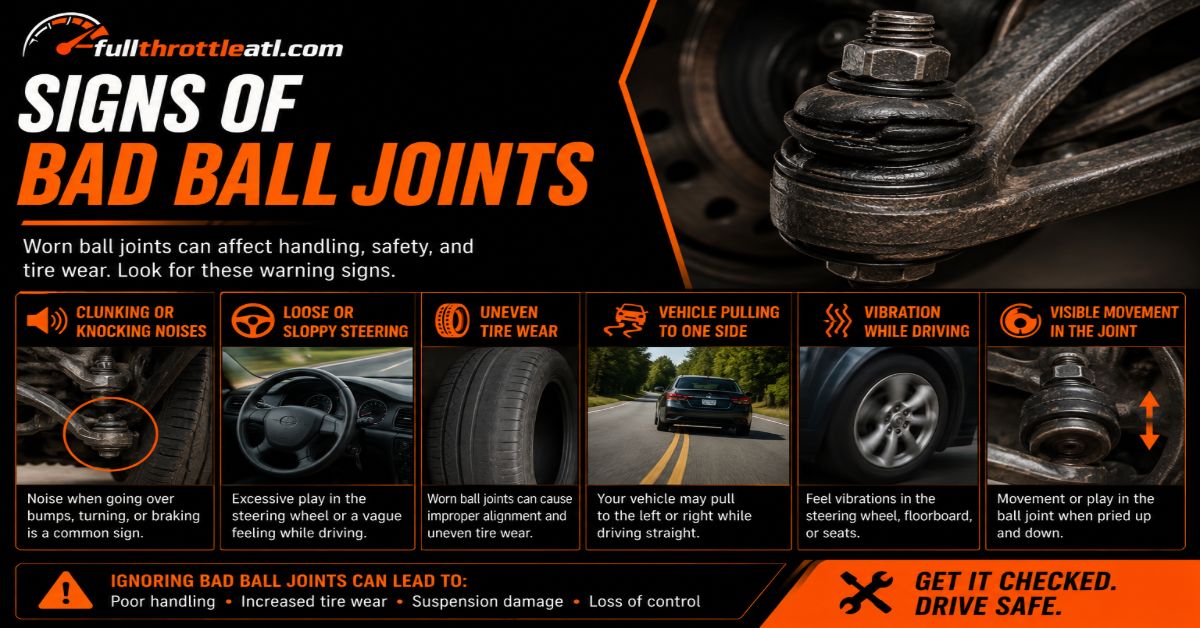
Bad ball joints typically manifest through uneven tire wear, metallic clunking noises, and loose or wandering steering. Ignoring these warning signs can lead to catastrophic suspension failure, where the wheel completely detaches from the vehicle while driving. Mechanics rely on precise physical measurements, specialized pry tests, and an understanding of suspension geometry to accurately diagnose component failure before it compromises vehicle safety.
At a Glance: Essential Facts About Ball Joints
- Permissible Play: The maximum allowable radial and axial play for most passenger vehicle ball joints is 0.5 mm to 1.5 mm (0.02 to 0.06 inches).
- Average Lifespan: Factory ball joints typically last 100,000 kilometers (approx. 60,000 to 80,000 miles) under normal driving conditions.
- Failure Consequences: A completely failed joint separates the control arm from the steering knuckle, causing an immediate loss of vehicle control.
- Replacement Rule: While replacement is technically done per side, mechanics strongly recommend changing ball joints in pairs to ensure even handling and alignment retention.
- Diagnostic Pitfall: Visually intact rubber grease boots do not guarantee internal component health, as internal Teflon and nylon races can wear out silently.
What Causes a Ball Joint to Fail Prematurely?
Ball joints fail prematurely when moisture, road salt, or debris breach the protective rubber grease boot, washing away vital lubrication and accelerating metal-on-metal friction. Driving heavily overloaded vehicles, hitting deep potholes at high speeds, or using unsealed aftermarket replacement parts without routine maintenance schedules drastically shortens component lifespan.
When the internal grease breaks down, intense friction causes the steel ball stud to wear down its socket housing. This creates internal slop and excessive play that eventually leads to joint separation. Inspecting grease boots during every oil change helps catch tears before internal contamination destroys the joint entirely.
What Is the Maximum Allowable Play in a Ball Joint?
The maximum allowable radial and axial play for most standard passenger vehicle ball joints is between 0.5 mm and 1.5 mm (0.02 to 0.06 inches). Any movement exceeding this specific measurement requires immediate replacement of the component to prevent safety hazards.
Mechanics use a dial indicator mounted directly to the control arm to measure this movement precisely. Axial play refers to vertical movement (up and down) along the stud axis, while radial play measures horizontal movement (side to side). If physical movement surpasses 1.5 mm during a loaded or unloaded suspension test, the internal socket has lost its structural integrity.
How Long Do Factory Ball Joints Last Under Normal Driving Conditions?
Factory ball joints last an average of 100,000 kilometers, which translates to approximately 60,000 to 80,000 miles under normal driving conditions. Frequent exposure to unpaved roads, aggressive driving styles, and harsh winter climates can cut this expected lifespan in half.
Because wear accumulates gradually over years of driving, many motorists fail to notice subtle steering changes until the component reaches a critical failure point. Scheduling routine suspension inspections starting at 50,000 miles helps catch early wear indicators before secondary suspension components suffer damage.
How Do You Properly Unload a Load-Carrying Ball Joint?
You must place a jack directly beneath the lower control arm to support the vehicle weight, or use suspension unloaders, depending on whether the joint is load-carrying or a follower. Many trucks and SUVs use a Short Long Arm suspension where the lower ball joint carries the vehicle weight.
If you test a load-carrying lower ball joint while the suspension hangs freely with a jack under the frame, the vehicle weight is off the joint, but spring tension can still bind the internal socket. Conversely, if you jack up the vehicle by the frame without supporting the control arm, the massive tension from the coil spring will push the joint tightly together, hiding severe play. Always consult factory service manuals to determine whether the suspension needs compression or extension during testing.
Why Does the 12 and 6 O’Clock Wheel Shake Test Give False Results?
The traditional 12 and 6 o’clock wheel shake test often produces false diagnoses on vehicles equipped with MacPherson strut suspensions because worn top strut mounts or loose wheel bearings mimic ball joint play. When a mechanic shakes the tire at the top and bottom, movement can originate from the upper strut bearing rather than the lower control arm.
To isolate an actual ball joint failure, a technician must look behind the wheel assembly while it is shaken or use a dial indicator to watch the control arm relative to the steering knuckle. Relying solely on the wheel shake test without visual confirmation at the joint itself frequently leads to replacing healthy parts while leaving the real problem unaddressed.
How Do You Perform the Pry Bar Test on a Lower Ball Joint?
You perform a proper pry bar test by inserting a sturdy pry bar between the lower control arm and the steering knuckle, applying gentle leverage to check for vertical or horizontal movement. If the stud moves up and down inside the socket beyond factory tolerances, the joint is worn out.
However, technicians must account for inverted ball joints found on modern performance vehicles, where the stud points downward. On inverted setups, gravity pulls the control arm away from the knuckle, meaning an upward pry bar test will hide the gap. Mechanics must pry downward on inverted configurations to accurately expose internal play.
What Is a “Silent” Ball Joint Failure and How Does It Happen?
A silent ball joint failure occurs when a torn grease boot allows moisture and road salt inside, rusting the steel ball and socket together instead of creating loose play. This severe corrosion creates extreme friction without producing the classic clicking or clunking noises associated with worn suspension parts.
Drivers experiencing a silent failure notice heavy, sticky steering that refuses to return to the center position after completing a turn. Because the joint does not rattle or feel loose during a standard shake test, inexperienced mechanics often overlook this dangerous condition until steering resistance causes a hazardous driving situation.
Can You Drive with a Bad Ball Joint?
You should not drive a vehicle with a bad ball joint because total component separation causes the wheel to instantly fold outward and results in a complete loss of steering control. If a ball joint makes loud metallic clunking noises over bumps, the vehicle must be towed directly to a repair facility rather than driven on public roads.
Continuing to drive with worn suspension components risks a catastrophic accident that damages fenders, brake lines, and axle shafts. Prioritizing immediate repair when initial symptoms appear protects both personal safety and overall repair expenses.
Do Ball Joints Need to Be Replaced in Pairs?
Technically, you can replace a single failed ball joint, but practically, mechanics strongly recommend replacing them in pairs across the same axle. Because both sides of the vehicle experience identical road miles and environmental exposure, the opposite ball joint is usually close to failure if one has already worn out.
Replacing ball joints in pairs saves money on labor costs because a mandatory four-wheel alignment is required after suspension service anyway. Doing both sides simultaneously restores balanced handling and prevents steering pull caused by uneven wear rates.
How Much Does It Cost to Replace a Ball Joint?
The cost to replace a ball joint ranges from 4,000 to 12,000 BDT for parts and 8,000 to 25,000 BDT for labor on standard sedans. For heavy-duty trucks or vehicles where the ball joint is permanently pressed into the control arm, total repairs can exceed 50,000 BDT per side because the entire control arm assembly must be replaced.
Labor rates fluctuate based on whether the ball joint is bolted, riveted, or press-fit into the control arm. Press-fit joints require specialized hydraulic press tools and extra workshop time, which increases the total bill compared to bolt-in designs.
Why Does a New Ball Joint Feel Incredibly Stiff Out of the Box?
A new high-quality ball joint feels incredibly stiff out of the box because it is manufactured with precise internal tolerances designed to ensure long-term durability. It requires significant leverage to move by hand during installation and will naturally break in over the first few hundred miles of driving.
Attempting to loosen a new ball joint by hand before installation is unnecessary and counterproductive. Once installed under vehicle weight, the joint achieves its optimal operating range of motion smoothly.
Does Adding Grease Fix a Noisy or Clicking Ball Joint?
Adding fresh grease to a greaseable aftermarket ball joint can temporarily quiet a loud metallic clunk, but it cannot restore lost metal or worn internal nylon sockets. Relying on grease as a permanent fix provides a false sense of security right up until the compromised joint snaps under load.
Grease only lubricates healthy internal surfaces; it cannot reverse mechanical wear or bridge gaps caused by metal fatigue. If a joint already makes noise, internal damage is present and replacement is the only safe solution.
The Bottom Line
Recognizing the signs of bad ball joints, including uneven tire wear, clunking noises, and loose steering, is critical for preventing catastrophic suspension failure on the road. Mechanics must utilize precise physical measurements under 1.5 mm, account for suspension load types, and avoid misleading diagnostic tests like the standard wheel shake. Promptly replacing worn components in pairs ensures safe vehicle handling, predictable steering response, and long-term mechanical reliability.