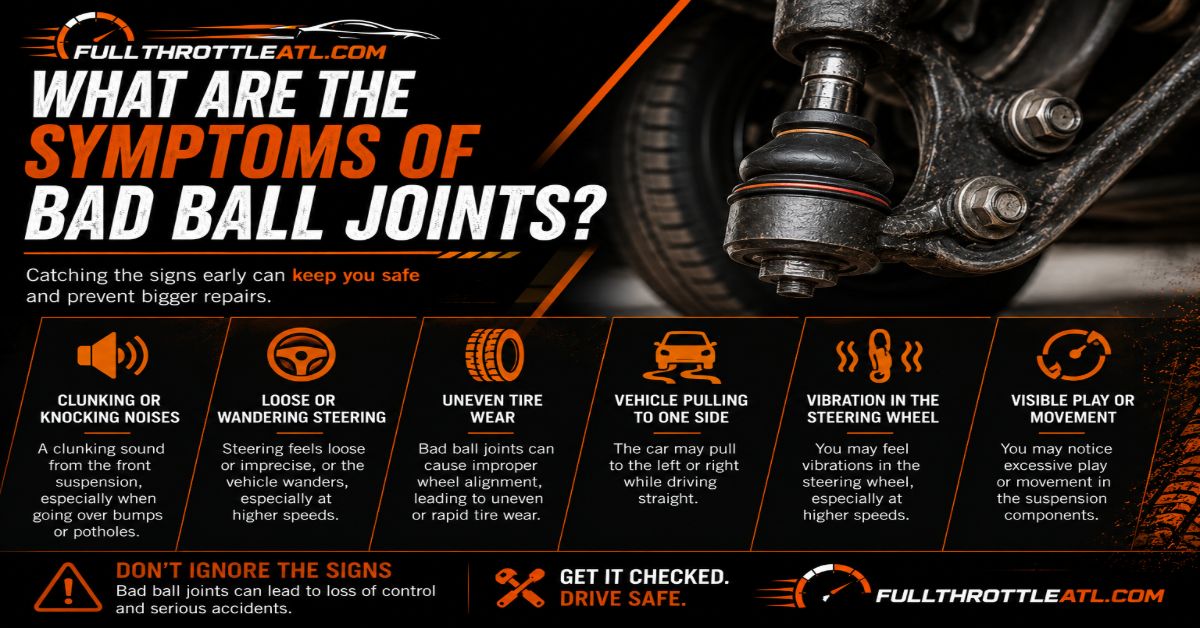
Bad ball joints typically cause metallic clunking noises, steering wander, and uneven tire wear. Because ball joints connect a vehicle steering knuckles to the control arms, their mechanical failure directly degrades both steering control and suspension alignment, posing a severe safety hazard if left unaddressed.
At a Glance
- Clunking Noises: Metallic pops or knocks occur over bumps or during turns as joint clearance exceeds allowable play.
- Steering Wander: The vehicle drifts left or right, requiring constant minor steering wheel corrections to stay straight.
- Uneven Tire Wear: Accelerated feathering or cupping destroys inner or outer tread edges within a few thousand miles.
- Steering Vibration: A loose wheel assembly creates distinct vibrations through the chassis at highway speeds.
- Diagnostic Traps: Loaded suspensions and frozen joints can hide severe mechanical wear during basic inspections.
What Causes Metallic Clunking Noises in the Suspension?
Drivers hear a distinct metallic clunking or knocking sound when a ball joint loses its internal structural integrity. This noise is generated when internal socket components strike each other as the vehicle passes over bumps, potholes, or executes tight turns.
The acoustic frequency of the noise changes as the vehicle ages. An occasional pop will escalate into a constant rattle when the internal clearance inside the joint socket exceeds 0.5 mm to 1.5 mm of allowable play. If you notice this noise intensifying during low speed turns into a driveway, the socket housing is likely experiencing metal on metal contact.
Why Does Steering Wander Happen with Worn Ball Joints?
Steering wander occurs because a loose ball joint allows the front wheel assembly to move independently of the steering linkage. This loose pivot point dynamically alters the vehicle toe alignment by 0.5 to 2.0 degrees during normal driving.
The driver must constantly make minor steering wheel corrections to keep the vehicle tracking straight down the road. This floating sensation often worsens when driving over uneven highway lanes or cresting hills where front end load shifts rapidly.
How Does Bad Ball Joint Alignment Cause Uneven Tire Wear?
Worn ball joints cause accelerated wear on either the inner or outer edges of front tires through severe camber misalignment. Severe ball joint play allows the top or bottom of the tire to tilt outward or inward, causing camber angles to deviate by 1 to 3 degrees out of factory specifications.
This incorrect angle places the entire vehicle weight onto a narrow strip of tread rubber. Consequently, this dynamic misalignment shortens tire lifespan by up to 50% to 70% and frequently produces a feathered or cupped wear pattern across the tire surface.
At What Speed Does Steering Wheel Vibration from Bad Ball Joints Occur?
Steering wheel vibration caused by bad ball joints typically intensifies at highway speeds between 80 km/h and 110 km/h. A loose or binding ball joint allows the entire front wheel assembly to resonate and vibrate independently of the vehicle frame.
Unlike tire balance issues that create a smooth, steady hum, ball joint vibrations often feel erratic and may worsen abruptly when passing over minor pavement seams at high speeds.
What Is a Frozen Ball Joint and Why Does It Trap Diagnosis?
A frozen ball joint occurs when rust or a lack of lubrication causes internal components to seize completely, resulting in 0.0 mm of play. This specific edge case completely invalidates the traditional mechanic advice of shaking the tire to check for loose play.
Instead of looseness, a frozen ball joint causes extremely stiff and heavy steering. It also prevents the steering wheel from naturally returning to the center position after completing a turn, creating a heavy and unresponsive driving feel.
How Does the Loaded Suspension Mistake Mask Bad Ball Joints?
The loaded suspension mistake happens when a technician or car owner jacks up a vehicle by the frame and attempts to check for play by shaking the tire. On many suspension setups, such as short arm and long arm designs, the vehicle spring weight forces the joint tightly into its socket, masking up to 3 mm of mechanical slop.
To bypass this diagnostic trap, the suspension must be properly unloaded using a hydraulic jack placed directly underneath the lower control arm. This specific placement removes spring tension and isolates the ball joint so internal wear becomes visible.
Why Do Some Bad Ball Joints Squeak Instead of Clunking?
Some bad ball joints emit a high pitched structural squeak instead of a clunking noise when the protective rubber boot tears. When moisture and road debris contaminate the internal joint without fully deforming the structural metal, turning the steering wheel at low speeds between 0 km/h and 15 km/h produces a loud squeal.
This squeak can temporarily disappear during heavy rainstorms because water acts as a temporary lubricant inside the damaged joint housing.
How Long Can I Safely Drive with a Bad Ball Joint?
You should not drive more than 50 miles to 100 miles once ball joint failure is verified, and you should completely avoid highway speeds. A severely worn joint is under constant tension from vehicle weight and road forces.
If the ball joint suffers a catastrophic separation while driving, the front wheel assembly will instantly fold outward. This structural failure causes an immediate and complete loss of steering control alongside massive secondary damage to the fender, axle, and braking system.
Should Ball Joints Be Replaced in Pairs?
It is highly recommended to replace ball joints in pairs, such as doing both front lowers or both upper joints at the same time. Because both sides of a vehicle experience identical road anomalies and log near identical mileage, the opposite side joint has typically suffered an 80% to 90% wear rate.
Replacing only one side means the older component will likely fail shortly after, requiring a second repair procedure and forcing you to pay for redundant labor and alignment fees.
Do I Need a Wheel Alignment After Replacing a Ball Joint?
A professional four wheel alignment is strictly mandatory immediately after installing a new ball joint. Changing this suspension component alters the precise pivot points of the vehicle steering geometry.
Even a tiny 0.5 mm difference in the manufacturing tolerances of a replacement part can throw toe and camber angles far out of factory specification. Skipping this step leads to rapid tire destruction and dangerous handling traits within a few hundred miles.
How Can I Test for Bad Ball Joints at Home?
- Secure the Vehicle: Park on a flat, level surface, engage the emergency brake, and loosen the front wheel lug nuts.
- Support the Control Arm: Place a hydraulic floor jack directly beneath the lower control arm to unload the suspension spring tension.
- Lift the Wheel: Raise the vehicle until the front tire clears the ground by a few inches, ensuring the chassis is securely supported on jack stands.
- Perform the 12 and 6 O’Clock Shake: Grasp the top and bottom of the front tire and firmly push and pull inward and outward.
- Inspect for Play: Watch the upper and lower control arm connection points while shaking the tire; any noticeable physical looseness, popping, or play indicates a failing ball joint.
What Is the Difference Between Upper and Lower Ball Joint Failure Symptoms?
Lower ball joints typically carry the primary weight of the vehicle and endure higher vertical loads, making them prone to severe clunking noises and structural separation. Upper ball joints primarily stabilize steering alignment and maintain proper camber angles during suspension travel.
When a lower ball joint fails, the front corner of the vehicle often drops noticeably. When an upper ball joint fails, the vehicle usually exhibits extreme steering wander and erratic highway tracking long before making loud noises.
What Happens If a Ball Joint Breaks While Driving?
When a ball joint breaks completely while driving, the control arm separates from the steering knuckle, and the wheel loses all structural connection to the vehicle chassis. The affected wheel turns sideways or tucks underneath the fender due to lack of guidance from the steering linkage.
This catastrophic failure locks the wheel rotation, destroys the fender panel, tears the CV axle, and instantly strips the driver of braking and steering capability.
How Much Does It Cost to Replace a Bad Ball Joint?
The total cost to replace a bad ball joint typically ranges from $200 to $500 per side, depending heavily on the make and model of the vehicle. Parts generally cost between $50 and $150, while labor accounts for $150 to $350 due to the specialized tools required to press old joints out of control arms.
Vehicles that require replacing the entire control arm assembly rather than just the press fit joint can see total repair costs climb up to $800 per axle.
The Bottom Line
Recognizing the symptoms of bad ball joints early prevents dangerous steering loss and expensive secondary repairs. While metallic clunking, steering wander, and uneven tire wear provide clear warning signs, hidden failures like frozen joints and loaded suspension traps require careful inspection. Always verify suspension play with the control arm unloaded, replace components in matched pairs, and secure a professional wheel alignment immediately after installation to protect your vehicle handling.