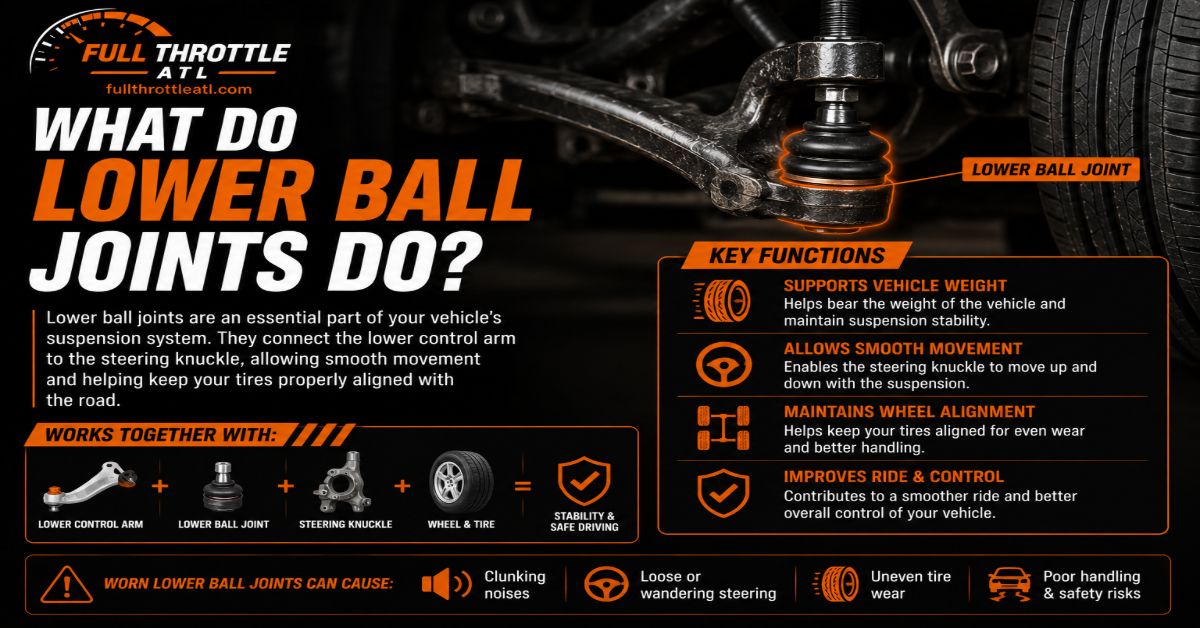
Lower ball joints act as the critical pivot points connecting a vehicle control arms to the steering knuckles. They bear the primary weight of the front end while simultaneously allowing the wheels to pivot for steering articulation and move vertically for suspension travel across uneven road surfaces.
At a Glance
- Weight Support: Lower ball joints handle up to 70% to 80% of front-end vehicle weight in standard SLA suspensions.
- Operational Tolerances: Maximum allowable radial and axial play before failure is strictly limited to 0.5 mm to 1.5 mm.
- Lifespan Range: Factory components typically endure between 70,000 and 150,000 miles under normal driving conditions.
- Replacement Rule: Technicians always recommend replacing lower ball joints in pairs to maintain balanced wear.
- Alignment Requirement: A professional wheel alignment is mandatory immediately following any ball joint replacement.
How Much Vehicle Weight Do Lower Ball Joints Support?
Lower ball joints support up to 70% to 80% of a vehicle front-end weight in standard Short-Long Arm (SLA) or double wishbone suspension layouts. Because they operate as tension-loaded joints in these configurations, gravity and vertical spring forces constantly pull and push against them during every mile of driving.
This immense physical load makes the lower ball joint one of the most heavily stressed mechanical components on any passenger vehicle or light truck. Every time a tire encounters a pothole, speed bump, or rough patch of asphalt, the lower ball joint absorbs the instantaneous impact energy while transferring directional commands from the steering rack to the wheel assembly.
What Is the Difference Between McPherson Strut and SLA Suspension Ball Joints?
The operational role of a lower ball joint changes completely depending on whether the vehicle utilizes a McPherson strut setup or an SLA suspension system.
In a McPherson strut suspension, the lower ball joint is follower-loaded. The heavy shock absorber and coil strut assembly carry the primary weight of the vehicle. Here, the lower ball joint only guides the lower control arm and handles lateral steering forces.
In contrast, an SLA or double wishbone suspension makes the lower ball joint strictly load-bearing. If a load-bearing ball joint experiences catastrophic structural failure, the suspension collapses completely, causing the vehicle chassis to drop instantly onto the front wheel.
How Long Do Lower Ball Joints Typically Last?
Factory lower ball joints typically last between 70,000 and 150,000 miles before requiring mechanical replacement. This wide mileage window depends heavily on environmental variables, road salt exposure, driving habits, and regular maintenance practices.
Vehicles driven primarily on smooth highways in temperate climates easily push past 120,000 miles on original factory ball joints. Conversely, vehicles operated on unpaved rural roads, construction sites, or regions that heavily salt winter roads often experience severe premature wear, sometimes necessitating joint replacement prior to 50,000 miles.
What Are the Warning Symptoms of a Failing Lower Ball Joint?
A failing lower ball joint exhibits distinct acoustic and handling symptoms long before it separates entirely from the steering knuckle.
The most common indicator is a dull clunking, snapping, or popping noise emanating from the front suspension when turning the steering wheel at low speeds or driving over sharp road bumps. Drivers may also notice vague steering feel, excessive steering wheel play, wandering on the highway, or erratic alignment where the vehicle pulls to one side despite a straight steering wheel.
What Happens If a Lower Ball Joint Fails Completely While Driving?
A complete lower ball joint separation causes an instant loss of directional control over the affected front wheel.
When the ball pulls out of its socket, the steering knuckle loses its lower connection to the control arm. The wheel immediately kicks outward at an unnatural angle, the fender catches the tire tread, and the front corner of the vehicle drops abruptly to the pavement. Drivers experiencing a lower ball joint failure at highway speeds often lose the ability to steer, frequently resulting in a dangerous loss of vehicle control.
Why Do Bad Ball Joints Sometimes Pass Standard Manual Wiggle Tests?
Worn ball joints frequently pass a standard manual wiggle test on a mechanic lift due to the dry joint phenomenon or incorrect vehicle unloading.
If a mechanic jacks up an SLA suspension by the vehicle frame rather than supporting the lower control arm, the heavy coil spring forces the ball joint tightly into its socket. The joint feels completely solid to hand pressure even if the internal bearing surface is dangerously worn out. Furthermore, a joint that has lost all internal grease can remain bound tightly under high spring tension until it suddenly seizes and snaps under dynamic driving stress.
How Do Lifted Trucks and Modified Suspensions Affect Lower Ball Joints?
Suspension lifts on trucks and off-road vehicles compromise the factory operating angle of lower ball joints, accelerating wear cycles dramatically.
Installing a lift kit forces the lower control arm downward, causing the ball joint stud to run at a permanent, severe tilt against its internal socket boundary. This geometric stress pinches the protective rubber dust boot, leading to early tearing, rapid grease loss, and metal-on-metal friction. Unmodified factory ball joints on heavily lifted trucks frequently fail in fewer than 15,000 miles unless replaced with specialized aftermarket high-angle components.
What Are the Factory Torque Specifications for Lower Ball Joints?
Securing a lower ball joint requires strict adherence to manufacturer torque specifications to prevent fastener loosening or stud shear.
The castle nut fastening the lower ball joint stud to the steering knuckle typically requires high torque, ranging between 60 and 90 lb-ft depending on vehicle weight and gross vehicle mass rating. Once torqued to specification, technicians must always align the castle nut slots with the stud hole and install a fresh cotter pin to physically prevent the nut from backing off under vibration.
How Do You Properly Inspect a Lower Ball Joint Under Load?
Properly inspecting a lower ball joint requires unloading the suspension according to its specific design geometry to reveal hidden internal play.
For coil-over or McPherson strut setups, technicians lift the vehicle by the control arm to keep the spring compressed while checking for vertical movement using a pry bar under the tire. For SLA and torsion bar suspensions, technicians place a floor jack directly underneath the lower control arm to support the vehicle weight, allowing them to measure radial and axial play with a dial indicator attached to the control arm.
Can You Safely Drive with a Squeaking Ball Joint?
Driving with a squeaking ball joint is unsafe because acoustic friction indicates that protective internal lubrication has completely vanished.
A squeaking sound occurs when bare metal rubs against metal inside the joint housing due to a torn rubber boot or dried-out grease. While the joint may not feature excessive physical play yet, the lack of lubrication invites rapid friction welding, sudden binding, and ultimate structural fracture under normal steering loads.
How Much Does It Cost to Replace Lower Ball Joints?
Replacing lower ball joints typically costs between $250 and $600 per axle for parts and professional labor combined.
The physical components themselves are relatively inexpensive, usually ranging from $40 to $150 per side for quality aftermarket or OEM replacements. Labor costs account for the bulk of the invoice because pressing old ball joints out of stamped steel control arms requires specialized hydraulic press tools and substantial technician time.
Should Ball Joints Be Replaced in Pairs?
Technicians always recommend replacing lower ball joints in pairs across the same axle to ensure symmetrical vehicle handling and wear characteristics.
If one lower ball joint fails due to high mileage, the opposite side has traveled the exact same distance under identical road stresses and is near the end of its useful service life. Replacing both joints simultaneously eliminates the cost and hassle of returning to the repair shop a few months later when the second side inevitably fails.
Do I Need an Alignment After Replacing a Lower Ball Joint?
A professional wheel alignment is strictly mandatory after replacing any lower ball joint.
Even precision-machined replacement components feature microscopic dimensional variations compared to factory original parts. Disconnecting and reinstalling the steering knuckle alters the front-end geometry, shifting wheel camber and toe angles out of factory specification and causing rapid tire tread wear if left uncorrected.
What Is the Difference Between Greaseable and Sealed Ball Joints?
Sealed factory ball joints are maintenance-free units packed with a fixed amount of grease during manufacturing, whereas greaseable aftermarket joints feature a threaded Zerk fitting.
Sealed joints rely entirely on the integrity of their rubber boot; once that boot tears, the joint fails quickly due to contamination. Greaseable joints allow vehicle owners to pump fresh chassis grease into the housing during routine oil changes, flushing out old contaminants, water, and debris to significantly extend operational lifespan.
The Bottom Line
Lower ball joints are essential suspension components that bear vehicle weight while enabling smooth steering articulation and vertical wheel travel. Ensuring safety requires understanding their mechanical load limits, recognizing inspection pitfalls like improper suspension unloading, and replacing worn units in balanced pairs followed by a professional wheel alignment.