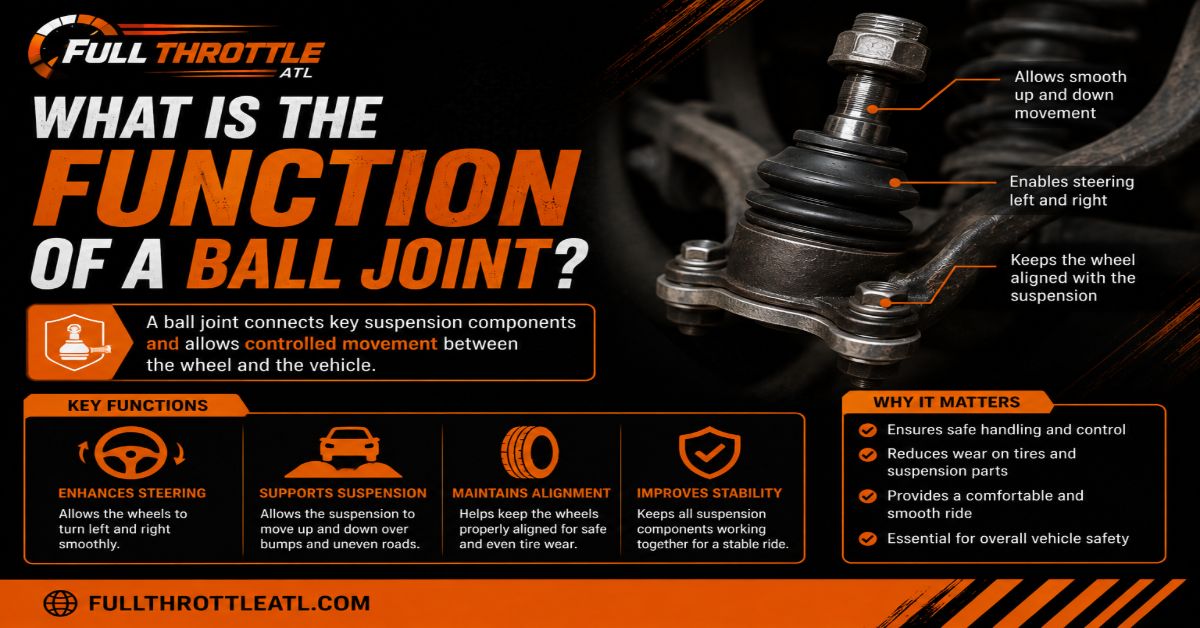
A ball joint acts as a mechanical pivot point connecting a vehicle control arm to the steering knuckle. The ball joint provides a spherical, rotating connection that allows the front wheels to steer horizontally while simultaneously moving vertically to absorb impacts from the road surface.
At a Glance
- Ball joints provide three degrees of angular freedom while restricting linear movement.
- Standard automotive ball joints allow between 15 degrees and 30 degrees of angular deflection.
- Original equipment manufacturer sealed ball joints typically last between 70,000 and 150,000 miles.
- Maximum allowable radial or axial play before failure ranges from 0.5 millimeters to 1.5 millimeters.
- Catastrophic ball joint failure causes the steering knuckle to detach entirely from the suspension.
Where are ball joints located on a vehicle?
Ball joints are located at the outer ends of the suspension control arms, directly attaching the arms to the wheel hub assembly or steering knuckle. Most modern passenger vehicles feature lower ball joints exclusively on the front suspension. Vehicles utilizing a short-long arm suspension system feature both upper and lower ball joints on each front wheel. Rear-wheel-drive vehicles with independent rear suspensions may also incorporate rear ball joints to maintain precise rear wheel alignment. The exact location depends on the suspension geometry, but the joints always sit between the static chassis components and the dynamic wheel assemblies.
How does a suspension ball joint move?
A suspension ball joint moves by allowing an internal steel ball stud to rotate and pivot inside a lubricated spherical bearing socket. The joint provides three degrees of freedom, meaning the stud can rotate freely in any angular direction. This multi-axis rotation allows the steering knuckle to pivot left and right for steering inputs. Simultaneously, the joint articulates up and down to handle suspension travel over uneven terrain. Automotive engineers design the internal clearances tightly between 0.01 millimeters and 0.05 millimeters. This tight tolerance ensures the stud moves smoothly without any linear play or horizontal slop.
What is the difference between load-carrying and follower joints?
A load-carrying ball joint supports the physical weight of the vehicle chassis, while a follower joint primarily handles lateral steering forces. In a short-long arm suspension setup, the lower ball joint typically acts as the load carrier because the main suspension spring rests directly on the lower control arm. The upper ball joint acts as the follower. The follower joint guides the steering knuckle and keeps the wheel vertically aligned without bearing the vehicle weight. Load-carrying joints experience significantly higher compressive and tensile stress. Consequently, load-carrying joints wear out faster and require stricter inspection protocols than follower joints.
How long do factory ball joints last?
Factory sealed ball joints typically last between 70,000 and 150,000 miles under normal driving conditions. Lifespan depends entirely on road quality, climate, and driving habits. Vehicles driven on smooth highways often exceed 150,000 miles without any joint degradation. Conversely, pickup trucks and commuter cars driven daily over deep potholes, gravel roads, or salt-treated winter streets may require replacement before reaching 70,000 miles. Original equipment manufacturer parts use high-quality synthetic grease and durable polyurethane boots. These materials maximize longevity compared to cheaper aftermarket alternatives.
How much does it cost to replace a ball joint?
The total cost to replace a single ball joint typically ranges from $200 to $400 for parts and labor. The standalone part usually costs between $40 and $100 depending on the vehicle make and model. Labor charges account for the remaining balance. Pressing a rusted joint out of a suspension knuckle requires specialized heavy-duty tools and roughly one to two hours of labor. If the vehicle requires a complete control arm replacement, the total cost often increases to a range of $400 to $800 per side. Every ball joint replacement also mandates a professional wheel alignment, adding roughly $100 to the final repair bill.
Can you replace just the ball joint or the entire control arm?
You can replace just the ball joint on some older vehicles, but many modern cars require replacing the entire control arm assembly. The deciding factor is the factory manufacturing method. Some ball joints are bolted or snap-ringed into the control arm. This modular design allows a mechanic to press the old joint out and press a new one in. Other manufacturers integrate the ball joint directly into an aluminum control arm permanently. In integrated setups, you must purchase and install the complete control arm. Replacing the entire arm often saves labor time and provides the added benefit of fresh control arm bushings.
Should you replace ball joints in pairs?
Yes, you should replace ball joints in pairs across the same axle. Suspension components on the left and right sides of a vehicle experience identical mileage, thermal cycles, and road conditions. If the passenger side lower ball joint has worn out past safety limits, the driver side lower ball joint is undoubtedly nearing the end of its operational lifespan. Replacing both joints simultaneously restores balanced steering geometry. Furthermore, doing the job in pairs saves you from paying for a second wheel alignment a few months later.
What is the difference between greasable and sealed joints?
Sealed ball joints are permanently lubricated at the factory and require no maintenance, whereas greasable ball joints feature a Zerk fitting that requires manual grease application. Original equipment units are almost always sealed for life. These sealed units prevent contamination effectively but cannot be replenished once the internal grease degrades. Heavy-duty aftermarket joints often utilize greasable designs. Owners must pump fresh chassis grease into greasable joints every 3,000 to 5,000 miles to flush out moisture and debris. Failing to maintain a greasable joint causes the component to fail much faster than a standard sealed unit. Over-greasing can also pop the rubber seal, accelerating wear.
Are aftermarket ball joints better than OEM?
Aftermarket ball joints are only better than original equipment manufacturer components if you purchase premium upgrades designed for severe applications. Standard off-brand aftermarket joints generally feature inferior metallurgy and weaker boot seals, leading to premature failure. Premium aftermarket brands engineer heavy-duty joints with oversized ball studs, sintered metal bearings, and greasable fittings. These premium upgrades outperform original equipment parts for lifted trucks, off-road vehicles, and fleet vehicles subjected to severe abuse. For the average daily driver, genuine factory replacement parts offer the most reliable and cost-effective performance.
What are the first symptoms of a bad ball joint?
The first symptoms of a bad ball joint include muffled clunking noises over bumps and a wandering steering feel at highway speeds. As the internal socket wears down, the ball stud gains excessive clearance. This clearance allows the suspension to shift unexpectedly during weight transfers. Drivers will notice the vehicle pulling to one side, uneven front tire wear (specifically inner or outer edge feathering), and a vague disconnected feeling in the steering wheel. Visual inspection may also reveal a torn rubber dust boot or dark chassis grease leaking onto the lower control arm.
Why do ball joints squeak or bind when turning?
Ball joints squeak or bind when turning due to a condition known as the dry joint phenomenon. Extreme thermal cycles and age cause the internal lubricating grease to break down, harden, or evaporate completely. The rubber protective boot may remain completely intact, hiding the issue from visual inspection. Without lubrication, the steel ball stud grinds directly against the internal steel socket. This metal-on-metal friction creates a loud creaking sound at low speeds. At highway speeds, the dry joint micro-seizes and binds. This binding causes memory steer, a condition where the steering wheel refuses to naturally return to the center position after exiting a curve.
How much wear is acceptable in a suspension joint?
The maximum acceptable wear in a suspension ball joint ranges from 0.5 millimeters to 1.5 millimeters of play. Any clearance exceeding this specific threshold dictates immediate component replacement. A healthy ball joint possesses absolute zero linear play. The stud should pivot smoothly but resist any up-and-down (axial) or side-to-side (radial) shifting. Professional mechanics measure this deflection using a specialized dial indicator tool mounted securely to the steering knuckle. Relying purely on visual inspections or shaking the wheel by hand is insufficient for measuring precise tolerance limits.
How do you properly test a loaded ball joint?
To properly test a loaded ball joint, you must lift the vehicle in a way that compresses the suspension spring and removes tension from the joint. Testing a loaded joint while the vehicle hangs free on a frame-contact lift will compress the mechanical play, resulting in a dangerous false negative diagnosis.
- Identify if the main suspension spring rests on the lower or upper control arm.
- Place a hydraulic jack directly under the spring-bearing control arm.
- Position the jack as close to the ball joint as physically possible.
- Raise the vehicle until the tire clears the ground by roughly two inches.
- Position a magnetic dial indicator against the steering knuckle.
- Insert a long pry bar under the tire and lift upward to measure axial play.
- Grasp the tire at the three o’clock and nine o’clock positions and push back and forth to check for radial play.
Is it safe to drive with a clicking ball joint?
No, it is never safe to drive a vehicle with a clicking, popping, or clunking ball joint. These audible noises indicate that the internal clearances have vastly surpassed safe operating limits. When a joint makes a popping sound, the ball stud is violently shifting inside the worn socket during vehicle weight transfers. The structural integrity of the joint is severely compromised at this advanced stage of wear. Continuing to drive places the component at a high risk of catastrophic separation, especially under heavy braking or during evasive steering maneuvers.
Can a ball joint fail without warning?
Yes, a ball joint can fail without any prior warning signs if the vehicle experiences a severe kinetic impact. Standard wear and tear usually provide ample auditory and physical warnings over thousands of miles. However, hitting a deep pothole, striking a curb, or hitting solid road debris at highway speeds introduces massive shear forces to the suspension system. These sudden shear forces can instantly snap the steel ball stud in half. Impact-related shear failure can occur instantly even if the suspension components are brand new and perfectly lubricated.
What happens if a ball joint breaks while driving?
If a ball joint breaks while driving, the steering knuckle instantly detaches from the suspension control arm. The affected wheel will immediately fold outward or tuck completely under the vehicle chassis. The driver will experience a sudden and violent loss of steering control. The collapsing suspension geometry typically crushes the exterior fender, tears the hydraulic brake lines, and rips the CV axle completely out of the transmission. This catastrophic mechanical failure often results in severe accidents and requires a flatbed tow truck to remove the immobilized vehicle from the roadway.
The Bottom Line
The primary function of a ball joint is to act as a crucial mechanical pivot connecting the vehicle control arms to the steering knuckles. This vital connection allows for simultaneous horizontal steering and vertical suspension movement. Routine inspection is critical because these components bear the entire dynamic load of the vehicle. Mechanics and vehicle owners must test joints using the correct unloading procedures to avoid false negative readings. Addressing early symptoms like steering wander, dry squeaking, or muffled clunking noises prevents catastrophic joint separation and ensures safe vehicle operation.