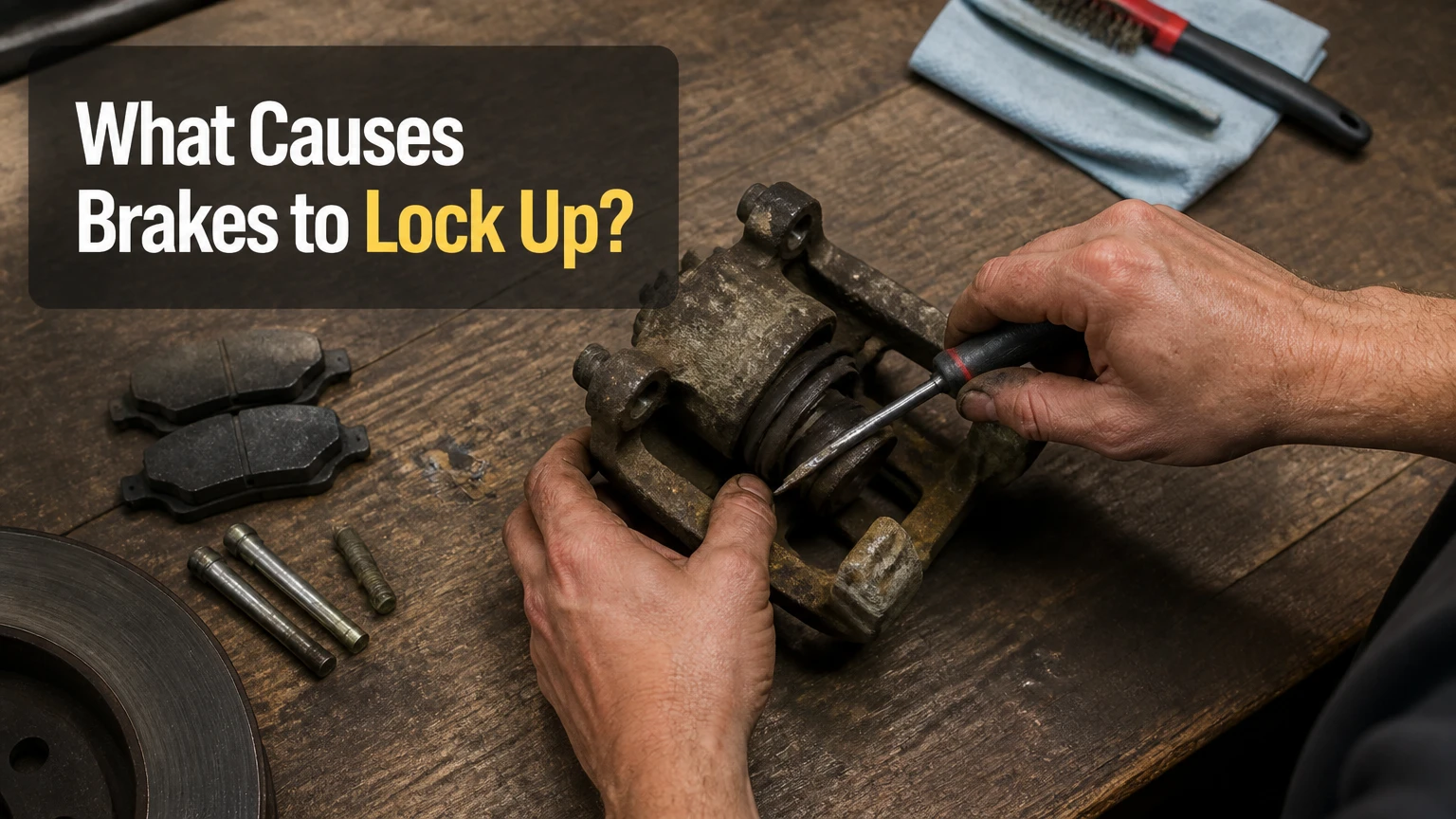
Brakes lock up when hydraulic line pressure fails to release, mechanical components seize, or electronic control systems malfunction, causing braking force to exceed tire traction. This forces one or more wheels to stop spinning entirely while the vehicle remains in motion, resulting in skid hazards and severe thermal damage to the braking assembly.
At a Glance
- Brakes lock up whenever clamping force exceeds road traction, stopping wheel rotation while moving.
- Hydraulic over-pressurization trapped above 300 PSI continuously clamps pads against the rotor even after releasing the pedal.
- Mechanical slide pin seizure and rust jacking elevate the pad friction coefficient above 0.60, triggering sudden lockups.
- Faulty Wheel Speed Sensors (WSS) or miscalibrated stability control units can falsely command the ABS module to clamp calipers.
- Internal hose delamination creates a hidden one-way check valve that traps fluid pressure without showing external damage.
- Driving with a locked brake pushes rotor temperatures past 500°C (932°F) within 3 miles, risking fluid boil, wheel bearing destruction, and vehicle fires.
What Mechanical Component Failures Force a Brake to Lock?
Mechanical brake lock-up occurs when physical binding prevents the brake pads or shoes from retracting away from the friction surface after pedal release. The two primary mechanical causes are seized caliper slide pins and rust-jacking underneath brake pad backing plates.
+-----------------------------------------------------------------------+
|                       MECHANICAL BINDING FLOW                         |
|                                                                       |
|  [ Corroded Slide Pins / Rust Jacking ]                               |
|                     │                                                 |
|                     ▼                                                 |
|  [ Zero Retraction Clearance (0 mm Travel) ]                          |
|                     │                                                 |
|                     ▼                                                 |
|  [ Friction Coefficient Spikes: µ 0.35 ──> >0.60 ]                     |
|                     │                                                 |
|                     ▼                                                 |
|  [ Mechanical Clamping Force Exceeds Tire Traction ──> Wheel Lock ]   |
+-----------------------------------------------------------------------+
Under normal conditions, brake pads operate with a friction coefficient (μ) between 0.35 and 0.45. When slide pins lose lubrication or corrode, caliper travel drops to zero millimeters. Continued pad contact causes extreme localized heat buildup and surface scoring, spiking the local friction coefficient past 0.60. This sharp leverage shift forces the tire to break traction and lock instantly.
Similarly, in geographic rust belts, road salt causes rust scale to form between the steel caliper bracket and the pad backing plate. This expansion, known as rust jacking, distorts backing plates by 1 to 2 mm and wedges pads tightly inside bracket slots, preventing retraction even when hydraulic pressure drops to zero.
How Does Hydraulic Over-Pressurization Freeze a Brake Caliper?
Hydraulic brake lock-up is caused by fluid pressure remaining trapped inside the brake caliper or wheel cylinder after the brake pedal is released. Standard automotive braking systems operate between 800 and 1,200 PSI during heavy deceleration, dropping back to near zero PSI when the pedal springs back.
If trapped fluid maintains a residual line pressure above 300 PSI, the caliper piston continues exerting high clamping force against the rotor. The most common causes of continuous hydraulic pressure retention include:
- Stuck Master Cylinder Bypass Port: If the master cylinder pushrod is adjusted too long, or if internal seals swell, the primary return port remains blocked, preventing fluid from returning to the reservoir.
- Seized Caliper Piston: Corrosion or degraded rubber dust boots cause the piston to bind inside its bore, overcoming the square-cut seal’s natural elastic spring-back.
- Corroded Proportional Valves: Internal shuttle valves sticking in an off-center position prevent cross-circuit fluid return.
How Do Electronic ABS and ECU Malfunctions Cause Wheel Lock-Up?
Electronic brake lock-up occurs when the Anti-lock Braking System (ABS) module or Electronic Control Unit (ECU) misinterprets wheel speed data and erroneously closes hydraulic solenoid valves, trapping line pressure at a specific corner.
+-----------------------------------------------------------------------+
|                         ABS ERROR MECHANISM                           |
|                                                                       |
|  [ Damaged Tone Ring / Sensor Debris ]                                |
|                     │                                                 |
|                     ▼                                                 |
|  [ Sensor Falsely Signals 0 RPM at 60 MPH ]                           |
|                     │                                                 |
|                     ▼                                                 |
|  [ ECU Misinterprets Signal as Localized Skid ]                       |
|                     │                                                 |
|                     ▼                                                 |
|  [ Solenoid Valve Closes Erroneously ──> Pressure Trapped ──> Lock ]   |
+-----------------------------------------------------------------------+
The ABS ECU monitors individual Wheel Speed Sensors (WSS) reading magnetic tone rings down to 3 to 5 mph. If a tone ring loses a tooth or becomes coated in iron filings, the sensor abruptly reports 0 RPM while the vehicle travels at highway speeds (e.g., 60 mph). The ECU misinterprets this rapid signal drop as a localized wheel skid.
If the ABS hydraulic unit suffers a stuck internal solenoid valve, it can trap active brake fluid pressure inside that brake line indefinitely. Rather than pulsing the pressure to allow tire rotation, the ECU holds the clamping force, keeping the wheel mechanically locked.
How Do Internal Brake Hose Tears Trap Fluid Without External Damage?
Internal brake hose delamination causes brake lock-up when the innermost layer of a flexible rubber brake line tears, forming an internal flap that acts as a one-way check valve. Fluid flows past the flap toward the caliper under hard pedal pressure, but cannot flow backward when the pedal is released.
[ Master Cylinder ] ──( 1000 PSI Fluid Pressure )──> [ Flap Opens ] ──> [ Caliper Clamps ]
                                                                                │
                                                                                ▼
[ Trapped Pressure ] <── [ Flap Seals Shut ] <── ( Return Flow Blocked ) ───────┘
When you apply the brakes, hydraulic pressure exceeding 800 PSI easily forces fluid past the torn rubber flap to squeeze the caliper piston. When you release the brake pedal, the low-pressure return force fails to push the rubber flap open. The flap seals shut, trapping hundreds of pounds of pressure inside the caliper.
Standard visual inspections fail to detect this failure because the reinforced outer jacket of the hose remains in pristine condition. Technicians often replace pads, rotors, and calipers without resolving the issue because the hidden hydraulic valve inside the hose continues trapping fluid.
Can Rust Jacking Lock Brake Pads Inside the Caliper Bracket?
Yes, rust jacking routinely locks brake pads in place by corroding the metal surfaces of the caliper bracket, which expands and pinches the brake pad ears tightly in their guide slots.
+-----------------------------------------------------------------------+
|                        RUST JACKING DYNAMICS                          |
|                                                                       |
|  [ Moisture & Road Salt Exposure ]                                    |
|                     │                                                 |
|                     ▼                                                 |
|  [ Rust Scale Expands Beneath Caliper Abutment Clips ]                |
|                     │                                                 |
|                     ▼                                                 |
|  [ Bracket Opening Constricts by 1.0–2.0 mm ]                         |
|                     │                                                 |
|                     ▼                                                 |
|  [ Pad Metal Backing Plate Wedges Solidly in Slot ]                   |
|                     │                                                 |
|                     ▼                                                 |
|  [ Pad Cannot Retract ──> Continuous Drag & Thermal Lockup ]          |
+-----------------------------------------------------------------------+
In regions utilizing chemical road de-icers, moisture penetrates underneath stainless-steel abutment clips. Iron oxide scale expands up to six times the volume of raw steel, narrowing the bracket channel clearance by 1.0 to 2.0 mm.
This dimensional change binds the steel backing plate of the pad, immobilizing it. When the brake pedal is released, the piston retracts, but the wedged pad remains jammed against the spinning rotor face. This continuous contact generates rapid heat buildup, causing the pad material to glaze, expand, and physically weld itself to the rotor face.
Why Does a Faulty Proportioning Valve Make Rear Wheels Lock During Hard Stops?
A faulty proportioning valve causes rear-wheel lock-up by allowing unfiltered hydraulic pressure to reach the rear brakes, overriding the required front-to-rear pressure split.
During heavy deceleration, kinetic energy transfers weight toward the front axle, significantly lightening the rear tires’ downforce. To prevent rear wheel lockup, non-EBD (Electronic Brakeforce Distribution) systems use a proportioning valve to split hydraulic pressure roughly 70% to the front and 30% to the rear.
| Operating State | Front Pressure Ratio | Rear Pressure Ratio | Dynamic Result under Hard Braking |
|---|---|---|---|
| Normal Function | 70% | 30% | Controlled, stable stopping power across both axles. |
| Internal Valve Failure | 50% | 50% | Rear tires overpower reduced traction, locking instantly and causing vehicle spin. |
If the proportioning valve’s internal spring or metering piston corrodes, it defaults to an open 50:50 pressure split. When the driver hits the brakes hard, excess hydraulic pressure surges to the rear drum or disc assembly. Because the unloaded rear tires have minimal road friction, they instantaneously lock, causing the rear end of the vehicle to fishtail or spin out out of control.
Why Do Drum Brakes Lock Up or Grab Abruptly in the Morning?
Drum brakes grab or lock abruptly during the first few stops of the morning due to flash rust accumulation on the cast-iron drum surface overnight, a condition known as “morning bite.”
+-----------------------------------------------------------------------+
|                        MORNING BITE TIMELINE                          |
|                                                                       |
|  [ High Ambient Humidity Overnight ]                                  |
|                     │                                                 |
|                     ▼                                                 |
|  [ Flash Rust Layer Forms on Cast-Iron Drum ]                         |
|                     │                                                 |
|                     ▼                                                 |
|  [ First Brake Application: Brake Shoes Micro-Latch onto Rust ]       |
|                     │                                                 |
|                     ▼                                                 |
|  [ Self-Energizing Servo Action Multiplies Clamping Force ]           |
|                     │                                                 |
|                     ▼                                                 |
|  [ Aggressive Low-Speed Wheel Lock (<10 MPH) ]                        |
|                     │                                                 |
|                     ▼                                                 |
|  [ 2–3 Stops Abrade Rust Layer Away ──> Normal Function Restored ]    |
+-----------------------------------------------------------------------+
When high humidity or rain exposes cast-iron drums to air overnight, a micro-layer of iron oxide forms on the friction track within hours. Primary brake shoes utilize a self-energizing design, leveraging the drum’s rotation to wedge the shoe tighter against the wall.
When light pedal pressure is applied under 10 mph, the abrasive friction coefficient jumps dramatically as the shoe lining micro-latches into the flash rust layer. The self-energizing geometry amplifies this force into an unexpected wheel lockup. This condition self-corrects after two or three moderate stops scrape the microscopic rust film clear.
How Can Out-of-Calibration ESC Sensors Lock Individual Wheels?
Out-of-calibration Electronic Stability Control (ESC) sensors lock individual wheels by feeding incorrect vehicle dynamics data to the stability module, causing it to apply targeted hydraulic pressure to correct a rollover or skid that is not actually occurring.
Modern ESC systems rely on Inertial Measurement Units (IMUs) and yaw-rate sensors to measure vehicle rotation and lateral g-forces. If an IMU drops out of calibration by as little as 1.5 to 2.0 degrees due to an alignment shift or physical impact, the ESC module calculates that the vehicle is undergoing an uncontrolled spin or rollover.
To counter this perceived instability, the ESC pump autonomously energizes and fires individual ABS hydraulic solenoids, clamping a single wheel’s brake caliper to force the vehicle back on course. Because this is an active safety intervention rather than a system fault, it causes sudden wheel lock-ups without illuminating an ABS diagnostic light or setting standard Trouble Codes (DTCs).
Can Low Brake Fluid Cause Brakes to Lock Up?
No, low brake fluid level cannot cause your brakes to lock up under any operational circumstances.
Low brake fluid draws ambient air into the hydraulic lines through the master cylinder reservoir. Because air is a highly compressible gas while hydraulic fluid is an non-compressible liquid, the mechanical force from your foot compresses the air bubbles rather than moving the caliper pistons. This produces a soft, spongy pedal that sinks to the floorboards and results in a severe loss of stopping power.
┌─────────────────────────────────────────────────────────────────┐
│                    BRAKE FLUID STATUS EFFECTS                   │
├─────────────────────────────────────────────────────────────────┤
│  LOW FLUID LEVEL ──> Air in Lines ──> Spongy Pedal / NO Braking │
├─────────────────────────────────────────────────────────────────┤
│  LOCKED BRAKES   ──> Trapped Pressure / Mechanical Binding      │
└─────────────────────────────────────────────────────────────────┘
If your brakes are locking up, the underlying cause is trapped pressure, physical binding, or electronic sensor failure—not a low fluid level.
Why Is Only One Single Wheel Locking Up Instead of All Four?
A single wheel locks up when the failure mode is isolated to the hydraulic line, mechanical assembly, or electronic sensor dedicated to that specific corner of the vehicle.
Four-wheel brake lock-up is rare in modern vehicles equipped with split-diagonal hydraulic circuits. When a failure affects a single wheel, it points directly to specific localized components:
- Seized Caliper Piston or Slide Pin: Prevents pad retraction on that specific brake assembly while the remaining three retract normally.
- Collapsed Flex Hose: Acts as a localized check valve, trapping hydraulic pressure exclusively inside that wheel’s caliper.
- Corroded Drum Wheel Cylinder: One side’s piston binds outward, holding the brake shoe against that single drum wall.
- Damaged Wheel Speed Sensor (WSS): Corrupted speed feedback from one corner causes the ABS ECU to mismanage hydraulic pressure at that individual wheel.
What Causes All Four Vehicle Brakes to Lock Up at Once?
All four vehicle brakes lock up simultaneously only when a system-wide failure prevents hydraulic pressure relief across the master cylinder or primary electronic braking module.
+-----------------------------------------------------------------------+
|                    FOUR-WHEEL LOCKUP ROOT CAUSES                      |
|                                                                       |
|  [ Master Cylinder Pushrod Misadjustment ] ──> Blocks Return Vent     |
|                                                     │                 |
|  [ Contaminated Brake Fluid (Petroleum) ]  ──> Swells All Rubber Seals |
|                                                     │                 |
|  [ Hydro-Booster / Vacuum Servo Sticking ] ──> Applies Constant Pressure|
|                                                     │                 |
|                                                     ▼                 |
|  [ System-Wide Hydraulic Pressure Trapped Across Front & Rear Axles ] |
+-----------------------------------------------------------------------+
The four primary causes of full vehicle four-wheel lockup include:
- Incorrect Master Cylinder Pushrod Length: If an aftermarket master cylinder or booster is installed with an overly long pushrod, it keeps the master cylinder piston slightly depressed. This blocks the compensation ports for both brake circuits, trapping built-up fluid pressure across all four lines.
- Fluid Contamination: Introducing petroleum-based fluids (power steering fluid, oil, or engine degreaser) into the reservoir destroys EPDM rubber seals, causing every internal seal to swell and block return ports simultaneously.
- Stuck Power Brake Booster: A failed pedal return spring or broken internal reaction disc inside the vacuum booster or hydro-boost unit holds continuous mechanical force against the master cylinder pushrod.
- Complete ABS Module Lockup: Internal corrosion inside the main valve body jams both primary isolation valves in the closed position, locking pressure in all lines.
How Do You Test if a Locked Brake Is Hydraulic or Mechanical?
You can determine whether a locked brake is caused by trapped hydraulic pressure or mechanical binding by opening (cracking) the caliper bleeder screw while the wheel is jammed.
+-----------------------------------------------------------------------+
|                     BLEEDER SCREW DIAGNOSTIC TEST                     |
|                                                                       |
|                        [ Safely Lift & Block Locked Wheel ]           |
|                                         │                             |
|                                         ▼                             |
|                    [ Crack Bleeder Screw 1/4 Turn ]                   |
|                                         │                             |
|                   ┌─────────────────────┴─────────────────────┐       |
|                   ▼                                           ▼       |
|       [ Fluid Squirts Out + Wheel Spins ]             [ No Fluid Jet + Wheel Remains Stuck ]
|                   │                                           │       |
|                   ▼                                           ▼       |
|     HYDRAULIC FAILURE DETECTED                   MECHANICAL FAILURE DETECTED  |
|  (Torn Hose / Master Cylinder Port)          (Seized Caliper / Rust Jacking)  |
+-----------------------------------------------------------------------+
Diagnostic Steps:
- Elevate the vehicle safely on jack stands and confirm the affected wheel cannot be turned by hand.
- Attach a clear vinyl hose over the caliper bleeder screw and submerge the open end in a plastic container.
- Loosen the bleeder screw 1/4 turn using a box-end wrench.
- Evaluate the result:
- If brake fluid spurts out under high pressure and the wheel immediately spins freely: The issue is hydraulic. The caliper and pads are functional, but fluid is trapped upstream by a collapsed rubber hose, proportioning valve, or master cylinder.
- If no fluid spurts out and the wheel remains locked tight: The issue is mechanical. The caliper piston is physically seized in its bore, slide pins are frozen, or pads are wedged tight in the bracket.
Is It Safe to Drive a Short Distance With a Locking Brake?
No, driving even a short distance with a locking or dragging brake is extremely hazardous and causes catastrophic component damage within minutes.
When a brake pad continuously drags against a rotor at driving speeds, friction generates rapid thermal expansion. Within 2 to 3 miles, rotor temperatures exceed 500°C (932°F), triggering a destructive chain reaction:
[ Locked Brake Contact ] ──> [ Rotor Temp Spikes >500°C ] ──> [ Brake Fluid Boils ]
                                                                      │
                                                                      ▼
[ Wheel Bearing Failure / Tire Fire Risk ] <── [ Hub Seal Failure ] <── [ Total Pedal Fade ]
- Brake Fluid Vaporization: Heat transfers through the caliper piston into the hydraulic fluid, reaching its boiling point. Fluid boils turn liquid into gas bubbles, causing complete pedal fade and total loss of all braking ability.
- Structural Component Failure: Extreme heat warps wheel hubs, liquefies wheel bearing grease, degrades rubber axle seals, and leads to sudden wheel detachment.
- Fire Hazard: Superheated brake components easily ignite nearby grease, plastic fender liners, or tire rubber, risking a total vehicle fire.
How Do You Temporarily Free a Stuck Brake to Move a Vehicle Safely?
You can temporarily free a stuck brake to move a stranded vehicle to a safe area by releasing trapped hydraulic pressure or mechanically retracting the binding components.
+-----------------------------------------------------------------------+
|                      EMERGENCY BRAKE RELEASE STEPS                    |
|                                                                       |
|  1. COOLING: Allow assembly to cool completely (reduces thermal expansion)|
|                               │                                       |
|                               ▼                                       |
|  2. HYDRAULIC RELIEF: Crack bleeder screw 1/4 turn to drop pressure   |
|                               │                                       |
|                               ▼                                       |
|  3. MECHANICAL FREEING: Tap caliper bracket with a rubber mallet      |
|                               │                                       |
|                               ▼                                       |
|  4. PISTON RETRACTION: Pry pad off rotor using a flathead screwdriver |
|                               │                                       |
|                               ▼                                       |
|  5. SAFETY CHECK: Re-tighten bleeder, top off fluid, drive to repair  |
+-----------------------------------------------------------------------+
Emergency Release Procedure:
- Cool the Assembly: Allow the brake assembly to sit for 20 to 30 minutes. Metal contracts as it cools, which may reduce thermal seizure.
- Release Hydraulic Pressure: Turn the bleeder screw 1/4 turn counter-clockwise using a wrench to vent trapped pressure into a container, then close it tightly.
- Free Mechanical Binding: Tap the metal body of the caliper bracket (never the rotor surface) firmly with a rubber mallet or hammer to break loose frozen slide pins or pad ears.
- Leverage the Piston: Insert a sturdy flathead screwdriver or pry bar between the outer brake pad backing plate and the caliper body. Pry gently to compress the piston back into its bore, creating clearance around the rotor.
- Verify Free Movement: Ensure the wheel turns freely by hand before taking down the jack. Drive slowly at low speeds directly to a service bay or flatbed tow truck without aggressive brake applications.
The Bottom Line
Brake lock-up is a critical safety issue caused by continuous hydraulic pressure retention above 300 PSI, mechanical seizure of calipers and pad backing plates, or electronic sensor errors overriding the ABS. Isolating the issue starts with a bleeder screw diagnostic test to determine whether trapped fluid pressure or mechanical binding is preventing pad retraction. Never drive a vehicle with a locking brake; extreme heat buildup past 500°C can cause total brake pedal failure, wheel bearing destruction, and vehicle fires within just a few miles.