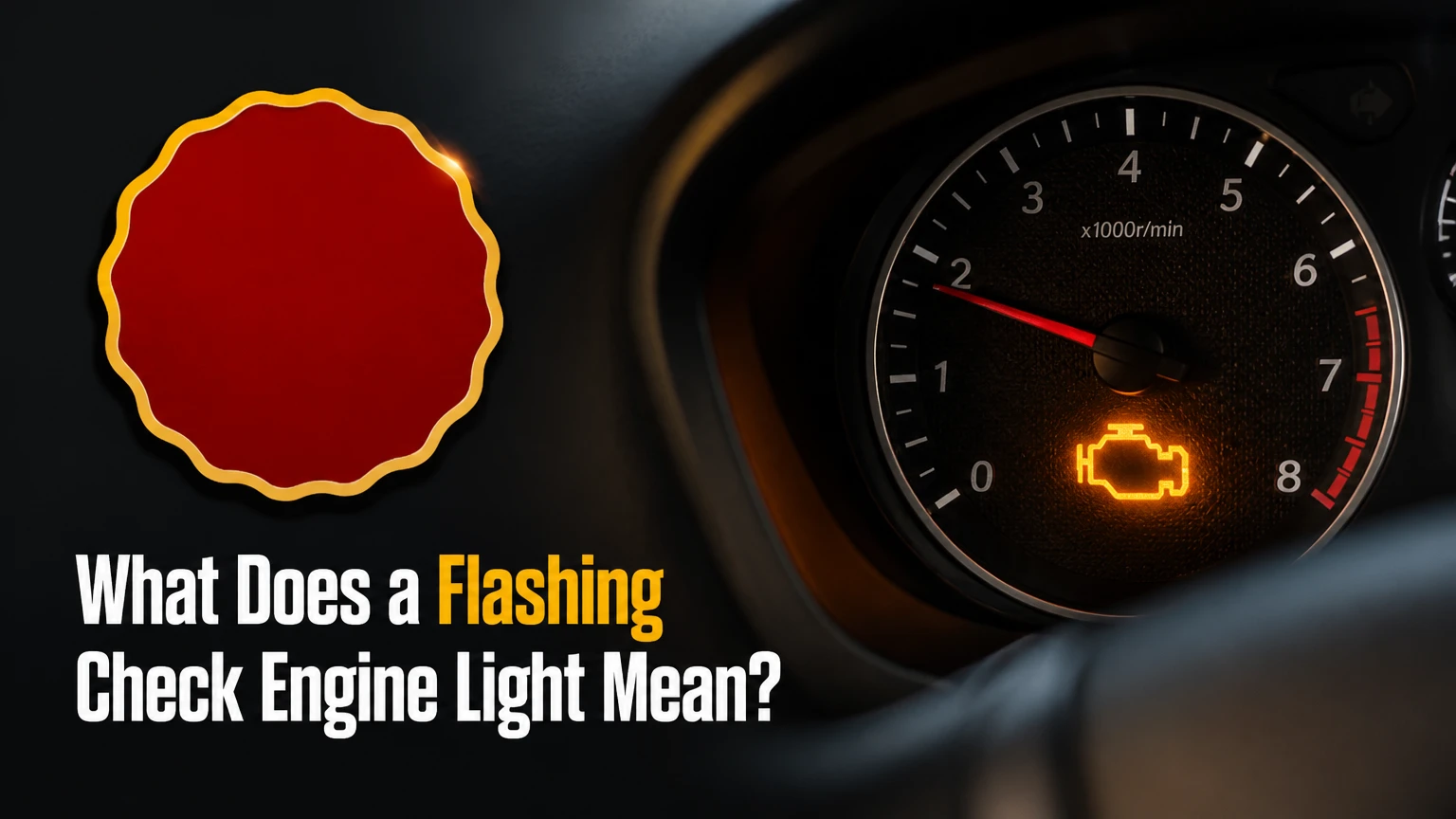
A flashing check engine light indicates an active, severe engine misfire that allows unburned fuel into the exhaust system. This condition rapidly elevates exhaust temperatures above 2,000°F (1,100°C), which can destroy the catalytic converter within 30 seconds to 2 minutes. Drivers must safely pull over and shut off the engine immediately.
A flashing check engine light demands an immediate engine shutdown.. Source: Maksim Rumiantsev / Getty Images
At a Glance
- Primary Cause: Unburned fuel dumping into the exhaust stream due to ignition, fuel, or mechanical failure.
- Critical Window: Sustained cylinder misfires melt ceramic catalytic converter substrates within 30 seconds to 2 minutes.
- Operating Temperatures: Normal catalytic converter temperatures range from 1,200°F to 1,600°F; flashing light conditions spike temperatures beyond 2,000°F.
- Financial Impact: Addressing an underlying ignition coil or spark plug costs $50 to $200, whereas replacing a melted catalytic converter costs $1,000 to $4,500.
- Standard Diagnostic Codes: Triggers OBD-II trouble codes P0300 (random/multiple misfire) through P0308 (cylinder-specific misfires).
What Is the Difference Between a Solid and a Flashing Check Engine Light?
A solid check engine light signals a non-emergency emissions or sensor defect, whereas a flashing check engine light indicates an active engine emergency requiring immediate engine shutdown.
| Attribute | Solid Check Engine Light | Flashing Check Engine Light |
|---|---|---|
| Urgency Level | Moderate (Schedule service soon) | Critical Emergency (Pull over immediately) |
| Primary Meaning | Emissions fault, bad sensor, or minor evaporative leak | Active cylinder misfire dumping raw fuel |
| Exhaust Temperature | Normal range (1,200°F to 1,600°F) | Extreme overheat (Exceeding 2,000°F) |
| Immediate Action | Continue driving cautiously to a destination | Pull over safely and shut off ignition |
| Risk to Catalytic Converter | Low to moderate over long periods | Melting or disintegration in under 2 minutes |
When the light is solid, the Powertrain Control Module (PCM) has recorded an error code that does not pose an immediate threat to physical drivetrain components—such as a loose gas cap (P0442) or a degraded oxygen sensor (P0135). Conversely, a blinking or flashing light indicates that fuel is passing through a cylinder without combusting. When this unburned mixture reaches the superheated catalytic converter, it ignites inside the honeycomb substrate, causing rapid structural thermal collapse.
How Fast Can a Flashing Light Destroy a Catalytic Converter?
A flashing check engine light can permanently destroy a catalytic converter in as little as 30 seconds to 2 minutes of continuous driving under misfire conditions.
Extreme heat from unburned fuel quickly melts internal converter substrates.. Source: Anastasija Vujic / Getty Images
Under normal operation, a catalytic converter operates between 1,200°F and 1,600°F (650°C to 870°C) to convert harmful exhaust gasses into inert compounds. During an active misfire, unburned gasoline enters the exhaust system and ignites directly on the converter’s precious-metal coating (platinum, palladium, and rhodium).
This secondary combustion drives internal temperatures past the ceramic substrate’s melting point of 2,000°F (1,100°C). Once melted, the ceramic core collapses, creating a complete physical exhaust blockage that can cause engine stalling, cylinder backpressure, and internal engine fire.
What OBD-II Diagnostic Codes Cause a Flashing Check Engine Light?
A flashing check engine light is triggered exclusively by OBD-II diagnostic trouble codes in the P0300 through P0308 series, which pinpoint cylinder misfire events.
- P0300: Random or Multiple Cylinder Misfire Detected (indicates systemic issues like low fuel pressure, vacuum leaks, or bad fuel).
- P0301: Cylinder 1 Misfire Detected.
- P0302: Cylinder 2 Misfire Detected.
- P0303: Cylinder 3 Misfire Detected.
- P0304: Cylinder 4 Misfire Detected.
- P0305: Cylinder 5 Misfire Detected.
- P0306: Cylinder 6 Misfire Detected.
- P0307: Cylinder 7 Misfire Detected.
- P0308: Cylinder 8 Misfire Detected.
When the PCM detects rotational speed fluctuations at the crankshaft via the Crankshaft Position Sensor (CKP), it calculates which specific cylinder failed to deliver expected rotational force. If misfires occur at a rate high enough to exceed emissions damage thresholds (typically >2% to 5% misfire rate per 200 engine revolutions), the PCM flashes the warning light.
What Immediate Steps Should You Take When the Light Starts Flashing?
When a check engine light begins flashing while driving, you must immediately reduce throttle input, safely pull off the roadway, and turn off the ignition.
- Safety Turn-Off: Signal and pull onto the shoulder or a safe parking area away from fast-moving traffic.
- Shut Down Ignition: Immediately turn off the engine to halt the delivery of raw fuel into the exhaust manifold.
- Do Not Restart: Avoid restarting the vehicle to “test” if the light remains on, as each cranking cycle pumps additional unburned fuel into the exhaust.
- Arrange Towing: Call a flatbed towing service to transport the vehicle directly to an automotive repair facility or garage.
- Scan Diagnostic Codes: Connect an OBD-II scanner to read stored freeze-frame data and confirm cylinder-specific error codes before attempting repairs.
Can You Drive Just 5 Miles Home with a Flashing Check Engine Light?
No, you should not drive even 5 miles with a flashing check engine light because doing so risks catastrophic catalytic converter damage and potential engine fires.
Driving even short distances under a flashing light condition subjects exhaust components to sustained temperatures exceeding 2,000°F. The cost of a 5-mile tow truck flatbed fee ($75 to $150) is vastly lower than replacing melted catalytic converters ($1,000 to $4,500) or repairing thermal damage to surrounding wiring harnesses and floor pans.
Why Does the Check Engine Light Only Flash Under Acceleration or Uphill?
A check engine light that flashes only during hard acceleration or steep climbs indicates a load-dependent misfire caused by breakdown in the ignition breakdown under high cylinder pressure.
When a vehicle accelerates or hauls a heavy load, cylinder pressures rise significantly. Higher density air-fuel mixtures increase dielectric resistance across the spark plug gap. If an ignition coil boot, spark plug wire insulation, or plug electrode is degraded, the high-voltage arc will take the path of least resistance—shorting through the rubber boot to the engine cylinder head rather than jumping the spark gap inside the combustion chamber.
Low Cylinder Load (Idle)       --> Lower Resistance --> Spark jumps gap properly
High Cylinder Load (Uphill/Gas) --> High Resistance  --> Spark shorts through boot to block (Misfire!)
Why Does the Light Flash Rapidly in Vehicles with Eco-Mode or Cylinder Deactivation?
Rapid flashing in modern engines equipped with cylinder deactivation (such as Honda VCM or GM AFM) often stems from transition failures between partial and full cylinder operational modes.
Systems like Variable Cylinder Management (VCM) or Active Fuel Management (AFM) deactivate specific cylinders by shutting off oil pressure to hydraulic lifters and collapsing valve actuators during highway cruising. If oil passages become clogged, solenoid valves stick, or oil viscosity is incorrect, the engine computer fails to re-engage active cylinders when power is requested. This momentary lockout causes violent rotational imbalance and sensor timing errors, triggering a rapid light flash despite intact primary ignition components.
What Causes a “Ghost Flash” When the Engine Drives Smoothly?
A “ghost flash”—where the light flashes continuously despite smooth engine operation—is caused by physical damage, corrosion, or ground loss affecting the crankshaft position sensor or PCM ground strap.
The PCM determines misfires by tracking micro-second speed changes in crankshaft rotation via a notched reluctor wheel. If the reluctor wheel has a bent tooth, accumulated metallic debris, or a loose sensor mount, the PCM receives false timing data that mimics a severe misfire. Similarly, a corroded engine-to-chassis ground strap drops voltage to the PCM, causing micro-reboots that flash the check engine light randomly even when mechanical combustion is balanced.
What Does It Mean If the Light Stops Flashing on Its Own?
If the check engine light stops flashing automatically, your vehicle experienced an intermittent misfire that paused but remains an active underlying mechanical defect.
Intermittent misfires frequently occur due to heat-induced thermal expansion in ignition components or weak electrical pin connections. For example, an internal crack in an ignition coil winding may open only when the engine reaches specific operating temperatures, causing a temporary misfire. Once cooled, connection resumes and the light stops flashing. However, the stored DTC remains in the PCM history, and the misfire will return under similar thermal or load conditions.
Why Do New Spark Plugs and Ignition Coils Fail to Fix the Flashing Light?
When replacing spark plugs and ignition coils fails to resolve a flashing check engine light, the root cause lies in mechanical cylinder failure or fuel delivery disruption.
Ignition system components account for roughly 70% of misfire conditions, but the remaining 30% stem from deeper mechanical or fuel-related defects:
- Stuck-Open Fuel Injector: Continuously drips raw fuel into the cylinder, drowning the spark flame.
- Burned Exhaust Valve: Prevents the cylinder from holding compression, stopping combustion entirely.
- Blown Head Gasket: Allows engine coolant to seep into the combustion chamber, snuffing out spark.
- Wiped Camshaft Lobe: Prevents intake or exhaust valves from opening to proper lift dimensions.
- Valvetrain Carbon Accumulation: Common in Gasoline Direct Injection (GDI/EcoBoost) engines, restricting intake air volume under load.
Will a Flashing Check Engine Light Clear Itself After Repair?
A flashing check engine light may clear automatically after repair, but only after the vehicle successfully completes multiple specific PCM drive cycles without registering misfires.
A drive cycle requires operating the vehicle under varied conditions—including cold start, idle, steady highway cruising, and deceleration—to allow internal monitors to execute diagnostic self-tests. Because driving a vehicle with active history codes can be unpredictable, mechanics manually clear trouble codes and freeze-frame data using an OBD-II scan tool immediately following physical repair.
Can Bad Gas Cause a Flashing Check Engine Light?
Yes, severely contaminated fuel or fuel with high water content can cause a flashing check engine light by preventing clean spark combustion across multiple cylinders simultaneously.
Water contamination in underground storage tanks or improper ethanol blending prevents the air-fuel mixture from igniting consistently. When contaminated gas reaches the fuel rail, multiple cylinders fail to combust, triggering random/multiple misfire code P0300 alongside a flashing light. If a flashing light begins within miles of refueling at a gas station, the fuel tank must be drained, lines flushed, and fresh fuel introduced.
What Is the Cost Difference Between Immediate Repair and Delayed Action?
Resolving the initial cause of a flashing check engine light immediately costs a fraction of the structural damage repairs resulting from continued driving.
| Scenario | Component Repaired / Replaced | Estimated Cost Range |
|---|---|---|
| Immediate Repair | Single Ignition Coil & Spark Plug Set | $50 – $200 |
| Immediate Repair | Fuel Injector Replacement | $150 – $400 |
| Delayed Repair | Melted OEM Catalytic Converter | $1,000 – $4,500 |
| Severe Delayed Damage | Engine Exhaust Valve / Head Gasket Repair | $2,000 – $5,500 |
The Bottom Line
A flashing check engine light is an active automotive emergency indicating unburned fuel is entering the exhaust stream due to a severe combustion misfire. Immediate action—pulling over and turning off the ignition—prevents destruction of the catalytic converter, which melts at temperatures above 2,000°F. While standard ignition parts like spark plugs and coils fix most cases, unresolved misfires require testing for mechanical compression loss, valvetrain carbon buildup, or fuel injector failure.