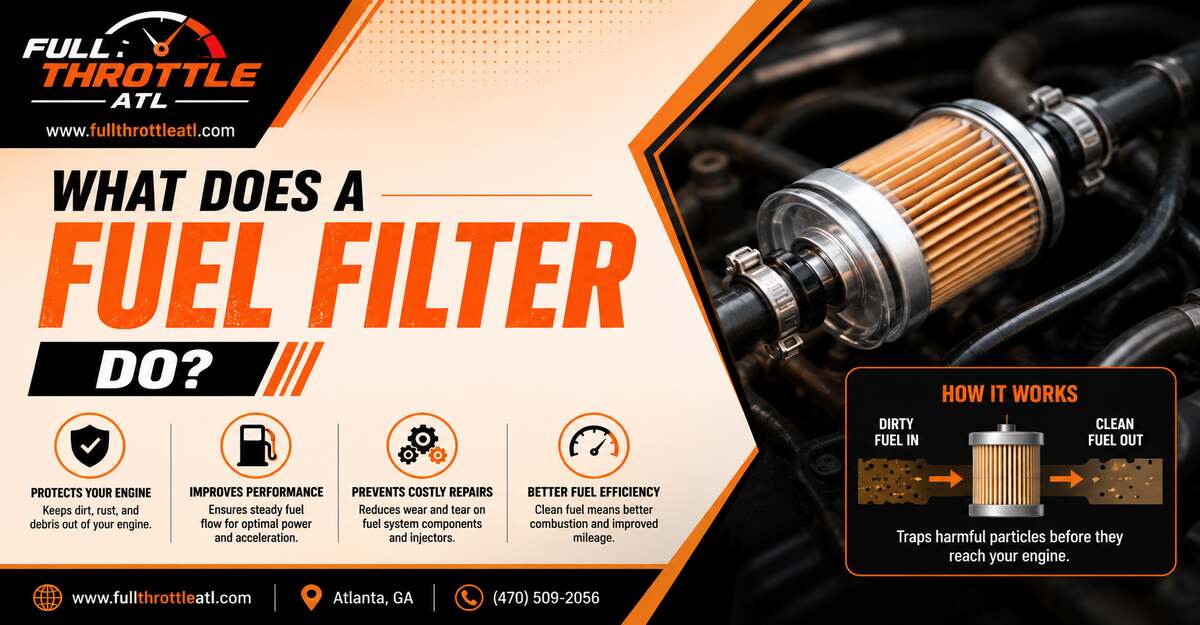
A fuel filter traps microscopic rust, dirt, and debris in a vehicle’s fuel system before these contaminants can reach the engine. By catching particles as small as 10 to 30 microns, the fuel filter protects highly pressurized fuel injectors and fuel pumps from severe abrasion, clogging, and catastrophic failure.
At a Glance
- Standard gasoline filters trap debris down to 10-30 microns, while diesel filters catch particles as small as 2-5 microns.
- Many modern gasoline vehicles use a permanent in-tank strainer rather than a serviceable inline filtration unit.
- Diesel systems utilize specialized fuel filter water separators to prevent injector corrosion and cold-weather freezing.
- A clogged fuel filter starves the engine of fuel, causing hard starting, hesitation under load, and rough idling.
- Neglecting fuel filtration on modern direct-injection cars can cause the fuel pump to overheat and fail completely.
How small are the particles a fuel filter catches?
Standard automotive fuel filters capture particles measuring 10 to 30 microns in diameter. For context, a human hair is roughly 70 microns wide. Advanced diesel fuel systems require even stricter filtration, utilizing secondary filters that catch debris as small as 2 to 5 microns.
High-quality aftermarket and OEM filters operate at 95% to 99% efficiency based on ISO 19438 industry standards. This efficiency rating means the filtration media catches nearly all harmful debris on the very first pass. The media must accomplish this while withstanding immense internal pressure; standard modern fuel pumps push gasoline at 40 to 60 PSI, whereas Gasoline Direct Injection (GDI) systems operate above 2,000 PSI. Diesel common-rail systems experience up to 30,000 PSI, requiring heavy-duty steel filter housings that will not burst under load.
Is a fuel filter the same as an oil or air filter?
No, a fuel filter is entirely different from an oil or air filter in construction, media design, and operating environment. While all three components utilize filtration media to protect the engine, they handle fundamentally different fluids and pressures.
An oil filter manages high-viscosity engine oil and heavy carbon sludge. An air filter manages low-pressure ambient air coming through the intake manifold. A fuel filter is specifically engineered to handle highly volatile, low-viscosity chemical solvents—gasoline or diesel—under extreme pressure. The cellulose or synthetic media inside a fuel filter must resist chemical degradation over years of submersion in fuel, a condition that would instantly destroy standard air or oil filter paper.
Do all modern cars have a replaceable fuel filter?
No, most gasoline vehicles manufactured after the mid-2000s do not feature an easily replaceable inline fuel filter. Instead, modern automotive manufacturers integrate a coarse plastic mesh strainer directly into the fuel pump module located inside the gas tank.
These in-tank strainers are rated for the lifetime of the fuel pump, which generally spans 100,000 to 150,000 miles. Automotive technicians do not service or replace these internal strainers during routine maintenance. The only time an in-tank strainer is replaced is when the entire fuel pump module fails and requires a complete swap. Owners of modern vehicles should consult their specific service manual to verify whether their car utilizes a lifetime strainer or a serviceable inline unit.
What is the difference between gasoline and diesel fuel filters?
Diesel fuel filters explicitly separate water from the fuel, whereas standard gasoline filters only trap solid particulates. Because diesel fuel’s chemical composition naturally attracts ambient moisture, and temperature fluctuations cause condensation inside the fuel tank, diesel engines require a specialized component called a “Fuel Filter Water Separator.”
This separator utilizes hydrophobic (water-repelling) media. The heavier water droplets fall to the bottom of the filter housing, where a sensor alerts the driver to manually open a petcock valve and drain the water. If a diesel vehicle lacked this water separation feature, microscopic water droplets would enter the 30,000-PSI fuel injectors, instantly vaporizing and causing severe cavitation or internal rust that destroys the injection system.
How do E85 flex-fuel vehicles change filtration requirements?
E85 flex-fuel vehicles require specialized fuel filters built with stainless steel mesh or synthetic glass-fiber media because high ethanol concentrations dissolve standard cellulose paper. Ethanol is a highly corrosive alcohol that aggressively breaks down the glues and paper elements used in traditional gasoline filters.
If a driver installs a standard paper fuel filter on an E85-converted vehicle, the ethanol will rapidly disintegrate the filtration media. The dissolved paper then flows directly into the fuel rail, instantly gumming up the engine and destroying the fuel injectors. High-performance and flex-fuel vehicles must always use synthetic or metal-element filtration systems explicitly rated for high-alcohol fuels.
Where is the fuel filter located in a vehicle?
An inline fuel filter is typically located underneath the vehicle along the frame rail, nestled in the fuel line running between the gas tank and the engine bay. In older carbureted vehicles, the filter often sits directly inside the engine bay near the carburetor inlet.
For modern vehicles utilizing in-tank strainers, the filtration unit resides entirely inside the gas tank, attached to the electric fuel pump assembly. Accessing an in-tank strainer requires removing the rear passenger seats to access the pump access port, or physically dropping the entire fuel tank from the undercarriage.
How much does it cost to replace a fuel filter?
Replacing an inline fuel filter typically costs between $50 and $175 for parts and professional labor. The replacement part itself is highly affordable, generally retailing for $15 to $40 at local auto parts stores. The remainder of the cost covers a half-hour of shop labor.
However, if the vehicle utilizes an in-tank lifetime strainer that has become hopelessly clogged, the cost rises dramatically. Because the strainer is integrated into the fuel pump, the entire fuel pump module must be replaced. A full fuel pump replacement generally costs between $600 and $1,200 depending on the vehicle make and whether the fuel tank requires removal.
What happens if you install a fuel filter backwards?
Installing a fuel filter backwards instantly restricts fuel volume and risks destroying the internal filter media, which can dump concentrated dirt directly into the fuel injectors. Fuel filters are strictly directional components.
Manufacturers print an arrow on the outside of the filter housing. This arrow must always point toward the engine (the direction of fuel flow). The internal filtration paper is structurally supported on the outlet side to withstand fuel pressure. Reversing the flow pushes against the unsupported side of the paper, causing the pleats to collapse, tear, and release all previously trapped contaminants into the delicate fuel rail.
Can you clean and reuse a dirty fuel filter?
No, you cannot clean and reuse a standard automotive fuel filter. Modern inline filters utilize tightly pleated cellulose or synthetic paper. Once microscopic dirt particles embed themselves deep inside the pores of this media, they cannot be washed out.
Attempting to spray harsh chemicals like brake cleaner backward through a paper filter will aggressively degrade the internal glue and tear the fragile pleats. Reinstalling a structurally compromised filter guarantees that raw, concentrated debris will bypass the media and destroy the fuel injectors. The only exception applies to high-performance aftermarket racing filters, which utilize washable stainless-steel mesh elements designed specifically for ultrasonic cleaning and reuse.
How long does a standard inline fuel filter last?
A traditional inline fuel filter lasts between 20,000 and 30,000 miles under normal driving conditions. Most automotive manufacturers mandate fuel filter replacement every two years as part of a major preventative maintenance schedule for older vehicles equipped with serviceable units.
Waiting beyond the 30,000-mile mark allows sediment to build up and severely restrict fuel flow. Even if the vehicle shows no obvious symptoms of hesitation, the restricted flow forces the vehicle’s fuel pump to work significantly harder to maintain adequate rail pressure, quietly shortening the lifespan of the entire fuel delivery system.
Why do standard fuel filter replacement schedules fail?
Standard mileage schedules fail because a single tank of highly contaminated gasoline can instantly clog a brand-new fuel filter. This scenario, known as the “bad batch” paradox, renders preventative maintenance intervals completely useless.
If a driver fills their tank at a gas station immediately after a fuel delivery truck has refilled the underground storage tanks, they risk pumping heavy sediment into their car. The delivery process violently stirs up years of settled dirt, rust, and water at the bottom of the station’s tanks. A brand-new fuel filter can clog completely within five miles of leaving a station that dispensed a bad batch of fuel.
What are the immediate signs of a clogged fuel filter?
The immediate signs of a clogged fuel filter include hard starting, severe hesitation during acceleration, and engine misfires at idle. These symptoms occur because the restricted filter starves the engine of the precise volume of fuel required for combustion. The progression typically follows three distinct stages:
- Hard starting: The vehicle takes longer to crank over in the morning because the fuel pump struggles to build initial pressure through the restricted media.
- Hesitation under load: The car drives normally at low speeds but bogs down, stutters, or loses power when accelerating hard onto a highway or climbing a steep hill.
- Misfires and rough idling: As the clog worsens, the engine shakes violently at stoplights because fuel starvation causes random cylinders to misfire.
Can a bad fuel filter trigger a Check Engine Light?
Yes, a severely restricted fuel filter will trigger a Check Engine Light, most commonly presenting as a P0171 (System Too Lean) diagnostic trouble code.
The vehicle’s engine control module (ECM) constantly monitors the air-to-fuel ratio via oxygen sensors in the exhaust. When a clogged fuel filter prevents adequate fuel from reaching the injectors, the engine pulls in far more air than fuel. The oxygen sensors detect this dangerous “lean” condition. The ECM will attempt to compensate by holding the fuel injectors open longer, but if the mechanical blockage is too severe, the computer illuminates the Check Engine Light to warn the driver of impending engine damage.
How does a clogged filter damage modern direct injection engines?
A restricted fuel filter forces the electronic fuel pump to operate at maximum capacity continuously, eventually causing the pump motor to overheat and burn out entirely.
On older carbureted vehicles, a clogged filter caused immediate sputtering, warning the driver of an issue. On modern turbocharged or Gasoline Direct Injection (GDI) vehicles, the engine computer masks the problem. The ECM senses the drop in fuel rail pressure and commands the electric fuel pump to increase its duty cycle. The driver feels no performance drop and sees no warning lights while the fuel pump quietly cooks itself. This silent damage turns a routine $30 filter replacement into a catastrophic $1,000 fuel pump failure.
Why does freezing weather cause intermittent stalling?
Freezing weather causes stalling when water trapped inside a fuel filter’s media solidifies into ice, physically blocking the flow of liquid fuel. This frustrating phenomenon is most common in diesel vehicles or gasoline vehicles that have absorbed condensation in the gas tank.
During a warm day, a water-contaminated fuel filter will pass fuel normally. However, when ambient temperatures drop below 32°F (0°C), the trapped water freezes solid against the microscopic pores of the filter paper. This causes a sudden “no-start” condition or severe stalling. Bafflingly, the problem disappears entirely once the ambient temperature rises or the vehicle is towed into a heated commercial garage, melting the ice and restoring fuel flow.
The Bottom Line
A fuel filter serves as the critical line of defense for a vehicle’s highly sensitive fuel delivery system, trapping microscopic contaminants before they can induce catastrophic injector failure. While standard replacement intervals hover around 20,000 to 30,000 miles, bad batches of gasoline or freezing temperatures can compromise a filter immediately. Drivers of modern vehicles must recognize the silent strain a clogged filter places on expensive fuel pumps, ensuring proactive maintenance prevents thousands of dollars in hidden engine damage.