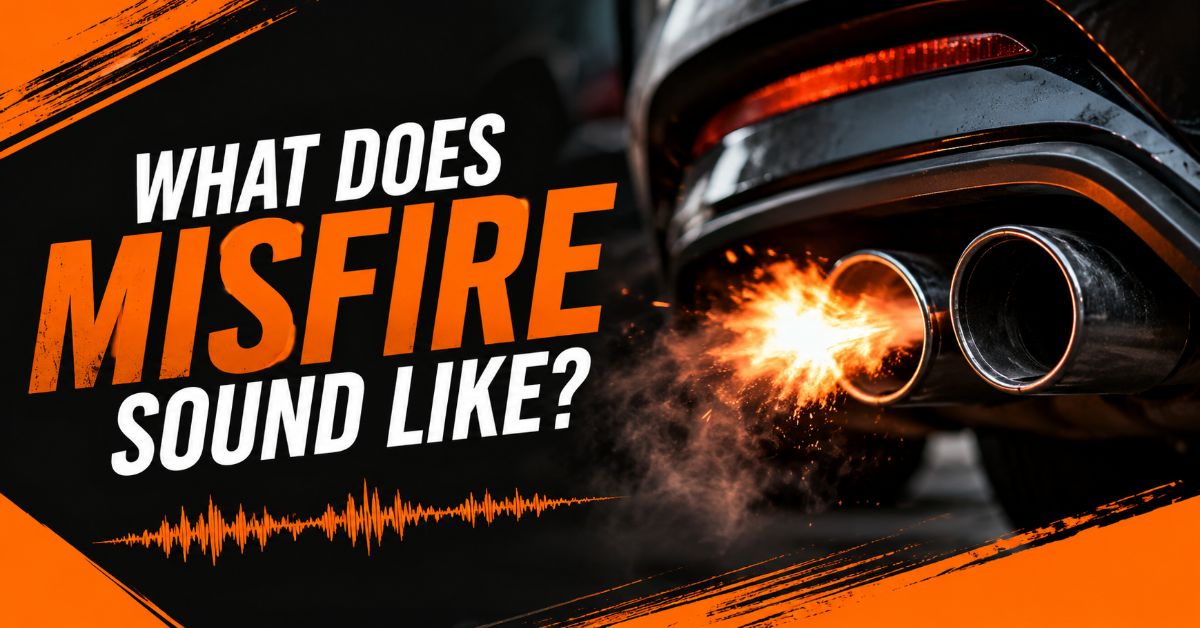
An engine misfire sounds like an irregular sputtering, popping, or deep thumping noise that interrupts the steady, rhythmic hum of a healthy engine. Depending on engine load, a misfire ranges from a soft “purr-cough-purr” at idle to a harsh, chugging, motorboat-like drone under heavy acceleration.
At a Glance
- At Idle: Sounds like a intermittent cough, uneven rhythm, or faint “puffing” pop out of the tailpipe.
- Under Acceleration: Sounds like a harsh, sputtering motorboat engine accompanied by severe chugging or vibration.
- At Highway Speeds: Sounds like a continuous low-frequency drone or floorboard vibration rather than a distinct pop.
- Acoustic Decibel Spike: A single cylinder misfire increases ambient cabin noise by 5 to 12 dB during firing drops.
- Visual Cue: The tachometer needle will bounce erratically by 50 to 150 RPM at idle.
What Does an Engine Misfire Sound Like at Different Speeds?
An engine misfire sounds different depending on engine load and rotational speed (RPM) because increasing exhaust velocity alters how combustion drops resonate through the exhaust system.
       MISFIRE ACOUSTIC PROFILE BY ENGINE OPERATING CONDITION
┌──────────────────┬───────────────────────────────┬────────────────────────────┐
│ Operating State  │ Primary Sound                 │ Physical Feeling           │
├──────────────────┼───────────────────────────────┼────────────────────────────┤
│ Idle             │ "Purr-purr-cough-purr"        │ Engine rocks irregularly   │
│ (600–800 RPM)    │ Rhythmic tailpipe "puffing"   │ Needle jumps 50-150 RPM    │
├──────────────────┼───────────────────────────────┼────────────────────────────┤
│ Acceleration     │ Sputtering "motorboat" chug   │ Violent vehicle hesitation │
│ (1,500–3,000 RPM)│ Low-frequency deep drone      │ Struggling power delivery  │
├──────────────────┼───────────────────────────────┼────────────────────────────┤
│ Highway Cruise   │ Continuous low buzzing        │ Subtle floorboard tremor   │
│ (>3,500 RPM)     │ Muffled acoustic drone        │ Disappears into road noise │
└──────────────────┴───────────────────────────────┴────────────────────────────┘
At Idle (600–800 RPM)
At idle, an engine misfire sounds like an uneven, stumbling beat—frequently described as a “purr-purr-cough-purr” pattern. Because exhaust gases travel slowly at idle, the unburnt air-fuel mixture escaping the dead cylinder creates a distinct “pop” or rhythm-breaking “puff” at the tailpipe every few combustion cycles.
Under Acceleration (1,500–3,000 RPM)
Under acceleration, an engine misfire sounds like a harsh, heavy sputtering or a rhythmic chugging similar to an overloaded motorboat. As the engine demands more power, the dead cylinder struggles against the working cylinders, generating a loud, low-frequency acoustic drone accompanied by strong cabin shaking.
At Highway Speeds (>3,500 RPM)
At highway speeds above 3,500 RPM, individual misfire pops merge together into a continuous background hum or buzzing sound. You will rarely hear distinct tailpipe pops at high speeds; instead, the misfire manifests as a steady, low-pitched vibration felt through the steering wheel and floorboards.
What Are the Decibel and RPM Signatures of a Misfire?
A single-cylinder misfire produces a measurable acoustic spike of 5 to 12 decibels (dB) above standard engine background noise, alongside erratic tachometer fluctuations of 50 to 150 RPM. Healthy engines idle smoothly within a tight ±10 RPM window, whereas a misfiring cylinder causes an immediate drop in rotational torque, forcing the crankshaft to decelerate momentarily.
You can calculate the exact acoustic frequency of a single-cylinder misfire sound using the Four-Stroke Cylinder Frequency Formula:
$$\text{Misfire Frequency (Hz)} = \frac{\text{RPM}}{60 \times 2}$$
For a standard 4-stroke engine idling at 720 RPM:
$$\text{Misfire Frequency} = \frac{720}{120} = 6 \text{ Hz}$$
This means a single dead cylinder on any 4-stroke engine idling at 720 RPM will produce an acoustic drop or tailpipe puff exactly 6 times per second (6 Hz).
What Does a Misfire Sound Like Inside the Cabin vs. Under the Hood?
Inside the cabin, a misfire sounds like a low, muffled bass thump or deep acoustic vibration accompanied by rattling plastic trim. Under the hood, the same misfire sounds like a sharp, mechanical slap, intake pop, or erratic engine mechanical stumble.
                  CABIN VS. UNDER-HOOD SOUND PROFILE
┌─────────────────────────┬─────────────────────────────────────────────────────┐
│ Location                │ Primary Acoustic Characteristics                    │
├─────────────────────────┼─────────────────────────────────────────────────────┤
│ Inside Cabin            │ • Low-frequency bass thud                           │
│                         │ • Rattling dashboard trim & steering column drone   │
│                         │ • Subdued interior resonance (firewall damped)      │
├─────────────────────────┼─────────────────────────────────────────────────────┤
│ Under Hood (Engine Bay) │ • Sharp intake spit or "pop"                        │
│                         │ • Metallic shaking and torque-mount slapping        │
│                         │ • Unfiltered mechanical stumble                     │
└─────────────────────────┴─────────────────────────────────────────────────────┘
The vehicle firewall and sound-deadening insulation filter out high-frequency mechanical noises. Consequently, drivers inside the cabin register misfires primarily as low-frequency vibrations and cabin resonance, whereas an observer standing over an open engine bay hears sharp intake spits, exhaust ticks, and direct mechanical shaking.
Why Do High-Cylinder Engines Disguise Misfire Sounds?
High-cylinder engines (V8, V10, V12) disguise misfire sounds because individual cylinder power strokes overlap heavily, diluting the acoustic interruption caused by a dead cylinder.
In a standard 4-cylinder engine, a single misfire represents a full 25% loss of total power strokes, producing a dramatic, unmistakable acoustic gap. In a V12 engine, one dead cylinder represents only 8.3% of power output. Because power strokes occur every 60 degrees of crankshaft rotation in a V12 (compared to 180 degrees in a 4-cylinder), the remaining eleven cylinders easily mask the dead cylinder’s silent cycle. At idle, a V12 engine with a complete single-cylinder misfire can sound entirely smooth to the human ear.
What Does a Lean Cruise Misfire Sound Like?
A lean cruise misfire sounds like a faint, erratic “pinging” or faint popcorn-popping noise coming from the front engine compartment while maintaining steady highway speeds.
This specific acoustic signature occurs under light throttle conditions when the air-fuel ratio becomes excessively lean (too much air, insufficient fuel). Unlike ignition-based misfires that grow louder under heavy acceleration, a lean cruise misfire disappears immediately the moment the driver presses the gas pedal down, as the engine control unit (ECU) enriches the fuel mixture and eliminates the lean condition.
What Is the “Afterfire Illusion” Caused by a Misfire?
The “afterfire illusion” is a deafening, gunshot-like “BANG” out of the tailpipe caused when raw, unburnt fuel from a misfiring cylinder ignites inside a red-hot exhaust pipe or catalytic converter.
When a spark plug fails to ignite the air-fuel mixture inside the combustion chamber, the engine pumps unburnt fuel directly into the exhaust system. When this raw fuel hits the white-hot internal substrates of the catalytic converter (which operates between 800°F and 1,400°F), it ignites instantaneously. This sudden, violent explosion in the exhaust tubing creates an acoustic bang so loud that it completely overwhelms and masks the subtle, original engine sputtering sound.
How Do You Tell if a Misfire Sound Is Spark, Fuel, or Compression Related?
You can identify the cause of a misfire sound by analyzing its sharpness, consistency, and reaction to throttle pressure.
                      MISFIRE SOUND DIAGNOSIS MATRIX
┌──────────────────────┬───────────────────────────────┬────────────────────────────┐
│ Cause                │ Acoustic Character            │ Throttle Reaction          │
├──────────────────────┼───────────────────────────────┼────────────────────────────┤
│ Spark Plug / Ignition │ Sharp, harsh, violent snap    │ Worse under heavy acceleration│
│ Fuel Injector        │ Soft, lean, erratic flutter   │ Consistent regardless of load│
│ Mechanical Compression│ Hollow, steady, rhythmic huff │ Constant at all speeds     │
└──────────────────────┴───────────────────────────────┴────────────────────────────┘
- Spark Plug (Ignition) Misfire: Sounds sharp, harsh, and abrupt. It becomes dramatically louder and more violent when accelerating hard or driving uphill, as high combustion pressures make it harder for weak spark plugs to fire.
- Fuel Injector Misfire: Sounds soft, lean, and fluttering. It presents as an erratic, subtle stumble at idle that remains relatively consistent regardless of how hard you press the accelerator pedal.
- Mechanical (Compression) Misfire: Sounds like a continuous, rhythmic “huffing” or cranking imbalance. It produces a distinct, hollow mechanical pulse that persists predictably across all RPM ranges.
How Do You Distinguish a Misfire Sound From Rod Knock or Valve Tap?
You can distinguish a misfire sound from rod knock or valve tap because a misfire is an irregular combustion stumble, whereas rod knock and valve tap are hard, metallic, mechanical impacts synchronized strictly with engine speed.
                       ENGINE NOISE DIFFERENTIAL TABLE
┌──────────────────┬─────────────────────────────┬─────────────────────────────────┐
│ Issue            │ Sound Character             │ Pitch & Tone                    │
├──────────────────┼─────────────────────────────┼─────────────────────────────────┤
│ Engine Misfire   │ Irregular stumble, pop, chug│ Low-frequency deep thud/sputter │
│ Rod Knock        │ Heavy, deep metallic thud   │ Loud, deep metallic impact      │
│ Valve Tap        │ Rapid, sharp ticking noise  │ High-pitched light tapping      │
└──────────────────┴─────────────────────────────┴─────────────────────────────────┘
- Misfire: Produces a low-frequency, irregular sputtering or thumping sound caused by missing combustion events.
- Rod Knock: Produces a heavy, double metallic “thud-thud” deep inside the engine block caused by worn crankshaft bearings. It gets exponentially louder with RPM and never sounds like a soft exhaust pop.
- Valve Tap (Tappet Noise): Produces a fast, high-pitched, crisp ticking sound at the top of the engine valve cover, caused by excessive clearance in the valvetrain.
What Non-Misfire Problems Sound Identical to a Misfire?
Three major non-misfire mechanical failures generate acoustic patterns and cabin vibrations identical to a cylinder misfire: dual-mass flywheel failures, broken engine mounts, and failing alternator diodes.
                NON-MISFIRE SIMILAR SOUND COMPARISON
┌───────────────────────┬──────────────────────────────┬────────────────────────────┐
│ Component Failure     │ Mimicked Misfire Sound       │ Actual Root Mechanism      │
├───────────────────────┼──────────────────────────────┼────────────────────────────┤
│ Dual-Mass Flywheel    │ Heavy idle thumping & shaking│ Internal spring breakdown  │
│ Broken Engine Mount   │ Low-frequency cabin drone    │ Metal-on-frame contact     │
│ Alternator Diode Leak │ Random jumping "ghost" pop   │ AC voltage corrupting ECU  │
└───────────────────────┴──────────────────────────────┴────────────────────────────┘
- Dual-Mass Flywheel Failure: An isolated flywheel spring failure produces a harsh, metallic thumping sound and severe low-RPM engine shaking. While it sounds identical to a dead cylinder, engine combustion is operating perfectly; the noise is entirely mechanical rotational imbalance.
- Broken Engine Mounts: When rubber engine mounts crack or tear, normal internal engine pulses transfer directly into the chassis. This creates a heavy interior cabin resonance and floorboard shudder that mimics a severe misfire.
- Failing Alternator Diode: A blown alternator diode leaks alternating current (AC) into the main direct current (DC) wiring harness. This AC ripple creates electrical noise that confuses ignition coils, causing a true “ghost misfire” that hops randomly from cylinder to cylinder with no stable acoustic pattern.
Can I Drive With an Engine Misfire?
No, you should not drive with an engine misfire, especially if your Check Engine Light is flashing. A flashing Check Engine Light indicates an active, severe misfire that is dumping raw, uncombusted fuel directly into the exhaust system.
Driving with an active misfire can destroy your vehicle’s catalytic converter within 5 to 15 minutes. The raw fuel ignites inside the catalytic converter, driving internal temperatures past 2,000°F and melting the internal ceramic honeycomb structure. This turns a minor spark plug or ignition coil repair into a multi-thousand-dollar exhaust overhaul. If your Check Engine Light flashes, safely pull off the road and turn off the ignition immediately.
How Long Can You Drive With a Misfiring Engine Before Damage Occurs?
You can drive a misfiring engine for less than 5 miles before permanent catalytic converter and cylinder wall damage occurs if the misfire is continuous.
If the misfire is light and intermittent (solid Check Engine Light), you may safely drive 10 to 20 miles directly to a repair shop at low speeds. However, continuous raw fuel washdown dilutes the protective oil film on cylinder walls within miles, leading to piston ring scoring, bearing wear, and total catalytic converter meltdown.
Why Does an Engine Misfire Sound Worse When the Engine Is Cold?
An engine misfire sounds worse when cold because cold thermal conditions create wider mechanical tolerances, lean fuel delivery, and weak electrical conductivity.
When an engine sits overnight, internal metal components contract. Small intake manifold vacuum leaks or slight head gasket sealing gaps are widest when cold, allowing excess air to enter and dilute the combustion mixture. Once the engine runs for 5 to 10 minutes, the metal components expand from thermal heat, effectively sealing tiny vacuum leaks and restoring cylinder compression. Consequently, cold-start misfire sputtering often disappears completely once the engine reaches normal operating temperature.
What Does a Misfire Sound Like on Turbocharged vs. Naturally Aspirated Engines?
On a turbocharged engine, a misfire sounds like an abrupt, fluttering “stutter-pop” accompanied by a sudden loss of boost pressure whistle. On a naturally aspirated engine, a misfire sounds like a classic, hollow motorboat chug.
When a turbocharged engine misfires under load, the sudden drop in exhaust gas volume causes the turbocharger compressor to briefly stall or lose momentum. This creates a distinct acoustic fluttering or “hiss-pop” through the intake system as forced air backpressures against the throttle body, making the misfire sound sharper and more sudden than on a naturally aspirated powertrain.
The Bottom Line
An engine misfire sounds like an irregular sputtering, popping, or motorboat-like chugging that breaks the smooth rhythm of your engine. While ignition issues produce sharp, loud pops under acceleration, fuel and compression misfires sound like soft, continuous flutters. If you hear these sounds accompanied by a flashing Check Engine Light, pull over and shut off the engine immediately to prevent catalytic converter destruction.