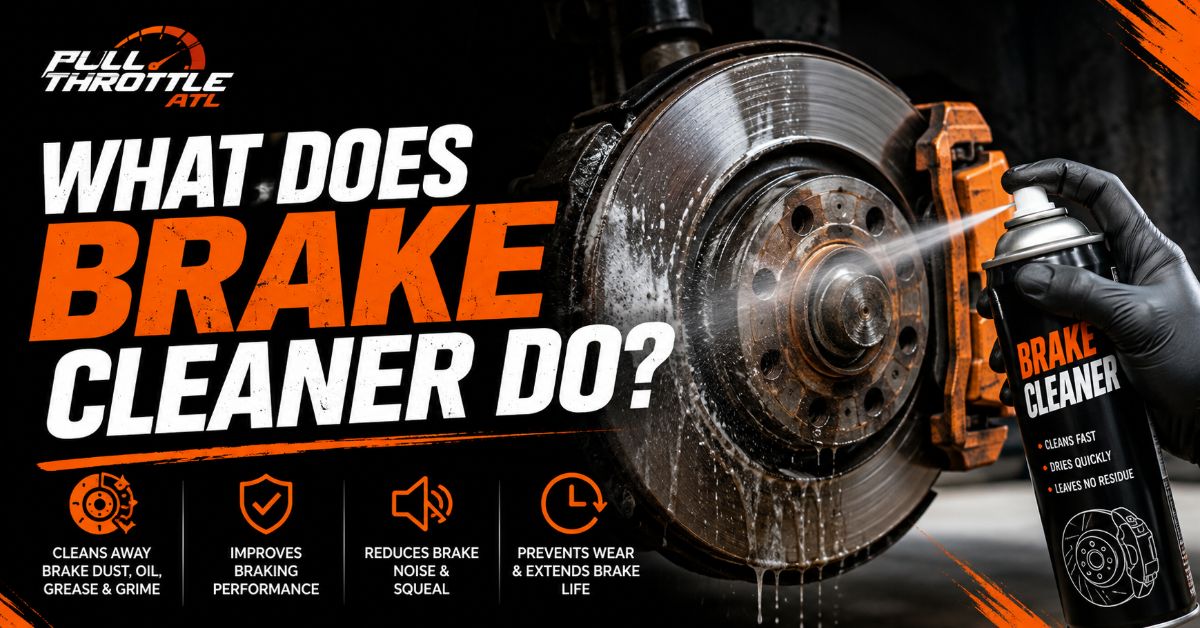
Brake cleaner is a fast-evaporating solvent spray engineered to dissolve oil, grease, brake fluid, and road grime from metal brake components without leaving a residue. By removing surface contaminants from rotors, calipers, and pads, brake cleaner restores the friction necessary for safe, optimal braking performance.
At a Glance
- Primary Function: Cleans oil, grease, and brake dust off bare metal friction surfaces instantly.
- Drying Speed: Dries residue-free within 5 to 10 seconds under standard conditions.
- Chemical Types: Available in non-flammable chlorinated and highly flammable non-chlorinated formulas.
- Critical Warning: Never spray chlorinated brake cleaner on metal prior to heating or welding due to phosgene gas formation.
- Material Compatibility: Destroys paint, degrades rubber seals, and melts soft plastics upon contact.
How Does Brake Cleaner Work Chemically and Mechanically?
Brake cleaner works through a combination of high-pressure mechanical displacement and rapid chemical solvation. The pressurized aerosol stream (typically delivered at 40 to 90 PSI) physically forces loose particulates, metallic dust, and caked-on dirt off assembly surfaces. Concurrently, powerful lipophilic chemical solvents break down insoluble organic compounds—such as heavy grease, silicone lubricants, and petroleum residue—dissolving them into a liquid runoff.
Because the chemical solvents chosen for brake cleaner feature exceptionally high volatility, they flash off into vapor rapidly after dissolving the grime. This ensures zero chemical film or greasy residue remains on the bare metal. Without a residue-free finish, residual solvents would contaminate brake pad friction linings and cause pedal fade or sudden stopping failure.
What Is the Difference Between Chlorinated and Non-Chlorinated Brake Cleaner?
The fundamental difference between chlorinated and non-chlorinated brake cleaners lies in their flammability, primary chemical solvent ingredients, and regulatory availability across regional markets.
| Feature | Chlorinated Brake Cleaner | Non-Chlorinated Brake Cleaner |
| Primary Solvents | Tetrachloroethylene (Perchloroethylene) | Acetone, Toluene, Heptane, Methanol |
| Flammability | Non-flammable | Highly flammable |
| Drying Speed | Rapid (under 5 seconds) | Moderate (5 to 10 seconds) |
| Degreasing Power | Exceptional on heavy grease | Strong, requires more mechanical aerosol pressure |
| Environmental Hazard | High VOCs/Toxic Air Contaminant | Variable VOCs (regulated under CARB) |
| Regional Availability | Restricted in CA, NJ, and select states | Widely available across all jurisdictions |
Chlorinated formulas rely on dense chlorinated hydrocarbons that will not catch fire, making them traditional shop favorites around hot engines. However, non-chlorinated formulas use flammable hydrocarbon alcohols and ketones to meet strict Volatile Organic Compound (VOC) environmental compliance standards.
How Long Does Brake Cleaner Take to Dry and Evaporate?
Brake cleaner evaporates completely in 5 to 10 seconds under standard ambient temperatures ($20^\circ\text{C}$ / $68^\circ\text{F}$). Chlorinated variants flash off almost instantly within 3 to 5 seconds, whereas non-chlorinated mixtures containing heptane or toluene may take up to 10 to 15 seconds in cold or high-humidity environments.
To ensure proper drying and prevent trapped moisture from degrading braking friction, observe these operational factors:
- Ambient Temperature: Temperatures below freezing ($0^\circ\text{C}$ / $32^\circ\text{F}$) slow solvent evaporation by more than half.
- Surface Mass: Thick iron rotors dissipate solvent vapor faster than recessed caliper boots or enclosed drum assemblies.
- Airflow: Spraying in a well-ventilated cross-breeze accelerates drying time to under 3 seconds.
How Do You Safely Apply Brake Cleaner to a Brake Assembly?
To safely apply brake cleaner during a brake job or routine inspection, follow this step-by-step procedure to eliminate contamination while protecting surrounding non-metal components.
1.Put on Personal Protective Equipment (PPE):Eye and skin protection is mandatory.
Put on chemical-resistant nitrile gloves and ANSI-approved safety glasses. Brake cleaner causes severe eye irritation and penetrates skin quickly.
2.Position a Catch Pan:Collect solvent runoff and dissolved grime.
Place a metal or solvent-safe drip tray directly underneath the brake rotor and caliper assembly to collect dirty liquid runoff and keep shop floors clean.
3.Mask Sensitive Components:Protect non-metal rubber and plastic parts.
Shield nearby rubber slide-pin boots, ABS wheel speed sensors, and painted body panels using a shop rag or temporary barrier.
4.Spray from Top to Bottom:Allow gravity to flush away contaminants.
Hold the can 10 to 12 inches away from the brake components. Spray liberally starting at the top of the rotor and caliper, letting the liquid stream flush contaminants down into the catch pan.
5.Wipe or Air Dry:Ensure zero liquid remains before reassembly.
Allow the surface to air-dry for 10 seconds, or wipe the bare metal with a clean, lint-free microfiber towel. Ensure no pooled liquid remains in bolt recesses or caliper crevices.
What Happens if You Spray Brake Cleaner on Plastic, Rubber, or Paint?
Spraying brake cleaner on plastic, rubber, or automotive paint causes immediate surface degradation, structural weakening, or complete chemical dissolution. The aggressive solvents—specifically acetone, toluene, and tetrachloroethylene—act as immediate plasticizers and paint strippers.
- Plastics (ABS housings, electrical plugs): Solvents attack polymer chains, causing the plastic to cloud, soften, stress-crack, or melt into a sticky paste.
- Rubbers (Caliper piston seals, guide pin boots): Rubber components absorb the solvent, causing rapid swelling, loss of elasticity, embrittlement, and eventual tear failure.
- Painted Surfaces: Brake cleaner strips clear coats and base layers within seconds, causing automotive paint to bubble, cloud, or peel.
If accidental contact occurs, immediately flush the affected area with water and wipe it clean with a dry microfiber rag to minimize long-term damage.
Why Is Using Brake Cleaner Before Welding Extremely Dangerous?
Using chlorinated brake cleaner on metal components prior to welding or torch heating is extremely dangerous because it creates phosgene gas ($COCl_2$), a deadly chemical weapon and pulmonary irritant.
When tetrachloroethylene residues are exposed to intense heat exceeding $315^\circ\text{C}$ ($600^\circ\text{F}$) or ultraviolet radiation from an electric welding arc, the molecule decomposes. This thermal breakdown releases phosgene gas alongside hydrogen chloride.
Fatal Exposure Risk
Inhaling even trace concentrations of phosgene gas (as low as 2 parts per million) causes severe pulmonary edema, severe chemical burns to lung tissue, and potential death. Symptoms are often delayed by up to 24 hours. Never use chlorinated solvents on parts intended for welding, heating, or plasma cutting.
What Else Can You Use Brake Cleaner For Besides Brakes?
Mechanics frequently use brake cleaner as a general-purpose heavy degreaser outside the braking system due to its residue-free drying profile. Safe alternative uses include:
- Engine Mating Surfaces: Cleans oil pans, valve cover rails, and timing covers prior to applying RTV silicone gasket maker to guarantee a leak-free seal.
- Hand Tool Maintenance: Instantly strips greasy film, oil, and metal shavings from steel sockets, ratchets, and wrenches.
- Driveway Spot Treatment: Blasts fresh petroleum and motor oil spills off concrete driveways to lift the fluid before it saturates the porous masonry.
- Clutch and Flywheel Prep: Removes anti-corrosion storage oils from newly unboxed manual transmission flywheels and pressure plates.
Can You Use Brake Cleaner to Clean a Mass Air Flow (MAF) Sensor?
No, you should never use brake cleaner on a Mass Air Flow (MAF) sensor. MAF sensors rely on microscopic, sensitive platinum hot-wires housed inside delicate plastic sleeves.
The harsh solvents in standard brake cleaners—such as acetone and toluene—will instantly melt the sensor’s internal plastic housing, strip delicate protective coatings, or leave microscopic chemical residues that distort airflow readings. Distorted sensor readings cause engine misfires, rough idling, and poor fuel economy. Always use a dedicated MAF Sensor Cleaner, which uses mild, plastic-safe hexanes that dry clean without harming fragile electronics.
Is Brake Cleaner Safe to Use on Electrical Wires and Connections?
No, brake cleaner is generally unsafe for electrical wires, harness connectors, and electronic components. The solvents dissolve the insulating varnish on copper windings inside alternators and starter motors, leading to short circuits. Furthermore, non-chlorinated variants can melt the plastic locking tabs on modern wiring harnesses and dissolve dielectric grease inside terminal boots.
For electrical components, use a dedicated Electrical Contact Cleaner formulated with plastic-safe, non-conductive solvents.
Will Brake Cleaner Stop My Brakes From Squeaking?
Brake cleaner will only stop brake squeaking if the noise is directly caused by temporary surface contamination, such as road oil, dirt, or oversprayed grease on the rotor faces.
Brake cleaner will not fix structural or mechanical causes of brake noise, including:
- Worn Friction Pads: Pads worn down to the metal backing plate or scraping their built-in mechanical wear indicators.
- Glazed Rotors and Pads: Overheated friction materials that have hardened into a smooth, glassy finish.
- Missing Anti-Squeal Hardware: Absence of anti-squeal shims, abutment clips, or proper high-temperature caliper grease on pad backing contact points.
Is It Safe to Use Brake Cleaner as Engine Starting Fluid?
No, brake cleaner should not be used as an engine starting fluid.
Using chlorinated brake cleaner as a starting fluid introduces tetrachloroethylene into the combustion chamber. When burned, chlorinated solvents produce toxic hydrochloric acid and phosgene gas, which corrode internal cylinder walls, destroy oxygen sensors, and poison the catalytic converter.
While non-chlorinated brake cleaner is highly flammable and may fire an engine, it lacks the upper-cylinder lubricants found in true diethyl ether starting fluids. Repeated use dries out cylinder walls, leading to ring scoring and engine compression loss.
What Is the Best Alternative If You Do Not Have Brake Cleaner?
If you do not have brake cleaner on hand, the best alternatives depend on the component you are cleaning and the surface material involved.
| Alternative Solvent | Best Used For | Pros | Cons |
| Isopropyl Alcohol (99%) | Rotor faces, MAF sensors, light oil prep | Safe on most plastics, leaves zero residue | Slower evaporation, weaker on heavy grease |
| Acetone (Pure) | Bare, unpainted steel or iron parts | Superior grease-dissolving power | Highly flammable, instantly destroys plastic and paint |
| Warm Water & Dawn Soap | Washable bare metal brake rotors | Environmentally friendly, cuts heavy grease | Requires immediate thorough drying to prevent flash rust |
| Degreaser / Mineral Spirits | Structural engine blocks, suspension arms | High solvency for heavy caked-on sludge | Leaves an oily residue that must be rinsed before brake assembly |
How Should Brake Cleaner Be Disposed of and Cleaned Off Shop Floors?
Unused liquid brake cleaner, contaminated shop rags, and saturated floor absorbent must be treated as hazardous waste under federal and local environmental laws.
- Liquid and Aerosol Disposal: Never pour liquid brake cleaner down drains, storm sewers, or onto soil. Empty aerosol cans can often be recycled with scrap metal once depressurized, but cans containing liquid must go to a certified household hazardous waste collection facility.
- Cleaning Floor Spills: Apply a commercial clay-based floor absorbent or cat litter over liquid spills on concrete. Allow the absorbent to soak up the solvent, sweep it into a sealed metal container, and dispose of it through hazardous waste channels.
- Rag Storage: Store solvent-soaked shop towels in an OSHA-approved self-closing, fire-safe steel container to prevent spontaneous combustion from flammable non-chlorinated vapor buildup.
The Bottom Line
Brake cleaner is a high-pressure solvent engineered to dissolve oil, grease, and grime from bare metal braking components, drying residue-free within seconds. However, its strength makes it dangerous around non-metal materials like plastics, rubbers, and painted surfaces. Most importantly, chlorinated brake cleaner must never be exposed to heat or welding due to the production of lethal phosgene gas. For non-braking tasks like cleaning MAF sensors or electrical wiring, always skip brake cleaner in favor of specialized, plastic-safe contact sprays.