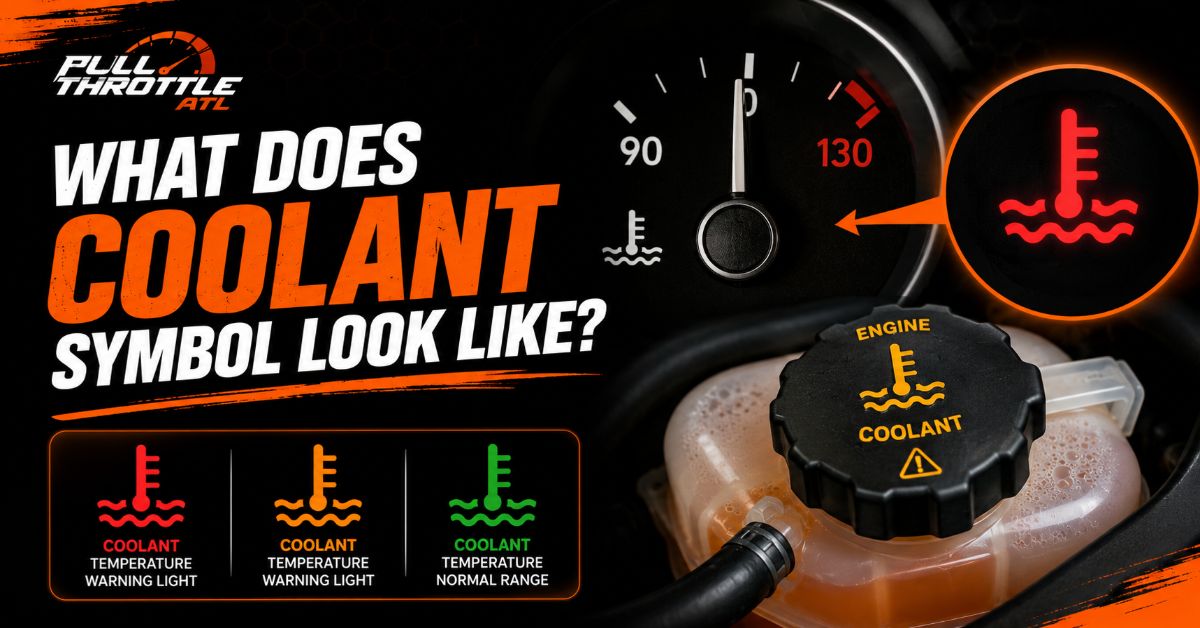
The standard engine coolant symbol looks like a vertical thermometer submerged in two wavy horizontal lines, representing liquid. On modern vehicle dashboards, this icon illuminates in blue to signal a cold engine, yellow or amber to indicate low fluid levels, and solid or flashing red to warn of critical engine overheating.
   [ | ]   <- Thermometer
 ~~~~~~~~~ <- Liquid Waves
 ~~~~~~~~~
At a Glance
- Standard Visual: A upright thermometer resting inside two wavy lines indicating coolant liquid.
- Blue Light: Engine operating temperature is below $120^\circ\text{F}$ ($49^\circ\text{C}$); drive moderately until it turns off.
- Red Light: Engine temperature exceeds $240^\circ\text{F}$ ($115^\circ\text{C}$); pull over and shut off the engine within 60 seconds.
- Secondary Cap Icon: A radiator with a cap being opened or steam escaping indicates low fluid volume, not temperature.
- The Air Pocket Trap: A severe coolant leak can leave the sensor in dry air, showing a false “Cold” reading while the engine actively overheats.
What is the visual difference between the coolant temperature light and low coolant level light?
The coolant temperature light depicts a thermometer submerged in wavy lines, whereas the low coolant level light displays a rectangular radiator box with a cap being removed or steam venting from it.
| Symbol Type | Graphic Design | Primary Trigger | Critical Action |
| Coolant Temperature | Vertical thermometer inside two wavy liquid lines | Thermal excursion above $240^\circ\text{F}$ or below $120^\circ\text{F}$ | Stop driving immediately if red; avoid hard acceleration if blue. |
| Low Coolant Level | Rectangular radiator with fill cap or dripping liquid | Fluid volume in expansion tank drops below minimum sensor probe | Top off system with proper 50/50 mix when engine is cold. |
While the temperature icon alerts you to thermal spikes, the level icon warns of volume loss before overheating occurs. Some European vehicles combine both functions into the thermometer symbol, switching the color from amber (low fluid) to red (overheating).
What does a blue coolant symbol mean on your dashboard?
A blue coolant symbol indicates that the engine coolant temperature is below its normal operating threshold, typically under $120^\circ\text{F}$ ($49^\circ\text{C}$). It is a status indicator rather than a fault warning, appearing automatically upon cold engine startup in vehicles without physical temperature gauges (such as Subaru, Mazda, and Honda models).
[ Blue Light ] ---> Engine Temp < 120°F ---> Drive moderately until light extinguishes
The blue icon automatically turns off once the coolant reaches normal operating range ($195^\circ\text{F}\text{–}220^\circ\text{F}$). You can safely drive while the blue symbol is visible, but you must avoid hard acceleration, high RPMs, and heavy towing until the light extinguishes. If the blue light remains illuminated after 15 minutes of continuous driving, your engine thermostat is likely stuck in the open position, preventing proper thermal warmup and degrading fuel economy.
What should you do when a red coolant light comes on while driving?
When a red coolant light illuminates solid or flashing, you must immediately pull over to a safe location, turn off the engine within 60 seconds, and let the vehicle cool completely. Driving with a red coolant light risks warping the aluminum cylinder head, blowing a head gasket, or cracking the engine block.
[ Red Light Appears ]
        │
        ▼
[ Pull Over Safely ] ---> Turn Off Engine Within 60 Seconds
        │
        ▼
[ Wait 30-45 Minutes ] ---> Check Fluid Levels safely (Do NOT open hot cap)
- Safely pull onto the shoulder or parking lot immediately. Do not attempt to complete your drive or reach the next highway exit.
- Turn off the ignition instantly. Shutting off the combustion process stops further heat generation inside the cylinder heads.
- Pop the hood release latch from inside the cabin, but do not touch the engine bay until steam stops escaping.
- Wait a minimum of 30 to 45 minutes before inspecting the coolant reservoir level or engine components.
- Call for roadside assistance if fluid is visible leaking beneath the engine cradle or if the fluid reservoir is empty.
What does a yellow or amber coolant symbol mean?
A yellow or amber coolant symbol indicates a non-critical warning, typically signaling that the engine coolant level is low or that operating temperatures have crossed an initial caution threshold between $225^\circ\text{F}$ and $230^\circ\text{F}$ ($107^\circ\text{C}\text{–}110^\circ\text{C}$).
Unlike a red warning, an amber icon does not demand an immediate emergency shutdown on the highway shoulder. However, it alerts you to service the cooling system at the earliest opportunity. Continued driving under an active yellow coolant light will cause the system to breach the critical $240^\circ\text{F}$ limit, triggering a full red overheating warning. Stop at a service station, wait for the engine to cool down, and inspect the fluid expansion tank level.
Why is the coolant light flashing instead of staying solid?
A flashing red coolant light indicates a critical, active thermal emergency or severe fluid loss where temperatures are rising at an unsafe rate.
While a solid red light warns that temperatures have exceeded normal bounds, a flashing light indicates active boiling or massive pressure spikes within the cooling jacket. In brands like Volkswagen and Audi, a flashing red coolant light specifically signifies that the fluid volume in the expansion tank has dropped critically low while the engine is running. Stop the vehicle immediately when a flashing state is observed; engine destruction can occur within seconds under these conditions.
At what engine temperature does the coolant light turn red?
The coolant light turns solid or flashing red when engine coolant temperatures reach $240^\circ\text{F}$ ($115^\circ\text{C}$) or higher.
| Temperature Range | Engine Operating Status | Coolant Symbol State |
| Below $120^\circ\text{F}$ ($49^\circ\text{C}$) | Cold Warmup Phase | Solid Blue (select models) |
| $195^\circ\text{F}\text{ to }220^\circ\text{F}$ ($90^\circ\text{C}\text{ to }104^\circ\text{C}$) | Ideal Operating Range | Unlit / Normal Gauge |
| $225^\circ\text{F}\text{ to }230^\circ\text{F}$ ($107^\circ\text{C}\text{–}110^\circ\text{C}$) | Elevated Caution Level | Yellow / Amber Warning |
| $240^\circ\text{F}+$ ($115^\circ\text{C}+$) | Critical Overheating Zone | Solid or Flashing Red |
Modern pressurized cooling systems use a 50/50 ethylene glycol mix and a 15 PSI radiator cap to elevate the boiling point of coolant to roughly $265^\circ\text{F}$ ($129^\circ\text{C}$). The red warning light triggers at $240^\circ\text{F}$ to give the driver a safety margin before total thermal boil-over occurs.
Why is your coolant light on if the coolant reservoir is full?
A coolant light that illuminates while the plastic coolant reservoir is full is caused by a failed fluid level sensor, a broken water pump, or a non-functional radiator cooling fan.
           [ Full Coolant Reservoir + Active Light ]
                              │
       ┌──────────────────────┼──────────────────────┐
       ▼                      ▼                      ▼
[ Sensor Failure ]     [ Pump Failure ]      [ Fan Failure ]
 Magnetic float stuck  Impeller broken; no   Fan motor dead;
 in empty position     internal circulation  idle overheating
- Faulty Level Sensor: The magnetic float inside the plastic expansion tank can sink, stick, or suffer electrical failure, signaling an empty tank to the engine control unit (ECU) when fluid levels are correct.
- Water Pump Impeller Failure: If the internal impeller blades of the water pump shear off, coolant remains stationary. The fluid inside the expansion tank stays cool, but the fluid trapped inside the engine block boils instantly.
- Radiator Fan Failure: If the electric cooling fan fails, air will not pull through the radiator fins while idling. The car will overheat in traffic even with a filled coolant reservoir.
Why does the coolant temperature gauge read cold when the engine is overheating?
A temperature gauge reads cold during active overheating when a complete loss of coolant leaves the temperature sensor surrounded by dry air instead of liquid fluid.
Temperature senders are calibrated to read thermal transfer through liquid. Air does not conduct heat to the sensor probe as efficiently as liquid coolant. When a catastrophic hose burst empties the system, the sensor sits in dry air and drops the gauge needle down to “Cold.” Meanwhile, the uncooled metal pistons and cylinder walls heat up rapidly. If you observe steam, smell a sweet syrup odor, or notice engine pinging while your temperature gauge displays “Cold,” ignore the gauge reading and shut down the engine immediately.
How long should you wait for an overheating engine to cool down before opening the cap?
You must wait at least 30 to 45 minutes for an overheating engine to cool before attempting to open the radiator or expansion tank cap.
Opening a hot cooling system releases pressurized, superheated liquid that flashes instantly into steam, causing severe thermal skin burns.
- Touch the top rubber radiator hose with your bare hand only after 30+ minutes.
- If the hose feels hard and hot when squeezed, the system is still under high pressure.
- Wait until the hose feels soft, pliable, and cool to the touch.
- Drape a thick shop towel over the cap and rotate it counterclockwise to its first safety stop to vent residual pressure safely before removing it completely.
Can you drive with a blue coolant light illuminated?
Yes, you can safely drive your vehicle with a blue coolant light illuminated, provided you drive gently and limit engine loads.
The blue light signals that the engine oil and coolant have not reached optimal thermal efficiency. Accelerating rapidly, towing trailers, or driving at wide-open throttle with a blue light active accelerates internal engine wear because cold engine oil is thicker and less capable of protecting high-friction components. Once the engine reaches operating temperature, the light turns off automatically.
Can you add tap water to your coolant reservoir in an emergency?
You can add tap water to your coolant reservoir only as a short-term emergency measure to reach a repair facility.
[ Emergency Tap Water Added ] ---> Drive to Safety ---> Full Flush Required
                                                      (Prevents Corrosion/Freezing)
Tap water contains minerals like calcium and magnesium that precipitate under heat, forming scale deposits inside radiator passages and water pump seals. Pure water also lacks anti-corrosion additives, freezes at $32^\circ\text{F}$ ($0^\circ\text{C}$), and boils at a lower temperature than proper antifreeze mixtures. If tap water is used to survive an emergency roadside leak, you must perform a complete cooling system flush and refill with the manufacturer-recommended 50/50 antifreeze-to-distilled-water blend as soon as possible.
Why does your cabin heater blow cold air when the coolant light is on?
Your cabin heater blows cold air during a coolant warning because the fluid level inside the cooling system has dropped below the supply hose to the heater core.
The heater core is a small radiator mounted behind your vehicle’s dashboard that relies on hot engine coolant circulating through it to generate cabin heat. Because the heater core sits high in the cooling system circuit, it is the first component to lose fluid circulation when a leak occurs. Cold air blowing from your vents when the heat is turned to maximum is an early mechanical symptom of severe coolant loss, often occurring minutes before the red temperature light triggers on the instrument cluster.
How does a coolant symbol work on an electric vehicle (EV)?
On an electric vehicle (EV), the coolant symbol indicates a thermal fault or low fluid level in the liquid cooling loop that regulates the high-voltage battery pack, electric drive motors, and power electronics.
EVs do not have internal combustion engine oil, but they use glycol-based coolant loops to keep battery cells within an optimal $59^\circ\text{F}\text{ to }95^\circ\text{F}$ ($15^\circ\text{C}\text{–}35^\circ\text{C}$) window. If an EV coolant light illuminates, the vehicle’s onboard management system will restrict fast-charging speeds, derate acceleration power, and limit overall vehicle performance to protect battery cell chemistry from thermal degradation.
The Bottom Line
The engine coolant symbol—a thermometer resting in waves—is your primary visual defense against catastrophic engine damage. A blue icon requires moderate driving until warmup finishes, while an amber icon indicates low volume or mild thermal elevation requiring prompt attention. A solid or flashing red symbol demands an immediate engine shutdown within 60 seconds to prevent permanent warping and engine failure.