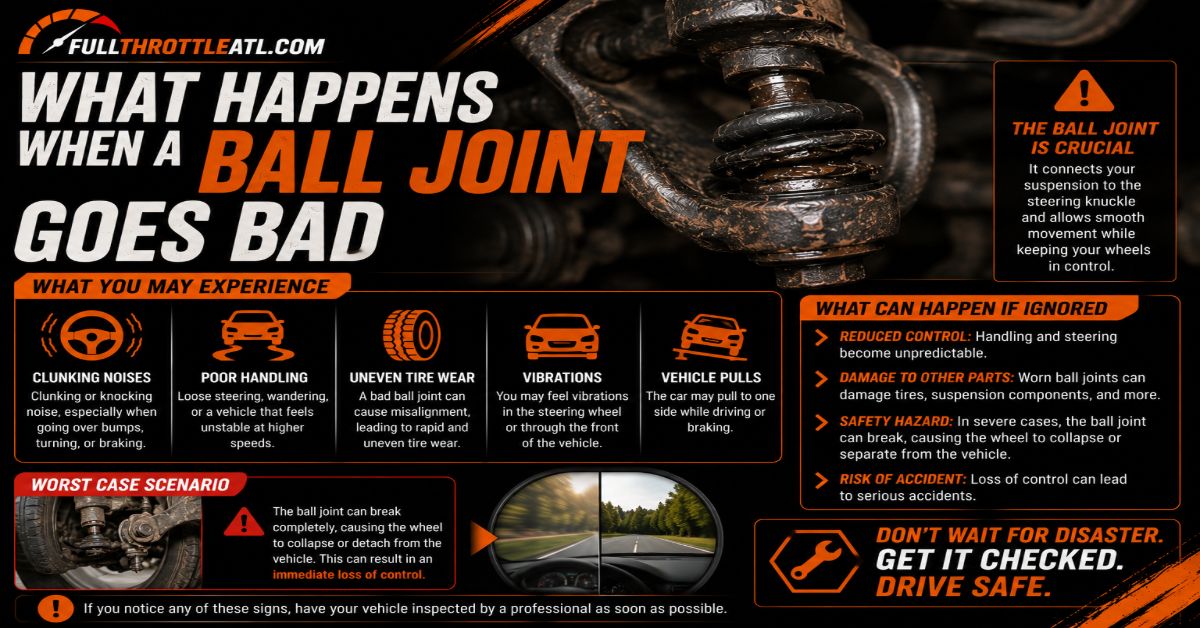
When a ball joint goes bad, the vehicle suspension loses its primary pivot point. This wear initially causes metallic clunking noises and vague steering. If left unaddressed, the internal ball pulls completely out of its socket, causing immediate wheel separation, total loss of steering, and catastrophic suspension damage.
At a Glance:
- Early wear introduces 0.5 mm to 1.5 mm of internal clearance, producing metallic popping sounds over speed bumps.
- Mid stage wear causes random steering wander and destroys tire treads within 500 to 1,000 miles.
- Critical failure results in complete wheel collapse, frequently severing brake lines and crushing the fender.
- Load carrying joints can show zero play when hanging freely on a lift due to spring tension.
- Seized joints may exhibit zero looseness but cause extreme steering stiffness and sudden snapping.
- Replacing a ball joint fundamentally alters steering knuckle geometry and requires an immediate wheel alignment.
What are the symptoms of early stage ball joint wear?
Early stage ball joint wear produces a distinct metallic clunking or popping noise when driving over uneven surfaces. This noise occurs because the internal ball and socket develop between 0.5 mm and 1.5 mm of excess clearance. When the suspension travels up and down, the steel ball physically hammers against the inside of the housing.
Drivers will typically notice this sound first during low speed maneuvers. Transitioning from a flat road into an inclined driveway, rolling over small potholes, or navigating over speed bumps in parking lots are the most common triggers. Because the ball joint connects the control arm to the heavy steering knuckle, the acoustic vibration travels directly through the vehicle chassis.
At this early stage, the vehicle may still drive relatively straight on smooth highways. The steering wheel might feel normal, and tire wear may not yet be visible. However, that faint metallic popping is the very first mechanical warning that the internal polyurethane bearing or steel housing has begun to degrade. Ignoring this early auditory warning allows the excess clearance to multiply rapidly under the weight of the engine.
How does mid stage wear affect vehicle handling and tires?
Mid stage wear causes the steering wheel to vibrate and forces the vehicle to wander unpredictably to the left or right. At this stage, internal clearance expands to between 1.5 mm and 3.0 mm. Because the wheel is no longer held firmly in its vertical axis, the tire essentially steers itself slightly independent of the steering wheel input.
This constant shifting creates a phenomenon called steering wander. The driver will feel forced to make constant micro corrections to keep the vehicle in a straight lane. Furthermore, this shifting severely disrupts the camber and toe angles of the wheel alignment.
When the tire leans inward or outward inappropriately, the abrasive road surface begins to scrub the rubber away. This uneven friction causes cupping or feathering, a specific wear pattern that rapidly destroys the inner or outer edge of the tire tread. A ball joint operating with mid stage wear can completely ruin a brand new set of tires within 500 to 1,000 miles. The vehicle may also exhibit a loose, disconnected feeling in the steering column, especially when braking firmly from highway speeds.
What happens during a critical ball joint failure?
Critical failure results in the ball pulling completely out of the socket, causing the wheel to instantly collapse outward or fold under the fender. This separation happens when the internal wear exceeds 3.0 mm or pushes past the manufacturer safety limits. The suspension completely loses its structural connection to the wheel hub.
This catastrophic separation usually happens under two specific conditions. The first is high load, low speed maneuvering. Parallel parking puts immense lateral shear force on the steering knuckle because the driver is turning the tires while they are gripping stationary pavement. The joint finally pops out under this twisting pressure. The second condition is an intense high speed impact, such as striking a deep pothole at 60 mph.
Once the joint separates, the lower control arm drops to the pavement. The wheel hub is suddenly free to pivot wildly, which usually snaps the CV axle on front wheel drive cars. The collapsing heavy metal components frequently sever the flexible rubber brake lines, causing an instant loss of hydraulic braking pressure. The tire then crashes into the metal fender, locking the wheel and dragging the vehicle to a violent, uncontrolled stop.
What causes a ball joint to fail prematurely?
The most common cause of premature ball joint failure is a torn polyurethane or rubber dust boot. Once the boot tears, internal lubricating grease escapes while water and abrasive road grit enter the socket. This mixture creates a highly destructive grinding paste that hollows out the steel housing at a highly accelerated rate.
Environmental factors play a massive role in this degradation. Vehicles driven in the salt belt experience faster failure rates because corrosive road salt hardens and cracks the rubber dust boots. Once the boot loses its elasticity, normal suspension movement rips it open.
Improper maintenance also drives early failure. Some aftermarket ball joints feature a grease fitting (known as a zert). If an inexperienced technician overfills the joint with a high pressure grease gun, the excess pressure blows the rubber boot completely off its sealing ring. Finally, striking curbs or continuously driving on heavily rutted dirt roads submits the internal bearing to impact forces that exceed its engineered load rating, resulting in rapid mechanical deformation.
Are upper or lower ball joints more likely to fail?
Lower ball joints are significantly more likely to fail because they bear the entire weight of the vehicle in most suspension designs. These load carrying joints endure constant tension and compression forces from the coil springs, the engine block, and the chassis.
In a standard Short Long Arm (SLA) suspension, the lower ball joint acts as the primary pivot point carrying the vertical load. The upper ball joint simply acts as a follower. The follower joint only manages lateral steering forces and keeps the wheel vertically aligned. Because the upper joint is not constantly supporting thousands of pounds of static vehicle weight, its internal surfaces experience far less friction.
Automotive mechanics consistently report replacing lower ball joints two to three times more frequently than upper ball joints on the same vehicle. When a lower ball joint fails, the result is an immediate suspension collapse. A failing upper ball joint will still cause severe alignment issues and clunking noises, but it is mechanically less likely to cause a catastrophic wheel separation compared to its lower counterpart.
Can a ball joint seize without making noise?
Yes, a ball joint can rust and seize completely without ever producing the typical clunking sounds. This silent failure occurs when moisture enters a sealed joint but the thick internal grease cannot escape. The water causes deep oxidation on the steel ball, effectively welding it to the socket.
Most drivers expect a bad suspension component to feel loose. A seized joint does the exact opposite. It will exhibit zero millimeters of play and feel completely solid upon inspection. However, because the ball can no longer pivot smoothly, the driver will experience incredibly stiff, binding steering. The steering wheel may refuse to return to the center position after making a turn.
This condition is highly dangerous. Because the joint cannot articulate with the up and down movement of the road, the steel stud absorbs all the bending stress. Over time, metal fatigue sets in. The stud can eventually snap completely in half without a single warning clunk, causing the same catastrophic wheel collapse as a loose joint.
Why does the 12 and 6 o’clock shake test fail?
The standard 12 and 6 o’clock tire shake test fails on load carrying ball joints because the internal coil spring pressure locks the worn ball tightly into the socket. This traditional DIY diagnostic method tells drivers to jack up the car, grab the top and bottom of the tire, and push back and forth.
If the suspension is hanging freely on a service lift or standard jack, the heavy coil spring pushes down violently on the lower control arm. This downward force jams the steel ball into the bottom of the worn housing. Even if the joint has a massive 3.0 mm of dangerous internal play, the tension makes it feel perfectly tight to human hands.
Furthermore, feeling looseness at the 12 and 6 o’clock positions does not automatically condemn the ball joint. On many vehicles with independent rear suspensions or complex front setups, rocking the tire vertically often points to a failing wheel bearing or a deteriorating upper control arm bushing instead of a bad ball joint.
How do you test load carrying versus follower joints?
To test a load carrying ball joint accurately, a mechanic must place a hydraulic jack directly under the lower control arm. Raising the control arm compresses the suspension spring and takes the vehicle weight completely off the ball joint.
- Elevate the vehicle using safe jack stands on the main frame.
- Place a floor jack under the outer edge of the lower control arm.
- Jack the arm upward until the tire lifts slightly.
- Insert a pry bar between the steering knuckle and the control arm.
- Apply upward leverage on the pry bar to check for vertical movement in the joint.
Follower joints require a different approach. Because they do not carry the vehicle spring weight, they can usually be tested with the suspension hanging freely. Shaking the tire firmly or prying laterally against the steering knuckle will immediately reveal any excess play in a follower joint.
How can you tell a ball joint from a tie rod issue?
You can distinguish a ball joint from a tie rod issue by the direction of the tire play and the specific driving conditions that trigger the noise. Both components cause steering looseness, but they govern different axes of wheel movement.
| Component | Shake Test Direction | Primary Symptom |
|---|---|---|
| Ball Joint | Vertical play (12 and 6 o’clock) with suspension unloaded | Clunking over bumps; pulling wandering steering |
| Tie Rod End | Horizontal play (3 and 9 o’clock) | Clicking while turning; steering wheel vibration |
A failing tie rod will allow the wheel to wiggle side to side. If you jack up the car and shake the tire by grabbing the left and right sides (the 3 and 9 o’clock positions), a bad tie rod will produce an obvious clanking sound and sloppy lateral movement. Ball joints, conversely, govern the vertical pivot. A bad ball joint manifests as vertical looseness and creates loud impact noises when the suspension compresses over bumps, whereas a tie rod creates noise mostly when rotating the steering wheel left or right.
Can you drive a car with a bad ball joint?
You can technically drive a car with early stage ball joint wear, but it is highly unsafe to drive any vehicle exhibiting mid stage or critical wear symptoms. Drivers experiencing a faint clunk should limit travel to 50 miles strictly to reach a repair facility.
Mechanically, the vehicle will continue to roll forward as long as the ball remains inside the housing. Legally and safely, driving with a known critical suspension defect puts the driver and the public at immense risk. If the steering wheel is vibrating, wandering, or feeling disconnected, the internal joint clearance has already reached a dangerous threshold.
Continuing to drive at highway speeds with these symptoms guarantees that you will destroy your tires through rapid uneven wear. More importantly, you are gambling against a catastrophic separation. Because drivers cannot visually inspect the internal wear of a sealed joint, any noticeable handling deterioration means the vehicle must be towed or driven at extremely low speeds directly to a mechanic.
What happens if a ball joint breaks at highway speeds?
If a ball joint breaks at highway speeds, the affected wheel instantly disconnects from the steering mechanism and slams into the pavement, causing a violent loss of directional control. The kinetic energy involved at 60 mph turns a mechanical failure into a life threatening emergency.
When the lower control arm drops, the wheel hub folds inward or outward at an extreme angle. The heavy metal components immediately gouge into the fast moving asphalt. This creates a sudden, massive drag force on one side of the vehicle, which will aggressively pull the car across traffic lanes regardless of what the driver does with the steering wheel.
Simultaneously, the collapsing components usually sever the brake lines on that wheel. As brake fluid sprays out, the brake pedal will sink completely to the floor, severely limiting the driver’s ability to stop the vehicle. The broken axle and dragging control arm will shower sparks and cause thousands of dollars in secondary damage to the transmission, frame, and body panels before the vehicle finally skids to a halt.
How much does ball joint replacement cost?
The average cost to replace a single ball joint ranges from $200 to $400 depending on the vehicle make and suspension design. The component itself typically costs between $40 and $120, while professional labor accounts for the remaining $150 to $280.
However, suspension architecture heavily influences this final bill. On traditional trucks and older cars, mechanics can press the old ball joint out and bolt or press a new one in. This modular design keeps costs low.
Modern luxury vehicles (including BMW, Audi, and Tesla) utilize integrated aluminum control arms. Manufacturers permanently press the ball joint into the aluminum arm at the factory. You cannot extract or replace the joint by itself. If the ball joint fails, the mechanic must discard the entire aluminum control arm assembly and install a brand new one. This design choice frequently increases the total repair cost by 300 to 500 percent, pushing a simple ball joint job closer to $800 or $1,200 per side.
Should you replace ball joints in pairs?
Yes, mechanics strongly recommend replacing ball joints in pairs across the same axle. Ball joints on the left and right sides of the vehicle experience identical road conditions, environmental exposure, and mileage throughout their lifespan.
If the driver side lower ball joint has failed at 90,000 miles, the passenger side joint is mathematically within 10 to 20 percent of its own failure point. Leaving the old joint on the opposing side guarantees a second trip to the repair shop in the near future.
Replacing them simultaneously is highly cost effective. A mechanic already has the vehicle on the lift, the specialized press tools out, and the wheels removed. Grouping the labor saves money. Furthermore, because a ball joint replacement strictly requires a wheel alignment afterward, doing both joints at once ensures you only pay the $100 alignment fee one time rather than twice in the same year.
Is an alignment necessary after replacing a ball joint?
An immediate wheel alignment is absolutely required after replacing any ball joint. Removing and installing a new suspension pivot point permanently alters the subtle geometric angles of the steering knuckle.
Even if the mechanic installs a premium OEM replacement part, manufacturing tolerances mean the new joint will sit at a slightly different microscopic angle than the worn out part. A fraction of a millimeter difference in the ball joint stud shifts the wheel camber (vertical tilt) and toe (horizontal inward or outward point) significantly out of factory specification.
Skipping the alignment will result in a crooked steering wheel and rapid tire destruction. A vehicle with incorrect toe angles will scrub the rubber off the edges of a brand new tire in less than a month of highway driving. The cost of a $100 alignment is vital insurance to protect a $800 set of tires and ensure the vehicle tracks safely down the center of the lane.
How do aftermarket lift kits affect ball joint life?
Aftermarket lift kits drastically reduce ball joint lifespan by forcing the joint to operate at extreme, unnatural angles. A factory ball joint designed to last 100,000 miles may fail in less than 30,000 miles on a lifted truck or SUV.
When a manufacturer designs a suspension, the ball joint sits relatively flat and neutral when the vehicle is resting at its standard ride height. Lifting the chassis 3 to 6 inches pulls the control arms sharply downward. This constant steep angle pushes the ball joint stud to the very edge of its operational limit before the vehicle even moves.
When the lifted vehicle hits a bump, the suspension drops further, causing the ball joint stud to physically bind against its own metal housing. This extreme geometry also pinches and tears the rubber dust boots almost immediately. To resolve this, owners of lifted vehicles must install specialized, highly angled aftermarket upper control arms designed specifically to correct the suspension geometry and restore normal ball joint movement.
The Bottom Line
When a ball joint goes bad, your vehicle loses the critical pivot point connecting the wheels to the chassis. Drivers must treat metallic clunking noises over bumps and wandering steering as immediate mechanical emergencies. A failed joint will ultimately separate from its socket, resulting in catastrophic wheel collapse, severed brake lines, and instant loss of steering control. You must address wear early, replace the components in pairs, and always perform a full wheel alignment to ensure long term vehicle safety.