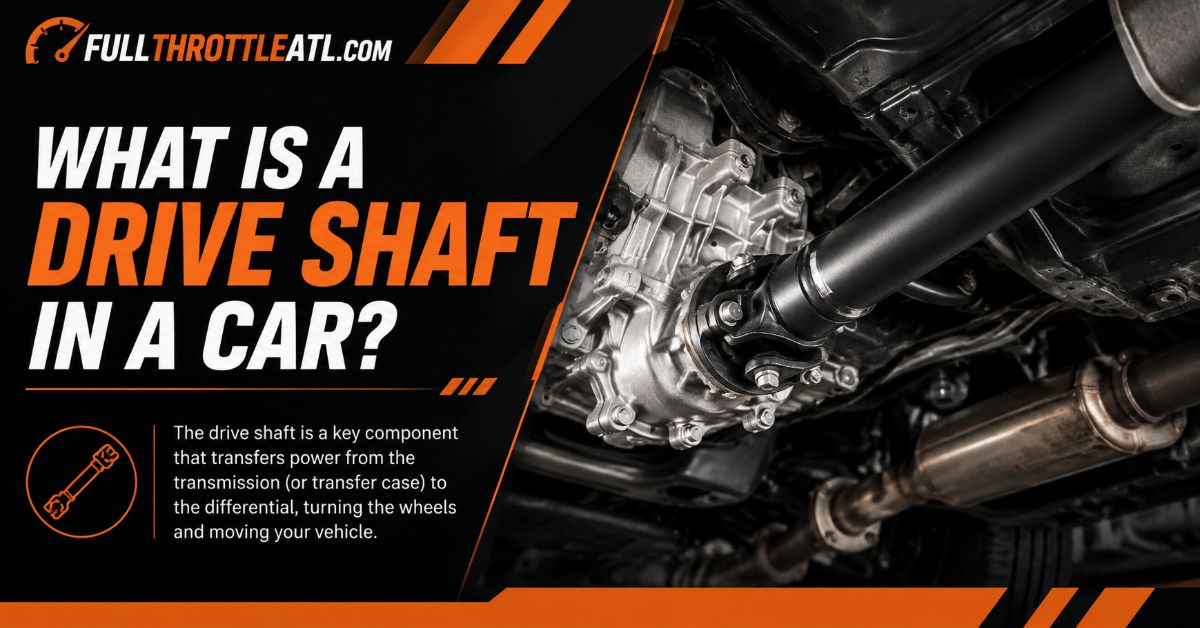
A car’s drive shaft is a rotating cylindrical component that transmits mechanical torque and rotational power from the transmission or transfer case directly to the differential or wheel hubs. It functions as the core structural connection in a vehicle’s drivetrain, allowing rotational energy generated by the engine to propel the wheels forward or backward.
At a Glance
- Primary Function: Transfers rotational power and torque from the gearbox to the axles.
- Operating Speed: Rotates at 3,000 to 8,000 RPM during highway driving.
- Torque Resistance: Engineered to handle 200 Nm in compact cars to over 1,000 Nm in heavy trucks.
- Operating Angle: Universal joints require a 1° to 5° working angle for continuous lubrication and minimal wear.
- Key Hazard: Severe drive shaft imbalance destroys transmission output seals and carrier bearings.
How Does a Drive Shaft Work in a Vehicle?
A drive shaft transfers power by rotating at high speeds while constantly flexing to accommodate the movement of the vehicle’s suspension. When the engine generates rotational energy, the transmission turns an output shaft connected to the drive shaft. As the drive shaft rotates, it delivers torque to a differential gear assembly, which translates the longitudinal spinning motion into transverse rotation that turns the drive wheels.
Because a vehicle’s rear axle moves up and down over road bumps while the transmission remains fixed to the frame, a drive shaft cannot be a rigid, static tube. It incorporates two critical mechanical components to absorb movement:
- Universal Joints (U-Joints) or CV Joints: Positioned at each end of the shaft, these flexible couplings allow the drive shaft to transfer rotational force continuously while changing angles relative to the differential and transmission.
- Slip Yoke or Spline Shaft: A telescoping joint that expands and contracts in length as the rear axle moves vertically, preventing the shaft from binding or pushing into the transmission casing.
Where Is the Drive Shaft Located across Different Drivetrains?
The drive shaft’s location, length, and quantity depend entirely on whether the vehicle uses a Rear-Wheel Drive (RWD), Four-Wheel Drive (4WD), All-Wheel Drive (AWD), or Front-Wheel Drive (FWD) configuration.
| Drivetrain Layout | Drive Shaft Configuration | Primary Location |
| Rear-Wheel Drive (RWD) | One long single-piece or two-piece longitudinal shaft | Runs down the center tunnel from transmission to rear differential |
| Four-Wheel Drive (4WD) | Two distinct longitudinal drive shafts | One from transfer case to front axle; one from transfer case to rear axle |
| All-Wheel Drive (AWD) | Central drive shaft + front/rear prop shafts | Connects center differential/PTU to front and rear axle modules |
| Front-Wheel Drive (FWD) | No central drive shaft (uses two transverse half-shafts) | Connects transaxle directly to front wheel hubs |
Rear-Wheel Drive (RWD)
In RWD vehicles, a single long, tubular drive shaft runs longitudinally down the center floor tunnel, bridging the engine-mounted transmission in the front to the rear differential.
Four-Wheel Drive (4WD) and All-Wheel Drive (AWD)
These systems utilize two separate drive shafts. A transfer case receives power from the transmission and splits it into two outputs: a rear drive shaft running to the rear differential and a front drive shaft running forward alongside the engine oil pan to the front axle differential.
Front-Wheel Drive (FWD)
Front-Wheel Drive vehicles do not have a central drive shaft. Instead, the engine and transaxle sit directly over the front wheels, utilizing two short, side-to-side drive shafts called half-shafts or CV axles to power each front wheel directly.
What Materials Are Used to Make Car Drive Shafts?
Drive shafts are constructed from steel, aluminum, carbon fiber, or composite materials depending on vehicle weight, expected torque load, and performance requirements.
- Tubular Steel: The standard choice for most production passenger cars, trucks, and SUVs. Steel offers high tensile strength and impact resistance at a low manufacturing cost, though it adds unsprung weight and can corrode over time if untreated.
- Aluminum Alloy: Popular in modern pickup trucks, sports sedans, and light commercial vehicles. Aluminum reduces rotational mass by roughly 30% to 40% compared to steel, improving throttle response, reducing fuel consumption, and offering high corrosion resistance.
- Carbon Fiber Reinforced Polymer (CFRP): Reserved for high-performance sports cars and racing applications. Carbon fiber shafts provide extreme torsional strength and ultra-low weight, allowing for higher engine speeds without critical vibration. In collision events, carbon fiber shafts safely shatter rather than penetrating the passenger cabin.
- Two-Piece Composite Systems: Used on long-wheelbase vehicles such as full-size pickup trucks and vans. A center carrier bearing supports two connected shaft segments, splitting the overall length to prevent high-speed bending (shaft whip).
What Is the Difference Between a Drive Shaft and a CV Axle?
A drive shaft runs longitudinally along the length of the chassis to transmit torque between major gearboxes, whereas a CV axle (half-shaft) runs transversely across the track width to deliver power directly from a differential or transaxle to an individual wheel hub.
While both components transfer rotational kinetic energy, their operating environments differ:
- Drive Shaft (Propeller Shaft): Operates under lower angular movement (typically 1° to 5°), rotates at high driveshaft speeds (engine/gearbox output RPM), and uses U-joints or rubber guibo flex discs at its ends.
- CV Axle (Constant Velocity Joint): Operates under extreme articulation angles (up to 45° during sharp turns) and continuous vertical suspension travel. It uses ball-bearing-based CV joints protected by sealed rubber accordion boots packed with synthetic grease.
Are There Vehicles That Do Not Use a Central Drive Shaft?
Modern automotive design includes several configurations that eliminate traditional central propeller shafts altogether:
- Electric Vehicles (EVs) with Axle Motors: EVs using dual-motor AWD feature independent electric drive units mounted directly on the front and rear axles. Power is communicated through high-voltage cables rather than a mechanical central spinning shaft.
- In-Wheel Hub Electric Motors: Advanced EV architectures place electric motors inside the wheel hubs themselves, eliminating the need for drive shafts, differentials, and CV axles entirely.
- Hybrid E-AWD Systems: Vehicles equipped with hybrid AWD systems (such as Toyota’s e-Four) use a gasoline engine to power the front wheels and an entirely separate, electronically controlled rear electric motor for the rear wheels. No physical shaft connects the front and rear axles.
- Torque Tube Systems (Chevrolet Corvette): Front-engine, rear-transaxle sports cars use an enclosed torque tube housing a high-strength inner shaft running inside a rigid structural shell, turning the engine and rear axle into a solid structural unit.
What Are the Earliest Signs of a Failing Drive Shaft?
The earliest warning signs of drive shaft degradation include persistent vehicle body vibrations, metallic clunking when changing gears, and high-pitched squeaking at low speeds.
- Under-Floor Vibrations: A high-frequency vibration felt in the driver’s seat or floorboards that intensifies as vehicle speed increases (often prominent between 45 mph and 70 mph).
- Metallic Clunking Noises: A sharp clunk or thud heard when shifting the transmission from Park into Drive or Reverse, or when accelerating after coasting. This indicates excessive play in worn U-joint needle bearings or loose differential yoke splines.
- Rhythmic Low-Speed Squeaking: A dry, metallic squeaking sound that increases in frequency with wheel rotation, typically caused by a dried-out U-joint bearing cup that has lost its grease seal.
- Shudder During Acceleration: A distinct wobble or shaking felt through the chassis when taking off from a complete stop under heavy acceleration.
Can a Drive Shaft Fail Without Making a Loud Clunking Sound?
Yes, a drive shaft can fail silently without producing clunking noises if the failure is caused by an imbalance or a bent tube rather than a loose U-joint.
If a drive shaft loses its factory-welded balancing weight or sustains a small dent from road debris, it maintains structural integrity but loses perfect rotational balance. At highway speeds, this imbalance creates a steady cabin vibration easily mistaken for an unbalanced tire or an out-of-round brake rotor. Left unaddressed, this silent vibration will ruin the transmission output shaft seal and destroy the rear differential pinion bearings.
Why Do Drive Shafts Need to Be Perfectly Balanced?
Drive shafts must be dynamic-balanced because they rotate at thousands of revolutions per minute; even a weight offset of a few grams generates immense centrifugal force that damages drivetrain seals and bearings.
When a drive shaft spins at 4,000 RPM, an unbalance of just 10 grams (0.35 oz) exerts tens of pounds of continuous cyclic force outward against its support points. This dynamic oscillation breaks down the lubricating oil film inside output shaft bushings, causing fluid leaks at the transmission slip yoke, rapid degradation of center carrier bearings, and premature failure of differential pinion seals.
Mechanics balance drive shafts on specialized electronic balancing machines by mounting the shaft, spinning it to operational RPM, identifying heavy spots with laser sensors, and spot-welding small steel weights onto the outer tube wall.
Why Do Suspension Lift Kits Cause Drive Shaft Vibrations?
Installing an aftermarket suspension lift kit alters the factory operating geometry between the transfer case and the axle differentials, forcing Universal joints to operate at steep, unapproved working angles.
U-joints do not rotate at a constant velocity when operating at an angle; they speed up and slow down twice per revolution. In factory setups, the transmission output angle and differential input angle are parallel, causing the speed fluctuations of the front joint to be cancelled out by the rear joint.
When a lift kit raises the vehicle body without dropping the transfer case or adjusting differential pinions, the operating angle can exceed 10 degrees. This creates a severe velocity mismatch that leads to driveline binding, high-frequency vibration, and rapid disintegration of the U-joint needle bearings. Correcting this requires installing a double-cardan (constant velocity) drive shaft or adjusting control arm lengths to restore parallel angles.
How Long Does a Drive Shaft Typically Last?
A standard drive shaft lasts between 75,000 and 150,000 miles under normal driving conditions. The shaft’s metal tube itself often lasts the life of the vehicle, but its wear components—specifically universal joints, CV boots, and center carrier bearings—require inspection and eventual replacement.
| Drive Shaft Component | Average Lifespan | Primary Cause of Failure |
| Metal Shaft Body | 200,000+ Miles / Lifetime | Corrosion, rock impact, extreme off-road torque overload |
| Universal Joints (U-Joints) | 60,000 – 100,000 Miles | Grease degradation, seal failure, water intrusion |
| CV Boots & Joints | 80,000 – 120,000 Miles | Rubber cracking, grease leaks, road debris tear |
| Center Carrier Bearing | 100,000 – 130,000 Miles | Rubber fatigue, excessive vibration, high mileage wear |
How Much Does Drive Shaft Repair or Replacement Cost?
Replacing a car’s drive shaft typically costs between $400 and $1,200 for parts and labor, depending on vehicle make, drivetrain complexity, and whether you install a brand-new original equipment manufacturer (OEM) part or an aftermarket assembly.
- U-Joint Replacement Only: $150 to $300 (Parts: $20–$50; Labor: $130–$250).
- Complete Shaft Assembly Replacement: $500 to $1,400 (Parts: $300–$900; Labor: $200–$500).
- Custom/Performance Shaft (Carbon Fiber/Aluminum): $1,200 to $2,500+.
Can You Drive a Car with a Damaged Drive Shaft?
No, you should not drive a car with a severely damaged drive shaft under any circumstances. Continued driving with a compromised drive shaft poses extreme safety risks and can cause catastrophic mechanical damage to your vehicle.
If a drive shaft breaks completely while the vehicle is in motion, the spinning metal tube drops to the pavement. At high speeds, the loose shaft can dig into the asphalt like a pole vault, throwing the vehicle off balance, flipping it, or rupturing fuel lines and floorboards. If an AWD or 4WD shaft snaps, it can violently strike the transfer case and transmission housing, cracking the aluminum casings and causing thousands of dollars in secondary mechanical destruction.
The Bottom Line
A drive shaft is the critical mechanical bridge that transfers engine torque and rotational power from a car’s transmission to its drive wheels. While durable, components like U-joints, carrier bearings, and balance weights wear out over time, displaying early symptoms such as high-frequency floorboard vibrations and low-speed clunking noises. Addressing driveline vibrations immediately prevents costly secondary damage to transmission seals, transfer cases, and differential assemblies.