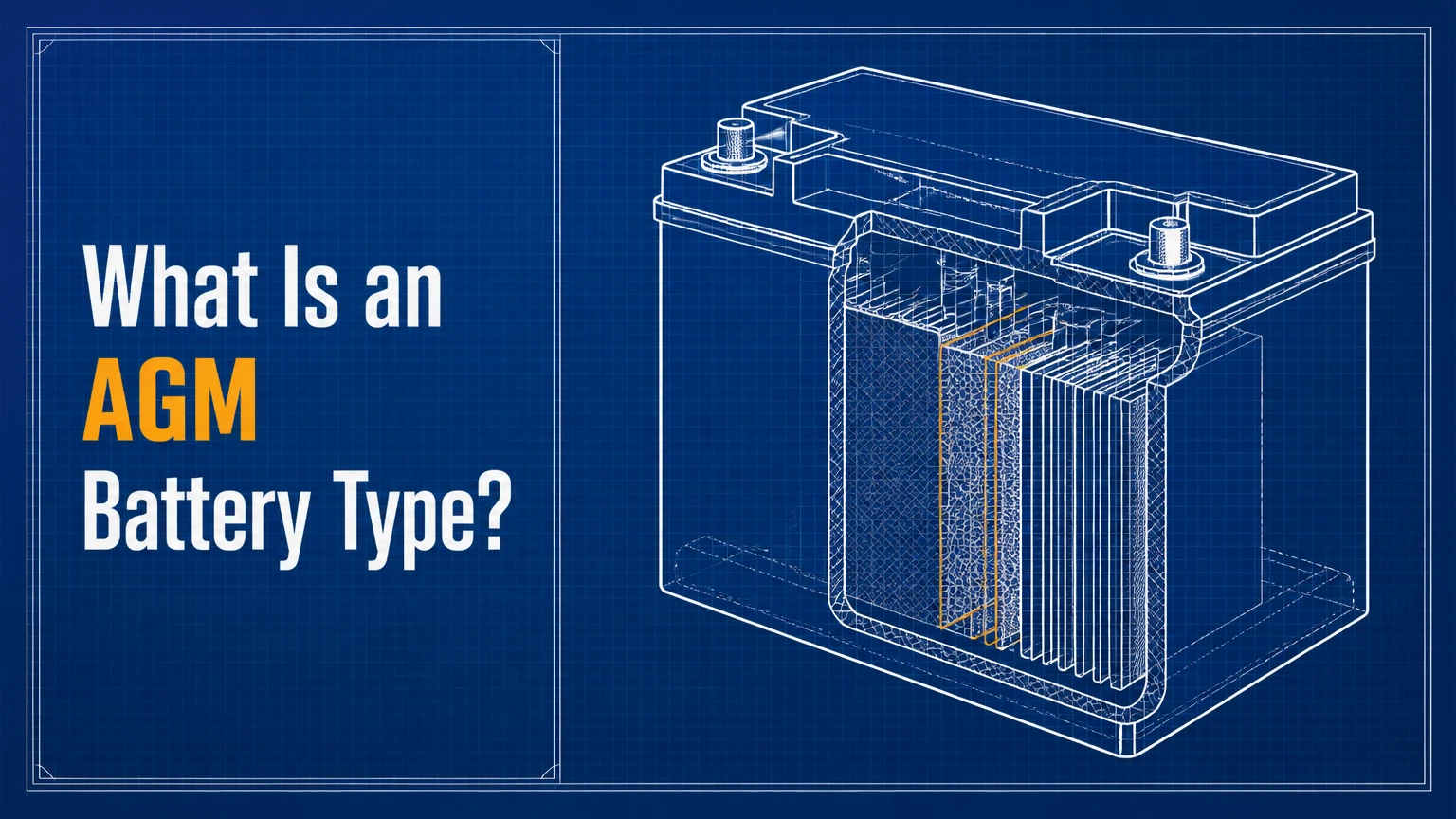
An Absorbent Glass Mat (AGM) battery is an advanced, valve-regulated sealed lead-acid (VRLA) battery that immobilizes liquid sulfuric acid electrolyte inside ultra-fine fiberglass mat separators pressed between lead plates. This design enables lower internal resistance, faster charging acceptance, spill-proof operation, and superior resistance to vibration compared to standard flooded lead-acid batteries.
Internal construction of sealed lead-acid cell architecture. Source: ZernLiew / Getty Images
At a Glance
- Internal Resistance: 2 to 5 milliohms, delivering up to 30% higher cranking current than flooded cells.
- Charging Profile: Requires strict regulated absorption voltage between 14.4V and 14.8V at 25°C (77°F).
- Float Voltage: Must be maintained precisely between 13.2V and 13.8V to prevent internal gas buildup.
- Cycle Life: Delivers 400 to 600 cycles at 80% Depth of Discharge (DoD) with a typical operational lifespan of 4 to 7 years.
- Self-Discharge Rate: Unusually low at 1% to 3% per month, allowing up to 12 months of shelf storage without recharging.
How Does Absorbent Glass Mat (AGM) Technology Work?
AGM batteries function through a recombining valve-regulated lead-acid (VRLA) architecture where electrolyte is completely absorbed into porous fiberglass fabric rather than sloshing freely. Microscopic glass fibers act like a sponge, holding acid in direct contact with the active lead plate material while leaving micro-cavities open for gas diffusion.
During charging, water electrolysis inside the battery generates oxygen at the positive plate. In a traditional flooded battery, this gas escapes into the atmosphere, requiring periodic water refilling. In an AGM battery, the oxygen migrates through the unsaturated channels of the glass mat directly to the negative plate, where it recombines with hydrogen ions to form water (2H2+O2→2H2O).
This internal oxygen recombination cycle operates at approximately 99% efficiency under normal operating temperatures and voltages. Because the gas converts back into liquid water within the cell matrix, the battery remains permanently sealed, maintenance-free, and leak-proof even if the outer polypropylene casing is cracked or punctured.
What Are the Core Electrical Specifications of an AGM Battery?
AGM batteries deliver significantly higher electrical efficiency and current output than flooded batteries due to their tightly compressed cell structure and low internal impedance.
- Internal Resistance: Measures 2 to 5 milliohms (compared to 10–15 milliohms in flooded cells), allowing rapid energy transfer during discharge and recharge.
- Cold Cranking Amps (CCA): Delivers 20% to 30% higher peak starting current than an equivalent-sized flooded battery in freezing conditions.
- Optimal Charge Voltage: Requires an absorption charge voltage between 14.4V and 14.8V at 25°C (77°F).
- Float Voltage: Requires a sustained trickle/float voltage of 13.2V to 13.8V.
- Cycle Life: Engineered to withstand 400 to 600 full discharge cycles down to 80% Depth of Discharge (DoD).
- Self-Discharge: Retains charge extraordinarily well, losing only 1% to 3% capacity per month at room temperature.
What Is the Difference Between AGM and Gel Batteries?
AGM batteries suspended liquid sulfuric acid inside porous fiberglass mats, whereas Gel batteries mix silica dust into the liquid electrolyte to create a thick, immobile gel paste. While both are sealed VRLA batteries, they operate on vastly different electrical profiles and cannot use identical charging equipment.
| Feature | AGM Battery | Gel Battery |
|---|---|---|
| Electrolyte Form | Acid absorbed in fine glass mats | Acid suspended in silica gel paste |
| Max Charge Voltage | 14.4V – 14.8V | 13.8V – 14.1V |
| High-Current Delivery | Excellent (ideal for engine starting) | Moderate (poor starting current, best for slow deep discharge) |
| Overcharge Sensitivity | High | Extreme (overcharging creates permanent void pockets in gel) |
| Vibration Resistance | Exceptional (compressed plate stack) | Moderate |
Applying an AGM charge voltage profile (14.8V) to a Gel battery will instantly cook the silica paste, creating air voids between the gel and lead plates that destroy the battery within days.
What Charger Do You Need to Safely Charge an AGM Battery?
You must use a multi-stage smart charger equipped with a dedicated AGM charging profile and ambient temperature compensation. Standard manual chargers or older constant-voltage battery tenders will permanently damage AGM units by supplying unregulated voltages above 15.0V.
Proper AGM charging requires three distinct stages:
- Bulk Stage: Delivers constant maximum current until cell voltage reaches approximately 14.4V–14.6V.
- Absorption Stage: Maintains constant voltage (14.4V–14.8V) while current gradually tapers off as internal resistance rises.
- Float Stage: Drops voltage down to 13.2V–13.8V to maintain full charge without boiling off hydrogen.
Additionally, smart chargers must feature thermal sensors: because lead-acid chemical reactions accelerate in heat, charge voltage must be reduced by approximately −3 mV/∘C per cell above 25°C to avoid thermal runaway.
Can You Mount an AGM Battery on Its Side or Upside Down?
You can safely mount an AGM battery on its side, end, or back, but you must never mount an AGM battery completely upside down.
Because the liquid acid is fully absorbed into fiberglass mats, gravity will not cause fluid to pool or leak when rotated 90 degrees. However, upside-down installation (terminals facing the ground) positions the emergency pressure relief valves directly beneath the internal cell chamber. If the battery experiences an unexpected overcharge event, gasses will push liquid acid down into the valve ports, causing permanent chemical leakage and valve failure.
Can You Replace a Standard Flooded Battery with an AGM Battery?
Yes, you can upgrade a standard flooded lead-acid battery to an AGM battery, provided your vehicle’s charging system supports AGM voltage profiles and the new unit physically fits the engine bay tray.
Upgrading to AGM provides longer service life, faster recharging, and superior cold-weather cranking power. However, if the vehicle features a modern Battery Management System (BMS), you must re-code the car’s computer to notify it of the upgrade. If the BMS continues to treat the new AGM battery as an older flooded type, it will apply incorrect charge rates that shorten the AGM battery’s life.
Can You Replace an AGM Battery with a Standard Flooded Battery?
No, you should never replace an factory-installed AGM battery with a standard flooded battery.
Modern vehicles factory-equipped with AGM batteries feature advanced power management demands, including automatic start-stop engines, regenerative braking systems, and heavy parasitic electronics loads. A standard flooded battery cannot handle the rapid charge-discharge cycling required by start-stop systems and will typically suffer complete plate degradation within 2 to 6 months of installation.
Why Must You Register a New AGM Battery with the Vehicle’s BMS?
You must register a new AGM battery so the vehicle’s computer can reset its internal battery-aging algorithm and adjust alternator output accordingly.
As an AGM battery ages, its internal resistance increases, prompting the vehicle’s Battery Management System (BMS) to steadily increase charging voltage to maintain capacity. When you install a fresh AGM battery without resetting the BMS memory, the vehicle continues to blast the new, low-resistance battery with high voltage meant for an aging unit. This overcharges the new AGM, triggers gas venting, and can ruin a new battery within 6 to 12 months.
Why Is Jump-Starting a Dead AGM Battery with an Alternator Dangerous?
Jump-starting a deeply discharged AGM battery and letting the vehicle alternator recharge it risks overheating both the alternator and the battery plates.
Because AGM batteries have exceptionally low internal resistance (2–5 mΩ), a dead AGM battery acts like an electrical sponge, drawing massive amperage from the alternator as soon as the engine starts. Vehicle alternators are designed to top off starter batteries, not bulk-charge depleted deep-cycle batteries at maximum output. Sustained high-amp output causes extreme alternator heat failure while simultaneously boiling the micro-quantities of acid in the AGM fiberglass mats, warping the lead grids.
Why Does High-Voltage Pulse Desulfation Destroy an AGM Battery?
High-voltage pulse desulfation techniques—which blast high-voltage spikes (often 15.5V to 16.0V+) into lead plates to break down lead sulfate crystals—destroy AGM batteries by triggering irreversible gas venting.
Because AGM batteries contain a strictly metered volume of electrolyte trapped inside fiberglass mats, any operation that forces the internal pressure relief valves open results in permanent water loss. Once hydrogen and oxygen escape through the safety valves, the fiberglass mats dry out, severing physical contact between the electrolyte and the lead plates. Unlike flooded batteries, lost water cannot be replenished in a sealed AGM unit.
How Low Can You Safely Discharge an AGM Battery?
You can safely discharge an AGM battery down to 50% Depth of Discharge (DoD) for routine applications, and down to 80% DoD in emergency scenarios.
Discharging an AGM battery below 10.5 volts (0% state of charge) causes severe hard sulfation on the lead plates and risks chemical cell reversal. While AGM batteries withstand deeper discharges than flooded batteries (which suffer damage below 50% DoD), regularly draining an AGM below 50% significantly reduces total cycle performance:
- 50% DoD: ~1,000–1,200 total life cycles.
- 80% DoD: ~400–600 total life cycles.
- 100% DoD (Complete drain): Fewer than 150 total life cycles.
What Causes an AGM Battery to Swell and Bulge?
Swelling and bulging in an AGM battery casing is caused by internal thermal runaway and gassing due to severe overcharging.
When charged at excessive voltages (above 14.8V) or high ambient temperatures, an AGM cell generates hydrogen and oxygen faster than the internal catalyst can recombine them into water. The excessive internal gas pressure expands the plastic outer casing outward. If overcharging continues, internal heat softens the polypropylene walls while pressure rises until safety relief valves pop open, releasing toxic gas and permanently ruining the battery’s chemical capacity.
How Does Extreme Temperature Impact AGM Battery Lifespan?
High ambient temperatures accelerate internal corrosion and dry-out in AGM batteries, while extreme cold temporarily reduces available current capacity.
Every 8°C (15°F) rise in ambient temperature above 25°C (77°F) cuts the chemical lifespan of an AGM battery in half due to accelerated grid corrosion. Conversely, while cold temperatures decrease available Cold Cranking Amps (at -18°C / 0°F, an AGM battery retains roughly 60% of its rated power), cold weather actually slows down chemical degradation and self-discharge during storage.
The Bottom Line
An AGM battery is an advanced VRLA lead-acid battery using sulfuric acid saturated inside fiberglass mats to offer high cold-cranking amps, low internal resistance, and spill-proof mounting flexibility. To maximize an AGM battery’s 4 to 7 year operational lifespan, always charge it using a dedicated smart charger capped between 14.4V and 14.8V, and never replace an AGM battery in a modern vehicle without registering the new unit in the vehicle’s Battery Management System.