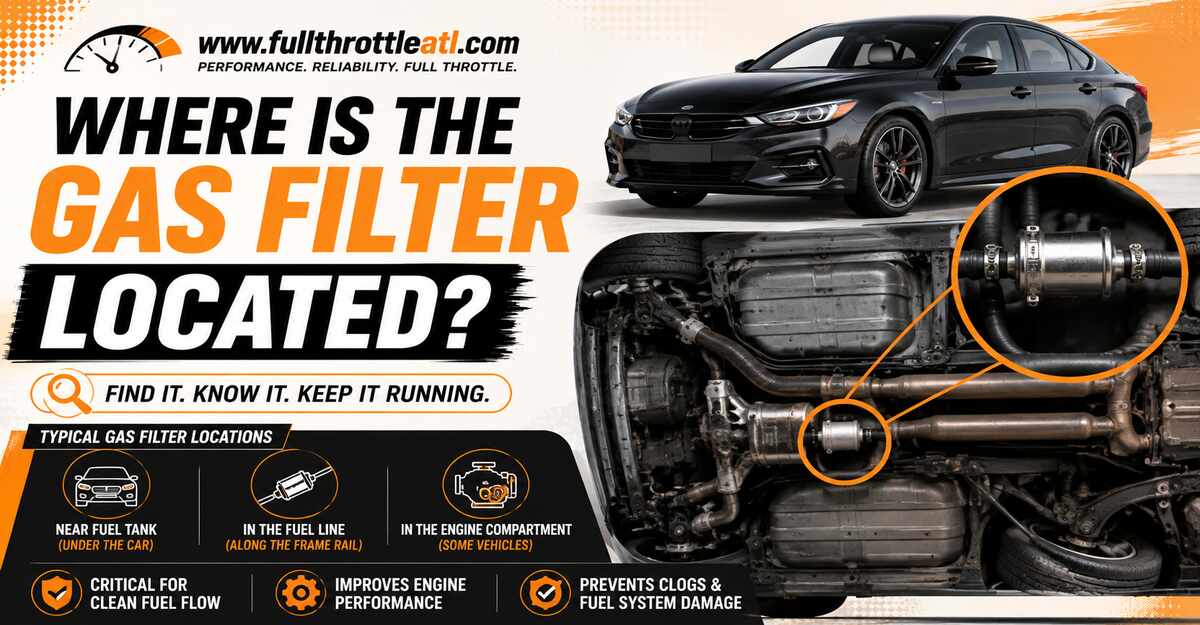
The gas filter, officially known as the fuel filter, is primarily located in one of two places: mounted underneath the vehicle along the frame rail, or submerged inside the gas tank as part of the fuel pump assembly. The exact location depends on the vehicle’s manufacturing year and engine type.
At a Glance
- Modern vehicles (post-2005) typically integrate the fuel filter inside the gas tank.
- Older vehicles (pre-2005) usually mount the fuel filter along the underbody frame rail.
- Diesel trucks often feature dual systems: a frame-mounted water separator and an engine-bay filter.
- Accessing an in-tank filter requires removing the rear seat cushion or dropping the fuel tank.
- Inline underbody filters should be replaced every 20,000 to 30,000 miles.
Where is the fuel filter on pre-2005 vehicles?
On vehicles manufactured before 2005, the fuel filter is located along the underbody frame rail on either the driver or passenger side. These inline filters resemble small metal cylinders with rubber or metal fuel lines attached to both ends.
The frame rail location typically positions the filter 12 to 24 inches forward from the rear fuel tank along the main longitudinal beam. Automakers placed the filter outside the tank to make routine servicing straightforward. To find the inline filter, inspect the undercarriage near the rocker panels, tracing the metal fuel lines from the gas tank toward the engine block. Classic carbureted vehicles may instead place a small, clear plastic inline filter directly inside the engine bay, spliced into the fuel hose just inches before the carburetor inlet.
Where is the fuel filter on modern cars (post-2005)?
On vehicles built after 2005, the fuel filter is located inside the gas tank, integrated directly into the plastic fuel pump module.
Manufacturers transitioned to this in-tank design to reduce evaporative emissions and simplify assembly line production. Because the filter sits submerged in gasoline, the fuel itself cools the pump and prevents the filter media from drying out. This integrated unit means the filter cannot be serviced independently; the entire fuel pump assembly must be replaced if the filter becomes restricted. The in-tank filter is typically accessible via a service port located beneath the rear passenger seat cushion, though some models require dropping the entire tank for access.
Where are diesel fuel filters located?
Diesel trucks and SUVs typically feature dual fuel filters: a primary filter located on the frame rail beneath the driver’s seat, and a secondary filter mounted under the hood near the firewall or engine block.
Heavy-duty diesel engines, such as the Ford Powerstroke or Chevy Duramax, require extreme fuel purity. The primary frame-mounted unit acts as a fuel/water separator, stripping moisture from the diesel before the fluid travels forward. The secondary engine-bay filter traps microscopic particulates right before the fuel enters the high-pressure injection system. Both filters require strict maintenance, typically every 10,000 to 15,000 miles, to prevent water damage to expensive diesel fuel injectors.
Are there hidden or secondary fuel filter locations?
Yes, certain vehicle models hide inline fuel filters in the rear wheel well housing, behind engine heat shields, or near the fuel pressure regulator.
Automakers occasionally place the fuel filter in obscure locations to protect the component from road debris. Older Honda Civics and Accords frequently bolt the filter directly to the engine bay firewall, tucked deeply behind a plastic splash guard. If tracing the underbody frame rail reveals nothing, mechanics must check the rear passenger wheel well or inspect the areas immediately surrounding the catalytic converter.
How do you access an in-tank fuel filter?
- Remove the rear seat cushion by unlatching the lower retaining clips.
- Locate the metal or plastic access panel on the floorboard.
- Unscrew the 4 to 6 retaining bolts holding the panel in place.
- Disconnect the electrical wiring harness and pressurized fuel lines from the top of the pump module.
- Use a specialized spanner wrench to rotate and remove the metal locking ring.
- Lift the entire fuel pump assembly out of the gas tank.
If a modern vehicle lacks an interior access panel under the rear seat, the only way to reach the in-tank filter is to physically drain the gasoline, unbolt the exhaust system, and lower the entire fuel tank from underneath the vehicle using a transmission jack.
How do you relieve fuel system pressure before removal?
- Open the vehicle’s primary engine bay fuse box and locate the fuel pump relay or fuse.
- Pull the fuel pump fuse out using a fuse puller.
- Start the engine and let it run until it sputters and stalls from fuel starvation.
- Crank the engine for three more seconds to ensure all residual pressure dissipates.
- Disconnect the negative battery terminal to prevent accidental sparks.
Relieving fuel system pressure is a mandatory safety step before disconnecting any fuel lines. Modern electronic fuel injection systems maintain between 40 and 80 PSI of pressure even when the engine is turned off. Opening a pressurized fuel line without bleeding the system first will spray highly flammable gasoline across the engine bay or undercarriage, creating an immediate fire hazard.
What tools are needed to replace an inline fuel filter?
Replacing an inline fuel filter requires line wrenches (flare nut wrenches), a standard socket set, a flathead screwdriver, safety glasses, and a fluid catch pan.
Line wrenches, typically sized at 10mm, 12mm, or 14mm, are specifically designed to grip five sides of the fuel line fitting, preventing the soft brass nuts from stripping during removal. Modern vehicles with quick-disconnect fuel lines require specialized plastic or metal fuel line disconnect tools to release the internal spring clips without damaging the nylon hoses. Mechanics must always place a dedicated catch pan beneath the filter location to capture the 2 to 4 ounces of residual gasoline that will inevitably spill during removal.
How often should a fuel filter be replaced?
Underbody inline fuel filters should be replaced every 20,000 to 30,000 miles (30,000 to 50,000 kilometers). In-tank fuel filters are designed to last over 100,000 miles (160,000 kilometers).
The replacement interval depends entirely on the filter’s location and physical size. Inline metal filters are smaller and clog more quickly with sediment drawn from low-quality gas stations. In-tank filters utilize a much larger surface area of synthetic mesh, allowing them to last the lifetime of the fuel pump. Diesel fuel filters require the most frequent replacement, mandating new elements every 10,000 to 15,000 miles to prevent water contamination from destroying the high-pressure injection system.
Can a “lifetime” in-tank fuel filter clog?
Yes, an in-tank fuel filter designated as a “lifetime” component by the manufacturer can still clog if the vehicle frequently runs on contaminated gasoline.
Automotive service manuals often state that the in-tank filter is non-serviceable and requires no routine maintenance. However, accumulating rust from older gas station storage tanks or dirt from agricultural environments will eventually restrict the synthetic filter mesh. When this “lifetime” filter clogs, the restricted fuel flow forces the electric fuel pump to work harder, causing the pump motor to overheat and fail prematurely. The only repair solution is replacing the complete fuel pump module.
How much does a fuel filter replacement cost?
Replacing an inline fuel filter costs between $60 and $120, while replacing an in-tank fuel filter costs between $400 and $1,000.
The extreme price difference stems from labor times and parts integration. An inline filter is a standalone metal component costing $15 to $30, requiring only 30 minutes of labor to swap out on a vehicle lift. An in-tank filter cannot be purchased separately; owners must buy the entire fuel pump assembly, which ranges from $200 to $600 in parts alone. Labor for an in-tank replacement adds $200 to $400, especially if the mechanic must drop the vehicle’s heavy exhaust and fuel tank to access the unit.
What are the symptoms of a clogged fuel filter?
The primary symptoms of a clogged fuel filter include engine sputtering at high speeds, hesitation during acceleration, hard starting, and an illuminated Check Engine Light.
When the filter media becomes saturated with debris, the unit restricts the volume of fuel reaching the engine block. This starvation is most noticeable under heavy loads, such as climbing a steep hill or merging onto a highway, where the engine demands maximum fuel pressure. A restricted filter will trigger the engine control module to register lean fuel mixture codes, specifically OBD-II codes P0171 (System Too Lean Bank 1) or P0174 (System Too Lean Bank 2). Left unaddressed, chronic fuel starvation will eventually destroy the electric fuel pump.
Can a clogged fuel filter prevent a car from starting?
Yes, a severely clogged fuel filter can completely block gasoline from reaching the engine, resulting in an engine that cranks continuously but refuses to start.
For internal combustion to occur, the fuel injectors require a highly pressurized spray of atomized gasoline. If the fuel filter is completely blocked by rust or sediment, fuel pressure at the injector rail drops to zero. The starter motor will successfully turn the engine over, and the spark plugs will fire, but the total lack of combustible fuel prevents ignition. Mechanics test for this specific no-start condition by attaching a mechanical fuel pressure gauge to the Schrader valve located on the engine’s fuel rail.
What happens if a fuel filter is installed backwards?
Installing a fuel filter backwards severely restricts fuel flow, damages the internal filter media, and causes immediate engine performance issues like stalling and hesitation.
Inline fuel filters are directional components engineered to flow pressurized gasoline in only one direction. The internal paper or synthetic element is reinforced on the outflow side to withstand 50 to 80 PSI of continuous pressure from the pump. Reversing the installation pushes fuel against the unsupported side of the media, causing the filter paper to collapse, tear, and send particulate matter directly into the sensitive fuel injectors. Every inline filter features a stamped arrow on the outer metal casing indicating the correct direction of fuel flow toward the engine.
The Bottom Line
The gas filter is located either underneath the vehicle along the frame rail (typical for cars built before 2005) or inside the gas tank attached to the fuel pump (standard for modern vehicles). Identifying your vehicle’s exact filter location dictates both the maintenance schedule and the overall replacement cost. Inline filters require replacement every 30,000 miles and offer easy DIY access, while in-tank filters are lifetime components that demand professional replacement of the entire pump assembly if they become clogged.