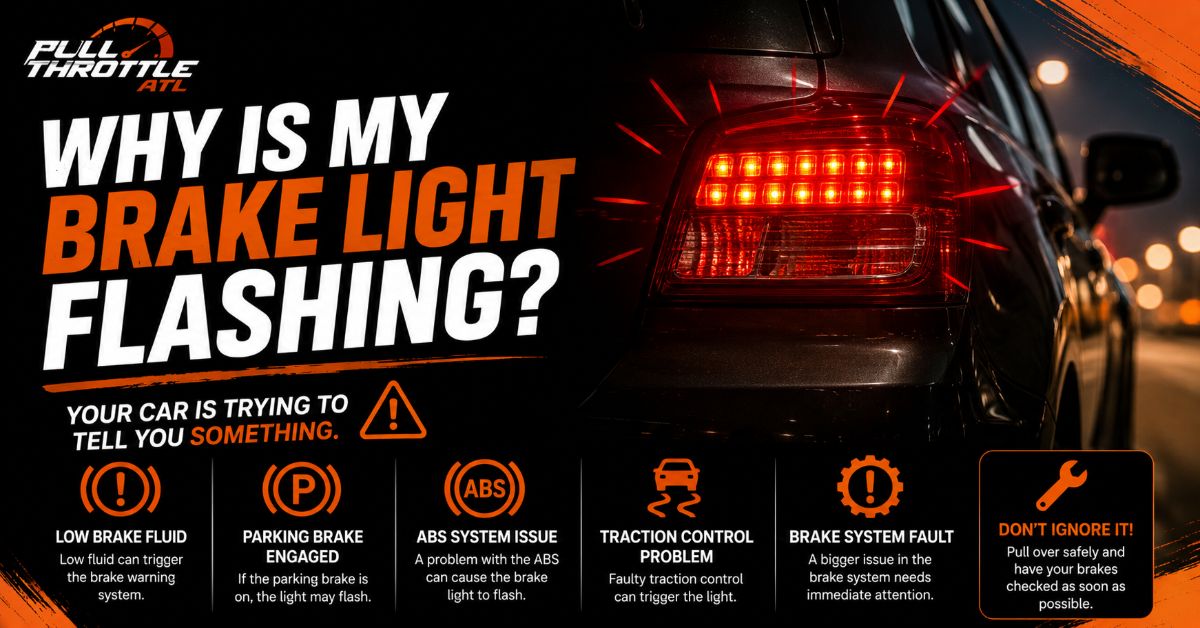
A flashing brake light on your dashboard indicates an immediate safety risk or critical electronic fault, such as dangerously low brake fluid, an actively engaged emergency brake, or a severe Anti-Lock Braking System (ABS) malfunction. Unlike a solid warning light that signals a routine maintenance warning, a flashing light is an active alert engineered to catch your eye when the vehicle computer detects potential hydraulic or electronic braking failure.
At a Glance
- A flashing brake light requires pulling over safely as soon as possible to avoid complete hydraulic brake failure.
- The float switch in your brake reservoir triggers a flashing light when fluid drops 15% to 20% below the MAX line.
- A wheel speed discrepancy of 3 to 5 MPH across tires will cause the ABS module to flash the dashboard indicator.
- Standard OBD-II code readers cannot scan ABS or chassis codes (C-codes); a professional diagnostic scanner is required.
- System voltage dropping below 10.5 Volts causes braking modules to flash safety lights as a safety fail-safe.
Is It Safe to Drive With a Flashing Brake Light?
No, it is not safe to drive with a flashing brake light, and you should pull over to a safe location as soon as possible. While a solid dashboard light allows you to carefully drive to a repair shop, a flashing light signals a critical condition where hydraulic pressure could drop suddenly, causing the brake pedal to go soft and preventing the vehicle from stopping.
+--------------------------+--------------------------------------+------------------------------------+
| Warning Light State      | Immediate Safety Risk                | Recommended Action                 |
+--------------------------+--------------------------------------+------------------------------------+
| Solid Light              | Moderate (Maintenance warning)       | Drive cautiously to a service center|
| Flashing Light           | Severe (Active failure/low fluid)   | Pull over safely and stop driving  |
| Flashing + Soft Pedal    | Critical (Total hydraulic failure)   | Tow immediately; do not drive      |
+--------------------------+--------------------------------------+------------------------------------+
If the warning light flashes while you are driving, reduce your speed gradually, avoid slamming on the brakes, and safely pull onto the shoulder or a parking lot. Check your brake fluid reservoir under the hood; if fluid levels are severely low, driving further can force air into the brake lines, rendering your foot pedal entirely ineffective.
What Triggers a Flashing Brake Light on the Dashboard?
A flashing brake light is triggered when your vehicle’s engine control unit (ECU) or ABS module receives an out-of-spec signal from primary safety sensors. The three most common causes are low hydraulic fluid levels, a misaligned or engaged parking brake switch, or a critical fault inside the ABS control circuit.
                     +---------------------------------------+
                     |  Vehicle Computer / ABS Control Unit  |
                     +-------------------+-------------------+
                                         |
         +-------------------------------+-------------------------------+
         |                               |                               |
         v                               v                               v
+-----------------+             +-----------------+             +-----------------+
| Low Brake Fluid |             | Parking Brake   |             | Wheel Speed     |
| Float Sensor    |             | Switch Engaged  |             | Sensor Mismatch |
+-----------------+             +-----------------+             +-----------------+
Vehicles use specific sensors to monitor braking integrity:
- Fluid Level Float Switches: Detect when hydraulic fluid drops below safe operating levels.
- Parking Brake Microswitches: Signal when the mechanical handbrake or foot pedal lever is not fully retracted.
- Wheel Speed Sensors: Measure individual wheel speeds to ensure balanced traction during braking.
When any of these sensors record data outside factory tolerances, the computer pulses the dashboard light to demand immediate driver intervention.
At What Sensor Thresholds Does the Brake Light Flash?
Car computers rely on precise numeric thresholds to trigger a flashing brake light indicator. Knowing these exact measurements helps pinpoint whether your issue is mechanical, fluid-based, or electrical:
- Brake Fluid Threshold (15% to 20% Drop): The fluid reservoir contains an internal float switch. If the fluid level drops 15% to 20% below the MAX mark (pushing it near or below the MIN line), electrical continuity breaks, triggering an intermittent or steady flash.
- ABS Speed Discrepancy (3 to 5 MPH): Wheel speed sensors constantly send rotation data to the ABS module. If one wheel reports a speed variance of 3 to 5 MPH compared to the other wheels, the computer interprets this as loss of traction or a bad sensor and flashes the light.
- Electrical System Voltage (Below 10.5 Volts): Electronic brake control modules require consistent power. If an alternator or battery issue causes system voltage to dip below 10.5 Volts, the ABS computer cannot function reliably and defaults to a flashing safety warning.
Why Does the Brake Light Flash Only When Turning or Accelerating?
A brake light that flashes specifically during acceleration, hard braking, or sharp turns indicates a borderline low brake fluid level in the master cylinder reservoir. As the vehicle moves, centrifugal force and inertia slosh the remaining fluid to one side of the tank.
       [ Normal Driving ]                     [ Hard Acceleration / Turn ]
   +-------------------------+               +-------------------------+
   |   ===================   |               |                     === |  <-- Fluid shifts
   |   [ Float Switch: OK ]  |               |   [ Float: TRIPPED ]    |  <-- Triggers flash
   +-------------------------+               +-------------------------+
When fluid shifts away from the internal float switch, the sensor momentarily drops to the bottom of the chamber, opening the electrical circuit and flashing the dashboard light. Once the vehicle straightens out or returns to a constant speed, the fluid settles, the float rises, and the light turns off. Inspecting your brake reservoir and topping it off with the manufacturer-specified brake fluid (such as DOT 3 or DOT 4) typically resolves this symptom immediately.
Why Does the Brake Light Flash 3 or 4 Times and Stop?
A brake light that blinks 3 to 4 times in a precise sequence—often accompanied by an audible chime—indicates a localized Electronic Parking Brake (EPB) actuator fault. Unlike manual lever handbrakes, electronic parking brakes use electric motors mounted directly on the rear brake calipers to compress the brake pads.
When you press the EPB button and the motor fails to extend or retract fully within its programmed time window, the EPB module flashes the dashboard brake icon 3 or 4 times to signal an incomplete stroke. This is frequently caused by a weak 12-volt battery, a seized caliper guide pin, or a cracked plastic gear housing inside the parking brake actuator motor.
Why Is the Light Flashing If Brake Fluid Is Full and Handbrake Is Off?
If your brake fluid is completely full and your parking brake is fully released, a flashing brake light is usually caused by a waterlogged reservoir float switch, a jammed parking brake microswitch, or a shorted CAN-Bus network wire.
1.Inspect the Reservoir Float Switch:Check for electrical sensor failure.
Unplug the electrical connector on the side of the brake fluid reservoir. Use a multimeter to test continuity across the terminal pins. If the sensor reads “open” while the reservoir is filled to the MAX line, the internal float has absorbed fluid, become heavy, and sunk to the bottom, requiring a new reservoir or sensor assembly.
2.Check the Parking Brake Lever Switch:Identify mechanical switch obstructions.
Inspect the base of the manual handbrake lever or foot brake pedal. Small objects like coins, dirt, or beverage spills can physically prevent the tiny microswitch from fully releasing, causing the car computer to register that the parking brake is engaged while driving.
3.Trace the CAN-Bus Communication Wiring:Rule out electrical shorts.
Look for rubbed, melted, or corroded wiring harnesses leading to the ABS module and master cylinder. A damaged wire shorting against the metal chassis can disrupt CAN-Bus digital communication, causing the dashboard instrument cluster to flash its primary safety warnings.
Why Does My OBD-II Scanner Show No Diagnostic Codes?
Standard consumer OBD-II scanners show no codes because they are programmed only to read Powertrain codes (P-codes) related to engine performance and emissions. A flashing brake light is controlled by the chassis system, which generates Chassis codes (C-codes) and Body codes (B-codes) managed by the ABS and Body Control Modules (BCM).
To retrieve error codes for a flashing brake light, you must use a mid-tier or professional-grade diagnostic scan tool capable of communicating with Four-System networks (Engine, Transmission, ABS, and SRS). Connecting a tool with ABS code coverage will instantly surface specific fault codes, such as C0035 (Left Front Wheel Speed Sensor Circuit) or C0040 (Right Front Wheel Speed Sensor Circuit).
Can a Bad Wheel Bearing Make the Brake Light Flash?
Yes, a severely worn wheel bearing can directly cause the dashboard brake light to flash by disrupting the ABS wheel speed sensor. Modern vehicles rely on a magnetic encoder ring embedded directly inside the wheel bearing seal, which spins mere millimeters away from the stationary ABS sensor tip.
+-----------------------------------------------------------------------------------+
|                            WHEEL BEARING & ABS RELATION                           |
+-----------------------------------------------------------------------------------+
|  [ Healthy Bearing ]   -->  Tight Clearance (1-2mm)  -->  Clean ABS Signal        |
|  [ Worn Bearing ]      -->  Wheel Wobble/Play       -->  Disrupted ABS Pulse      |
|  [ Failure Result ]    -->  Speed Discrepancy >3MPH  -->  Flashing Brake Light   |
+-----------------------------------------------------------------------------------+
When a wheel bearing degrades, its internal steel balls develop play, causing the entire wheel hub assembly to wobble while driving. This microscopic play changes the air gap between the sensor and magnetic ring, causing missing pulses. The ABS module detects a sudden speed drop on that specific wheel and flashes the dashboard light to signal a system fault.
Can Aftermarket LED Bulbs Cause the Dashboard Light to Flash?
Yes, replacing original halogen tail or brake light bulbs with aftermarket LED bulbs can trick your vehicle’s Body Control Module (BCM) into flashing the dashboard brake indicator. Standard halogen brake bulbs draw roughly 21 Watts of power, whereas energy-efficient LED bulbs draw under 5 Watts.
Because the vehicle’s computer monitors electrical resistance to alert drivers when a bulb burns out, the low power draw of an LED bulb is interpreted as a dead or missing bulb. The BCM responds by rapidly flashing the dashboard light or exterior turn indicators (“hyper-flashing”). Installing inline load resistors or LED bulbs engineered with built-in Canbus decoder chips restores proper electrical load and clears the error.
Does Cold Weather Cause Unexpected Brake Light Flashing?
Yes, extreme cold temperatures dropping below -20°F (-29°C) can trigger false flashing brake light alerts due to fluid thickening, mechanical contraction, and battery voltage drops. Cold weather impacts braking systems in three specific ways:
- Brake Fluid Viscosity: Extreme cold causes moisture-contaminated brake fluid to thicken, slowing down float switch response times and sending brief false low-fluid signals.
- Frozen Parking Brake Cables: Moisture trapped inside steel emergency brake cables freezes, preventing the return spring from fully releasing the rear brake shoes. The switch remains tripped even if you push the handbrake lever down.
- Low Battery Output: Cold temperatures reduce lead-acid battery capacity by up to 50%. A momentary voltage dip below 10.5 Volts during engine startup can trigger temporary ABS communication faults that flash dashboard indicators.
How Much Does It Cost to Fix a Flashing Brake Light?
Fixing a flashing brake light typically costs between $15 and $1,000+, depending entirely on whether the root cause is simple fluid maintenance, an electrical switch, or a major hydraulic component repair.
| Repair Category | Potential Cause | Estimated Repair Cost |
| DIY Fluid Top-Off | Low brake fluid (minor leak/pad wear) | $15 – $30 |
| Switch Replacement | Faulty parking brake microswitch | $80 – $150 |
| Wheel Speed Sensor | Defective or dirty ABS sensor | $150 – $300 |
| Wheel Bearing Repair | Worn hub assembly disrupting ABS | $350 – $650 |
| Electronic Actuator | Failed Electronic Parking Brake (EPB) motor | $400 – $800 |
| ABS Hydraulic Control | Failed ABS pump or control module | $800 – $1,500+ |
The Bottom Line
A flashing brake light is an urgent indicator that your vehicle’s safety network has detected an immediate hazard, most commonly low brake fluid, an engaged emergency brake, or an active ABS fault. Never ignore a flashing brake light; safely bring your car to a stop and check the master cylinder fluid level before attempting to drive further. If fluid levels are normal, utilize an ABS-capable diagnostic code reader to pinpoint wheel speed sensor, electronic parking brake, or voltage issues accurately.