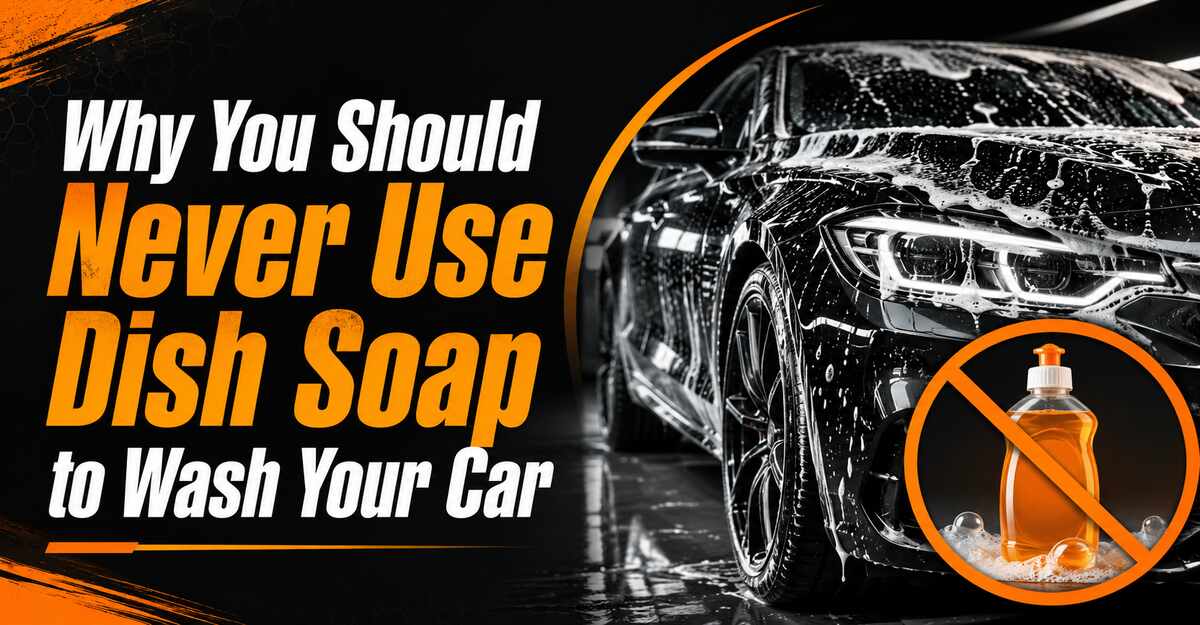
Washing a car with dish soap permanently damages automotive clear coats by acting as a harsh chemical stripper. Kitchen detergents possess high alkaline pH levels that instantly strip away essential protective waxes, dry out rubber window seals, and lack necessary lubrication, resulting in thousands of abrasive micro-scratches across the paintwork.
At a Glance: The Dish Soap Danger
- Alkaline damage: Dish soap has an aggressive pH of 8.5 to 9.5, which chemically burns through automotive waxes.
- High friction: Kitchen soaps lack engineered surfactants, creating 10 to 15 times less lubricity than dedicated car shampoos.
- Trim degradation: Repeated exposure causes plastic and rubber car trims to crack and fade 2 to 3 times faster.
- Matte paint destruction: A single dish soap wash can permanently ruin matte or satin finishes by creating uneven gloss spots.
- One valid exception: Professional detailers only use dish soap for pre-detail decontamination before full paint correction.
Why does dish soap damage automotive paint?
Dish soap damages automotive paint by employing aggressive alkaline degreasers designed to break down baked-on food grease, which identically attacks automotive clear coats and sealants. When applied to a vehicle, these household detergents actively dissolve the thin protective layer of oils, ultraviolet (UV) blockers, and synthetic polymers that shield the paint matrix from environmental degradation.
Without this chemical barrier, the clear coat absorbs direct solar radiation and environmental fallout. Furthermore, automotive shampoos contain engineered surfactants that encapsulate dirt particles to glide safely off the surface. Dish detergents entirely lack this encapsulating technology. As a result, washing with a kitchen detergent traps abrasive silica, road salt, and brake dust directly against the wash mitt, grinding those particulates deep into the clear coat with every swipe.
What is the pH difference between dish soap and car soap?
Dedicated car shampoos maintain a neutral pH of exactly 7.0, whereas common kitchen dish soaps register at a highly alkaline pH of 8.5 to 9.5. This chemical distinction is the primary reason kitchen detergents act as aggressive chemical strippers on automotive finishes.
| Soap Type | Average pH Level | Chemical Behavior on Automotive Paint |
| Dedicated Car Shampoo | 7.0 (Neutral) | Lifts dirt without degrading sealants or clear coats. |
| Kitchen Dish Soap | 8.5 – 9.5 (Alkaline) | Breaks down organic waxes, degreases oils, and dries rubber. |
| Baby Shampoo | 7.0 (Neutral) | Safe chemically, but severely lacks mechanical lubrication. |
A pH level of 9.0 is scientifically engineered to break down tough lipid bonds (fats and greases). On a car, this alkaline property chemically severs the bond between the carnauba wax and the clear coat, rendering the vehicle unprotected immediately after rinsing.
How does dish soap affect car wax and sealants?
A single wash with kitchen dish soap permanently strips up to 90% of traditional carnauba waxes and polymer paint sealants. Because dish soap is formulated with heavy-duty degreasing agents, it cannot distinguish between bacon grease on a dinner plate and protective carnauba wax on a car hood.
When the detergent contacts the vehicle, it rapidly emulsifies the wax layer. Owners will notice this immediate degradation during the rinse phase: the water will stop forming tight, symmetrical beads and will instead pool into flat, sluggish sheets. Once this wax layer is depleted, the vehicle requires a complete re-application of a protective sealant to prevent clear coat oxidation and UV failure.
Does washing a car with dish soap cause scratches?
Yes, washing a car with dish soap guarantees the creation of micro-scratches, commonly known in the automotive industry as swirl marks. Dish soap provides roughly 10 to 15 times less mechanical lubricity than a dedicated automotive wash soap.
Automotive shampoos are thick and highly lubricious, allowing the wash mitt to hydroplane over the clear coat while lifting dirt into the suds. Dish soap produces thin, watery suds that collapse under pressure. Because there is no lubricating barrier, the dirt particles scraped from the vehicle’s surface are dragged directly across the clear coat. Over time, these thousands of micro-marring incidents dull the paint’s reflection and create a spiderweb-like scratching effect visible under direct sunlight.
What happens to rubber and plastic trim exposed to dish soap?
Repeated exposure to dish soap causes automotive rubber door seals, window weather-stripping, and black plastic trims to dry, fade, and crack two to three times faster than normal. The chemical degreasers in kitchen detergents relentlessly extract the essential oils and plasticizers infused into these components during manufacturing.
Once these oils are stripped, the trim components lose their elasticity and UV resistance. Black plastics will rapidly oxidize, turning a chalky gray color. Rubber weather-stripping will become brittle and shrink, potentially leading to interior wind noise and cabin water leaks during heavy rain. Restoring these dried-out components often requires heavy chemical dressings or total replacement.
When is the only time you should use dish soap on a car?
You should only use dish soap on a car when executing a pre-detail paint decontamination immediately prior to a full machine polish and ceramic coating application. Professional detailers utilize dish soap specifically because of its aggressive stripping capabilities.
- Pre-Wash: The vehicle is rinsed to remove loose debris.
- Stripping Wash: The vehicle is washed with dish soap to intentionally strip all old waxes, traffic film, and masking glazes.
- Decontamination: The completely bare clear coat is then treated with an iron remover and a detailing clay bar.
- Correction and Protection: The naked paint is machine polished and immediately protected with a fresh ceramic coating or heavy-duty sealant.
Using dish soap is strictly a preparatory step for professional detailing, never a routine maintenance procedure.
How much dish soap is needed to strip car wax?
To intentionally strip old car wax for a pre-detail decontamination, you need 2 to 3 ounces of liquid dish soap diluted into a standard 5-gallon wash bucket. Using more than 3 ounces will not strip the wax any faster, but it will leave a sticky surfactant film on the paint that is extremely difficult to rinse off.
For those using a foam cannon attached to a pressure washer, 1 ounce of dish soap mixed with warm water in the cannon’s reservoir is sufficient to blanket the car in stripping foam. The vehicle must be kept wet and out of direct sunlight during this process, as dried dish soap can chemically etch into bare clear coats.
Can you wash a matte finish car with dish soap?
No, you must never wash a matte or satin finish vehicle with dish soap because it will permanently create uneven, blotchy gloss spots. Modern matte paint jobs do not have a traditional smooth clear coat that can be polished or corrected if damaged.
The strong alkaline degreasers in dish soap alter the microscopic texture of the matte finish. Because matte paint relies on a precisely textured surface to diffuse light, any chemical alteration instantly ruins the flat aesthetic. If a matte finish is stained or altered by dish soap, the damage cannot be buffed out; the affected body panel must be completely repainted by a professional body shop.
Does dish soap ruin ceramic coatings?
Dish soap will not chemically destroy a true 9H professional ceramic coating, but it will immediately clog the coating’s hydrophobic properties by leaving behind a heavy surfactant film. True quartz and ceramic coatings are highly chemically resistant and can withstand pH levels ranging from 2.0 to 12.0.
However, after a dish soap wash, a ceramic-coated car will stop repelling water and dirt. The kitchen detergent leaves a microscopic residue layer over the quartz structure, completely masking the coating’s self-cleaning abilities. To restore the ceramic coating’s water-beading performance, the vehicle must be washed again with a specialized, residue-free automotive decontamination soap to dissolve the dish soap film.
Can you use dish soap to clean car tires and wheels?
No, using dish soap on car tires and wheels is highly ineffective for removing baked-on brake dust and will accelerate tire dry-rot. The heavy alkaline nature of dish soap leaches the protective antiozonant chemicals baked into the tire sidewall rubber.
As these antiozonants are stripped away by the degreaser, the tire rubber oxidizes and turns brown (a process called tire blooming), eventually leading to premature micro-cracking in the sidewall. Furthermore, dish soap lacks the specific iron-dissolving chemicals required to safely melt away metallic brake dust from delicate alloy wheel finishes, making it both damaging and practically useless for wheel cleaning.
Should you use dish soap to remove bird droppings?
Yes, in a strict emergency where you have absolutely no car shampoo, washing highly corrosive bird droppings or tree sap immediately with heavily diluted dish soap is safer than letting the acid etch into your paint overnight. Avian waste contains high levels of uric acid that can permanently crack and eat through a clear coat in a matter of hours under a hot sun.
To execute an emergency wash:
- Dilute one drop of dish soap in a spray bottle filled with water.
- Spray the dropping heavily and let it soak for 30 seconds to soften the debris.
- Gently lift the waste away with a clean microfiber towel without scrubbing.
- Immediately reapply a spray wax or quick detailer to the area, as the soap will have removed the local protection.
Is baby shampoo a safe alternative to car soap?
No, baby shampoo is not a safe alternative to car soap because it severely lacks the heavy lubrication required to safely lift abrasive road grime without scratching the paint. While baby shampoo is pH-neutral (around 7.0) and chemically gentle enough not to strip wax, chemical safety is only half of the car-washing equation.
Automotive paint requires heavy, slick surfactants to safely drag dirt across the clear coat. Baby shampoo is formulated to be easily rinsed out of fine hair, meaning its suds are incredibly thin and watery. Washing a car with baby shampoo will result in severe micro-marring and swirl marks identical to those caused by dish soap.
What is the best household alternative to car shampoo?
There is no acceptable household liquid alternative to dedicated car shampoo, but a high-quality waterless wash spray or a rinseless wash solution (like Optimum No Rinse) is the best substitute if traditional soap is unavailable.
Do not substitute laundry detergent, hand soap, or glass cleaner, as all contain aggressive strippers or ammonia that will degrade clear coats. If your vehicle is only lightly dusty and you lack car shampoo, the safest household alternative is simply rinsing the vehicle heavily with a pressure washer and distilled water, then drying it gently with a premium microfiber drying towel aided by a lubricating spray wax.
How long does it take for dish soap to degrade car paint?
Dish soap immediately degrades the sacrificial wax layer on contact, but it takes roughly 6 to 12 months of repeated dish soap washing to visibly dry out rubber trim and accelerate clear coat oxidation. The damage is cumulative rather than instantaneous.
The first wash strips the wax and introduces micro-scratches. By the fifth wash, rubber window seals will begin feeling hard to the touch and black plastics will show a gray, chalky fade. By the tenth wash, the completely unprotected clear coat will begin succumbing to UV radiation, setting the stage for permanent clear coat peeling (delamination) within a year or two of continuous abuse.
Will washing your car with dish soap cause rust?
Washing your car with dish soap will not cause immediate rusting, but it rapidly accelerates the onset of rust by stripping away protective wax layers and exposing raw metal to moisture. Automotive paint systems rely on a sealed environment to keep oxygen and water away from the underlying steel body panels.
Dish soap dries out micro-cracks in the paint and removes the hydrophobic waxes that force water to bead and roll off the car. Once the wax is gone, water pools in these microscopic cracks and sits flat against the surface for longer periods. This prolonged moisture exposure, combined with the lack of chemical protection, creates the ideal breeding ground for rapid oxidation and rust formation.
The Bottom Line
Washing your vehicle with dish soap is an outdated practice that permanently damages your vehicle’s aesthetic and structural protection. Kitchen detergents rely on high-alkaline degreasers that instantly strip automotive waxes, dry out crucial rubber weather seals, and cause thousands of abrasive micro-scratches due to poor lubricity. Unless you are a professional detailer actively preparing a vehicle’s bare clear coat for a machine polish and ceramic coating, dish soap has no place in your garage. To preserve your clear coat and prevent premature aging, always use a pH-neutral, high-lubricity dedicated automotive shampoo.