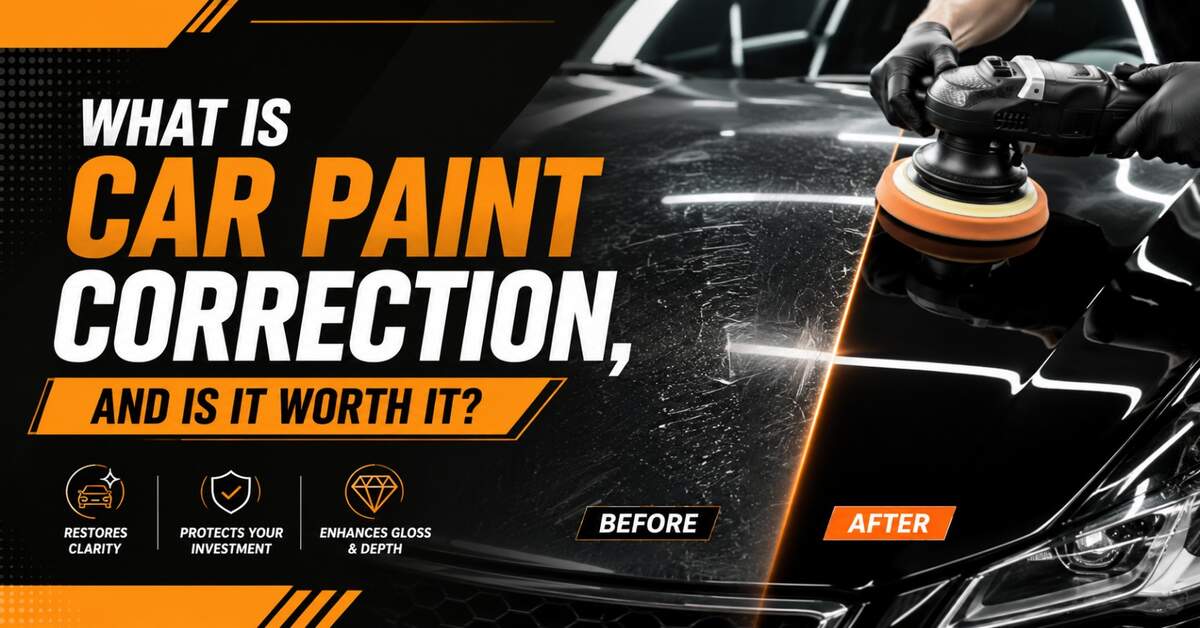
Car paint correction is the mechanical leveling of automotive clear coat using abrasive compounds and machine polishers to permanently remove surface defects like swirl marks, scratches, and oxidation. The process restores optical clarity and gloss by shaving away microscopic layers of damaged clear coat until the surface reflects light uniformly.
At a Glance
- Paint correction permanently removes defects by leveling the clear coat, rather than filling them in with waxes or glazes.
- Factory clear coats are thin (35–50 microns); a single multi-stage correction safely removes 2 to 5 microns.
- Professional correction costs range from $300 for a 1-stage enhancement to over $3,000 for a 3-stage restorative process.
- The fingernail test determines fixability: if a fingernail catches in a scratch, the defect has breached the clear coat and cannot be polished out.
- Corrected paint remains flawless for 2 to 5 years only if maintained with proper hand-washing techniques.
What is the difference between paint correction, polishing, and waxing?
Paint correction encompasses the entire multi-step process of compounding and polishing to remove physical clear coat defects, whereas waxing merely adds a temporary sacrificial layer of protection on top of the paint. Polishing is just one specific step within the broader paint correction workflow.
Compounding (the heavy cutting phase) uses aggressive abrasives to level deep scratches, while polishing uses ultra-fine abrasives to refine the finish and maximize gloss. Waxing, on the other hand, contains no abrasives. Applying carnauba wax or a synthetic sealant over heavily swirled paint will temporarily mask minor imperfections by filling them with oils, but the defects will reappear once the wax degrades after two to three months. Paint correction provides a permanent structural fix to the clear coat itself.
How do you know if a vehicle needs paint correction?
A vehicle requires paint correction when the clear coat exhibits visible wash scratches, swirl marks (spiderweb-like circular lines under direct sunlight), water spot etching, or widespread oxidation that makes the paint look dull or cloudy. The most definitive diagnostic tool is a high-lumen LED inspection light.
When a detailer shines an inspection light directly onto the panel, the light source should reflect as a perfectly crisp, tight circle. If the light reflection diffuses, scatters, or reveals a halo of fine micro-scratches surrounding the bulb’s reflection, the clear coat is damaged and uneven. Additionally, if the vehicle’s paint feels rough after a thorough chemical and physical decontamination (using an iron remover and clay bar), heavy oxidation or micro-marring is present, necessitating mechanical leveling.
What are the different stages of paint correction?
Paint correction is categorized into three professional tiers based on the severity of the defects, the aggressiveness of the pads and liquids used, and the desired final finish.
The choice of stage dictates the time required and the percentage of defect removal:
| Correction Stage | Process Involved | Defect Removal | Best Suited For |
|---|---|---|---|
| 1-Stage (Enhancement) | Single polishing pad paired with a finishing polish compound. | 50% – 70% | Well-maintained daily drivers, soft paint systems, or vehicles with light wash marring. |
| 2-Stage (Correction) | Heavy cutting compound on a microfiber/wool pad, followed by a finishing polish on a foam pad. | 70% – 85% | Vehicles with moderate swirling, light branch scratches, and faded or oxidized paint. |
| 3-Stage (Multi-Stage) | Heavy wet sanding or heavy compounding, medium cut, and a final refining polish. | 85% – 95%+ | Show cars, exotic vehicles, deep isolated scratches, and extremely hard clear coat systems. |
How much does a professional paint correction cost?
Professional paint correction costs range from $300 to over $3,000, depending heavily on the vehicle’s size, the clear coat’s hardness, and the specific stage of correction required.
A 1-stage paint enhancement on a small coupe typically costs between $300 and $600 and takes a professional four to six hours. A 2-stage correction on a mid-sized sedan or SUV generally costs between $600 and $1,200, requiring a full working day or more. For a comprehensive 3-stage correction involving wet sanding on an exotic vehicle or a large truck, prices start at $1,200 and frequently exceed $3,000 due to the 20 to 40 hours of intensive labor required. Geographic location and the detailer’s reputation also sway these prices by up to 30%.
How many microns of clear coat does polishing remove?
A standard multi-stage paint correction safely shaves away roughly 2 to 5 microns of the factory clear coat. Understanding clear coat thickness is critical because modern automotive factory paint systems are exceptionally thin.
The average factory clear coat measures between 35 and 50 microns in total thickness—roughly the thickness of a standard Post-it note. An aggressive cutting compound on a microfiber pad might level 3 microns to eliminate a cluster of swirl marks, while the subsequent finishing polish might remove just 0.5 microns to restore optical clarity. Because the material is finite, professionals must measure the panels using a digital paint depth gauge before proceeding.
Is paint correction worth the investment?
Paint correction is worth the financial investment for well-maintained enthusiast vehicles, high-value luxury cars, or prior to applying a long-term ceramic coating, but it is a waste of money for low-value daily commuters or owners who rely on automated car washes.
The value proposition depends entirely on the owner’s maintenance habits. Spending $1,500 on a 2-stage correction fails spectacularly if the owner subsequently drives the vehicle through a mechanical soft-touch car wash. The spinning nylon brushes in automated washes will re-inflict 80% of the swirl marks in a single pass. Furthermore, spending $1,000 to correct a commuter car valued at $5,000 will not yield a proportional increase in the vehicle’s resale or trade-in value.
How many times can a car safely undergo paint correction?
A modern vehicle can safely undergo a heavy 2-stage paint correction a maximum of two to three times in its lifespan before the clear coat becomes dangerously compromised.
Removing more than 25% of the total clear coat thickness (approximately 10 to 12 microns) permanently destroys the paint’s UV-blocking capabilities. Once the clear coat is thinned beyond this threshold, the underlying base coat (color layer) is subjected to direct solar radiation. Vehicles that have been aggressively polished multiple times become “thin clear coat rejects.” If a digital paint depth gauge reads below 70 microns for the total paint system (primer, base, and clear combined), a professional detailer will refuse to compound the car, opting only for an ultra-light finishing polish to avoid burning through to the base coat.
Can polishing burn through or damage automotive clear coat?
Yes, machine polishing can instantly burn through or permanently damage automotive clear coat if excessive heat is generated, if the pad is held on an edge too long, or if an aggressive rotary buffer is misused.
Clear coats flex and dissipate heat differently depending on the substrate. Polishing a plastic bumper requires much lower machine speeds than polishing a metal hood. Plastic does not disperse heat efficiently; therefore, hovering a spinning pad over a plastic bumper can cause the clear coat to reach temperatures exceeding 180°F (82°C) in seconds. At this temperature, the clear coat physically twists, blisters, and separates from the base color, creating a “burn through” that can only be fixed by a body shop repainting the entire panel.
Does paint correction fix deep key scratches and rock chips?
No, paint correction cannot fix rock chips or deep key scratches because these severe defects physically remove all layers of the paint down to the bare metal, aluminum, or plastic substrate.
Paint correction relies on leveling the clear coat surrounding a defect. The industry standard for diagnosing fixability is the “fingernail test.” If a detailer drags a fingernail across a scratch and it catches in the groove, the defect has breached the clear coat layer entirely. Buffing an inherently missing layer of paint is physically impossible. To repair rock chips or keying vandalism, the vehicle requires touch-up paint, wet sanding to level the new paint, or a complete respray from an automotive body shop.
Can machine polishing fix peeling clear coat?
No, machine polishing cannot fix peeling clear coat; in fact, running a polishing pad over a failing clear coat will drastically accelerate the peeling and rip the remaining fragile edges right off the panel.
Clear coat failure occurs when the UV inhibitors inside the chemical matrix are depleted, causing the clear layer to delaminate and flake away from the base color layer underneath. This often looks like a white, flaky rash on horizontal surfaces like the roof or hood. Because the bond between the layers is already broken, mechanical abrasion will only remove more material without restoring gloss to the exposed, unprotected base coat. The only remedy for clear coat failure is stripping the panel to bare metal and repainting it.
How long do the results of a paint correction last?
The physical results of a paint correction last permanently because the defects are shaved out of the clear coat rather than temporarily filled in, but the pristine finish will only remain flawless for as long as the owner’s maintenance habits allow.
With rigorous maintenance, a corrected vehicle can look perfect for 2 to 5 years. This requires the owner to exclusively use the two-bucket hand-washing method, high-lubricity pH-neutral auto shampoos, and clean microfiber drying towels. Conversely, the results of a $2,000 paint correction can be completely ruined in ten minutes if an inexperienced dealership lot porter aggressively wipes down the dry, dusty paint with a dirty shop rag.
Is a ceramic coating required after correcting automotive paint?
A ceramic coating is not strictly required after a paint correction, but applying a high-quality chemical coating or Paint Protection Film (PPF) is highly recommended by every automotive professional.
Corrected paint is completely bare; the heavy compounding and polishing steps strip away all legacy waxes, sealants, and road grime. Leaving leveled clear coat unprotected exposes the thinned surface to UV rays, bird dropping etchings, and environmental fallout. Applying a ceramic coating locks in the newly created optical clarity, provides intense hydrophobic water-beading properties, and adds a microscopic sacrificial layer of silicon dioxide (SiO2) that makes subsequent washing safer and easier.
Can you perform paint correction yourself at home?
Yes, you can perform paint correction yourself at home, provided you strictly use a dual-action (DA) polisher and practice on an inconspicuous panel first.
Beginners should invest in a budget DA polisher because the backing plate oscillates in a random orbit rather than just spinning on a fixed axis. This random movement drastically reduces the friction and heat buildup that causes clear coat burn-throughs. However, DIYers must avoid Rotary Buffers entirely. A rotary machine generates intense heat instantly and requires hundreds of hours of professional practice to master; in the hands of a novice, a rotary buffer can destroy a vehicle’s clear coat on the first attempt.
The Bottom Line
Car paint correction is a highly effective mechanical process that permanently removes swirl marks and scratches by leveling the microscopic top layer of the clear coat. It is absolutely worth the investment for high-value vehicles, provided the owner is committed to safe, two-bucket hand-washing methods to maintain the pristine finish. However, the process has strict physical limitations; it cannot fix deep scratches that fail the fingernail test, and vehicles with heavily thinned or failing clear coats will require professional repainting instead.