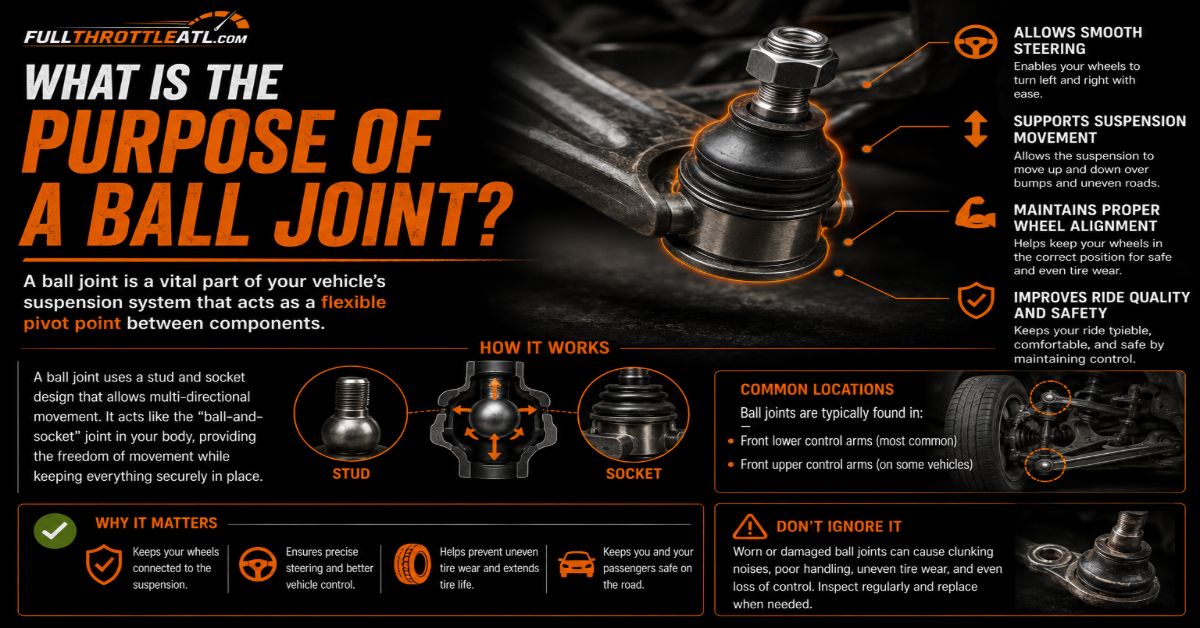
The primary purpose of a ball joint is to act as a flexible pivot point that connects a vehicle suspension control arm to the steering knuckle. This critical spherical bearing allows the front wheels to steer left and right while simultaneously moving up and down to absorb road impacts.
At a Glance
- Ball joints provide three degrees of rotational freedom for vehicle steering and suspension articulation while allowing zero degrees of linear movement.
- Standard factory ball joints are engineered to last between 70,000 and 150,000 miles under normal driving conditions.
- Load-carrying ball joints support the entire weight of the vehicle and wear out significantly faster than follower ball joints.
- Modern sealed ball joints do not require routine lubrication and can be permanently damaged by injecting grease through the protective boot.
- Complete ball joint failure while driving results in the steering knuckle detaching and an immediate loss of steering control.
How does a ball joint work within the suspension?
A ball joint works exactly like a human hip joint by utilizing a polished steel ball securely seated inside a lubricated spherical socket. The ball stud connects directly to the steering knuckle, while the socket housing presses or bolts into the suspension control arm. This mechanical arrangement grants the suspension three distinct degrees of rotational freedom: pitch, roll, and yaw.
While the ball joint rotates freely to accommodate steering geometry, it allows zero degrees of translational freedom. The joint firmly locks the knuckle to the control arm so the wheel cannot move independently forward, backward, inward, or outward. A specialized castle nut secures the ball joint stud to the knuckle, which technicians typically torque to a value between 40 and 80 lb-ft before locking it in place with a steel cotter pin. A flexible polyurethane or rubber boot seals the socket to keep internal grease inside and keep destructive road grit out.
What is the difference between load-carrying and follower ball joints?
Load-carrying ball joints support the direct weight of the vehicle, while follower ball joints simply guide the steering knuckle to maintain proper wheel alignment. This distinction appears prominently in Short Long Arm (SLA) suspension systems.
The spring or torsion bar in an SLA suspension dictates which joint carries the load. If the coil spring rests on the lower control arm, the lower ball joint acts as the load-carrying component. Because load-carrying joints endure the constant compression of the vehicle weight, these specific components wear out significantly faster than their follower counterparts. Follower ball joints, sometimes called guide joints, experience lateral forces during cornering but do not bear vertical chassis weight. When diagnosing suspension wear, technicians must understand this difference, because testing a load-carrying joint requires lifting the vehicle in a way that unloads the suspension spring tension completely.
How do inverted ball joint configurations function?
Inverted ball joint configurations feature a stud that points upward into the steering knuckle rather than downward. Automotive engineers use inverted ball joints on modern vehicles to improve suspension geometry and increase ground clearance under the lower control arm.
This inverted design completely reverses the direction of the mechanical forces applied to the joint. In a traditional configuration, the weight of the vehicle pushes the ball deeper into the socket. In an inverted configuration, the suspension constantly tries to pull the ball stud out of the socket. Traditional diagnostic methods will fail to identify wear on an inverted ball joint. A mechanic attempting to pry upward on an inverted joint will simply push the ball tighter into the socket, masking any internal play. Technicians must relieve the suspension tension in the exact opposite direction to reveal true mechanical wear.
What causes a ball joint to wear out prematurely?
The leading cause of premature ball joint wear is a ruptured protective dust boot that allows abrasive contaminants to enter the bearing socket. Once water, salt, and road grit breach the rubber boot, the factory grease degrades into an abrasive grinding paste that rapidly destroys the polished steel ball.
Beyond compromised seals, excessive unsprung weight drastically reduces ball joint lifespan. Installing oversized aftermarket wheels or heavy off-road tires multiplies the leverage forces applied to the suspension pivot points. Aggressive driving habits, frequent travel over pothole-ridden roads, and hauling heavy loads will also crush the internal bearing surfaces. Finally, improper maintenance causes rapid failure. The historical rule of thumb was to grease suspension joints during every oil change. However, modern OEM ball joints are completely sealed. Pumping grease into a sealed boot using a needle adapter will rupture the rubber, introducing moisture and causing catastrophic failure within a matter of months.
What are the warning signs of a failing ball joint?
The most common warning sign of a failing ball joint is a sharp clunking or popping noise originating from the front suspension when driving over bumps or turning the steering wheel. This noise occurs because the worn steel ball is physically slamming against the inside of the enlarged socket casing.
As the wear progresses, drivers often experience wandering steering. The vehicle may drift unpredictably from side to side on a flat highway, requiring constant minor steering corrections. A stiff or binding steering wheel can also indicate a ball joint that lacks lubrication and is beginning to seize. However, noise is not a guaranteed symptom. A completely dry ball joint can seize up tightly without making a single sound. This silent failure mode is particularly dangerous because the weakened joint can snap entirely at highway speeds without giving the driver any audible warning beforehand.
Can a bad ball joint cause uneven tire wear?
Yes, a bad ball joint will directly cause uneven and accelerated tire wear. The ball joint serves as the primary anchor point that maintains the exact camber and toe angles of the front wheels.
When the internal socket wears out, the ball stud develops lateral play. This loose tolerance allows the top or bottom of the tire to tilt inward or outward while the vehicle is in motion. A failing lower ball joint typically causes the bottom of the tire to kick outward, resulting in negative camber. This specific geometry shift rapidly scrubs the rubber off the inside edge of the tire tread. Alternatively, if the loose joint allows the wheel to toe outward, the tire will exhibit a feathered wear pattern across the entire tread block. Any technician performing a wheel alignment will refuse to align a vehicle until worn ball joints are replaced, as the shifting components make it impossible to lock in accurate alignment angles.
How do you properly test a ball joint for play?
Properly testing a ball joint requires lifting the vehicle correctly to unload the suspension, followed by measuring internal movement with a dial indicator. New factory ball joints possess exactly 0.000 inches of axial (vertical) and radial (side-to-side) play.
The standard advice of jacking up the car by the frame and shaking the tire at the 12 and 6 o’clock positions fails completely on vehicles with MacPherson strut suspensions. When the frame is lifted, the strut spring pushes the lower control arm down to its maximum limit. This heavy tension tightly binds the ball joint, effectively masking massive amounts of dangerous play. To test a MacPherson setup properly, the mechanic must place the jack directly under the lower control arm. Once properly lifted, industry standards dictate strict wear limits. General maximum allowable tolerances are 0.050 inches (1.27 mm) for vertical play and 0.020 to 0.030 inches (0.51 to 0.76 mm) for side-to-side play. Anything exceeding these numbers requires immediate component replacement.
How long can you safely drive on a bad ball joint?
You cannot safely drive any distance on a ball joint that has exceeded the manufacturer wear specifications. A ball joint is a primary safety-critical structural component, and driving on a failed joint risks a catastrophic suspension collapse.
If a mechanic notes that a ball joint is beginning to show early signs of wear but still falls well within the 0.050-inch axial tolerance limit, the vehicle remains safe for limited daily commuting. The driver should plan for replacement within the next few thousand miles. However, if the joint exhibits audible clunking, causes steering wander, or exceeds the radial play limits, the vehicle must be parked immediately. The transition from a noisy, loose joint to a completely separated suspension joint can happen instantaneously when the vehicle hits a simple pothole or speed bump.
What happens when a ball joint fails while driving?
When a ball joint fails completely while driving, the steering knuckle detaches instantly from the suspension control arm. The affected wheel becomes entirely disconnected from the steering system and will immediately fold outward or tuck violently underneath the vehicle chassis.
This mechanical separation causes an instantaneous, total loss of steering control. Because the wheel collapses inward, the heavy vehicle frame drops directly onto the tire or the pavement. The violent motion typically tears the flexible rubber brake lines in half, resulting in a sudden loss of hydraulic braking pressure. On front-wheel-drive or all-wheel-drive vehicles, the collapsed knuckle will rip the CV axle out of the transmission housing. The resulting collision between the folding wheel and the body panels will crush the vehicle fender, destroy the wheel well liner, and often cause thousands of dollars in secondary collision damage.
Should you replace ball joints in pairs?
While it is mechanically possible to replace just a single failed ball joint, automotive professionals highly discourage the practice and recommend replacing them in pairs across the same axle.
Suspension components on the left and right sides of a vehicle experience identical mileage, identical environmental exposure, and nearly identical road stress over their lifespan. If the right lower ball joint has reached its absolute mechanical wear limit after 100,000 miles, the left lower ball joint contains exactly the same internal fatigue. Replacing only one side restores tight factory steering geometry to the right wheel while leaving sloppy, degraded geometry on the left. This imbalance forces the new component to absorb unequal road forces, often leading to poor handling characteristics and premature wear of the newly installed part.
Can you replace just the ball joint on an integrated control arm?
No, you generally cannot replace an individual ball joint on a modern integrated control arm. On many newer vehicles, particularly those utilizing lightweight aluminum suspension components, the manufacturer permanently presses or casts the ball joint housing directly into the arm itself.
This integrated design saves weight and reduces factory assembly time, but it drastically increases the cost of routine maintenance. Even if the internal ball joint bearing is the only failed component, a mechanic cannot press the old joint out. The entire control arm assembly must go into the scrap bin. This manufacturing trend means a consumer must pay for a completely new $300 to $600 control arm assembly simply to resolve a failure in a part that traditionally cost $20 as a standalone replacement.
Are press-in ball joints better than bolt-on types?
Neither press-in nor bolt-on ball joints are inherently better or safer than the other. The difference lies purely in how the vehicle manufacturer engineered the suspension assembly line and how aftermarket companies approach part replacement.
Press-in ball joints rely entirely on microscopic interference fit friction to stay seated inside the control arm opening. They require immense hydraulic pressure to install and remove. Bolt-on ball joints secure to the control arm using heavy-duty hardened steel bolts, washers, and locking nuts. Bolt-on joints are significantly easier for technicians and DIY mechanics to service in a home garage. In many cases, a factory control arm may utilize a riveted ball joint. When replacing the part, the mechanic must drill or grind out the factory steel rivets and install an aftermarket bolt-on joint in its place.
Are aftermarket ball joints as reliable as OEM parts?
The reliability of aftermarket ball joints depends entirely on the price tier and the engineering philosophy of the specific manufacturer. Premium aftermarket ball joints frequently match or even exceed the durability of original equipment manufacturer parts.
Many high-end aftermarket brands redesign factory ball joints to fix known weaknesses. For example, a factory OEM joint might utilize a polished steel ball riding inside a plastic polymer socket to ensure a smooth, quiet ride. While quiet, the plastic degrades quickly under heavy use. Premium aftermarket companies often replace the plastic bearing with a sintered metal-to-metal design. This heavy-duty upgrade allows the joint to withstand severe off-road abuse and heavy towing that would destroy the OEM plastic part. Conversely, economy-tier aftermarket ball joints found in generic online kits use cheap, brittle steel and thin rubber boots that frequently tear and fail within the first 10,000 miles of use.
What tools are required to replace a press-in ball joint?
Replacing a press-in ball joint requires heavy-duty specialty tools designed specifically to safely apply and remove thousands of pounds of static pressure. Standard hand tools are insufficient for this procedure.
The primary tool required is a heavy-duty forged C-clamp style ball joint press kit. This specialized kit includes a threaded forcing screw and a variety of hardened steel receiver tubes and adapter cups. The mechanic uses the specific adapter cup that perfectly matches the diameter of the ball joint flange. Using an impact wrench or a long breaker bar, the technician drives the forcing screw to push the old joint out of the control arm. Attempting to remove a press-in ball joint with a sledgehammer or an improvised rig will permanently distort the control arm socket, rendering the entire suspension arm useless.
How much does a ball joint replacement cost?
A standard ball joint replacement typically costs between $200 and $400 per wheel when performed by a professional automotive repair shop. The exact cost heavily depends on the vehicle make, the labor rates in the local area, and the specific suspension design.
The raw cost of a standalone press-in or bolt-on ball joint usually ranges from $20 to $60. The majority of the repair bill comes from the required labor, as the technician must disassemble the brakes, remove the steering knuckle, and operate hydraulic press tools. If the vehicle utilizes an integrated control arm where the ball joint cannot be separated, the parts cost will jump significantly. Replacing an entire aluminum control arm assembly will push the total repair cost to anywhere between $400 and $800 per side.
Is a wheel alignment required after replacing a ball joint?
Yes, a professional wheel alignment is absolutely mandatory immediately following any ball joint replacement. You cannot skip this step without risking severe damage to the vehicle tires.
Even if a mechanic uses identical OEM parts from the original manufacturer, microscopic manufacturing variances exist between the old cast housing and the new unit. Furthermore, the act of unbolting the suspension components and bolting them back together naturally shifts the mounting holes by tiny fractions of an inch. These minute shifts at the pivot point translate into massive changes at the outer edge of the tire tread. Failing to align the vehicle will leave the toe and camber angles out of specification, leading to unpredictable vehicle handling and rapid, irreversible tire tread destruction within just a few hundred miles.
The Bottom Line
The purpose of a ball joint is to serve as the critical suspension pivot that allows a vehicle to steer smoothly while simultaneously absorbing bumps in the road. These joints tolerate zero linear movement, meaning any internal play beyond the strict 0.050-inch factory tolerance represents a serious safety hazard. While replacing load-carrying joints or integrated aluminum arms can be expensive, ignoring the wear risks a total suspension collapse at highway speeds. Proper diagnostic testing, unloading the suspension tension correctly, and following up with a precision wheel alignment are non-negotiable steps for a successful repair.