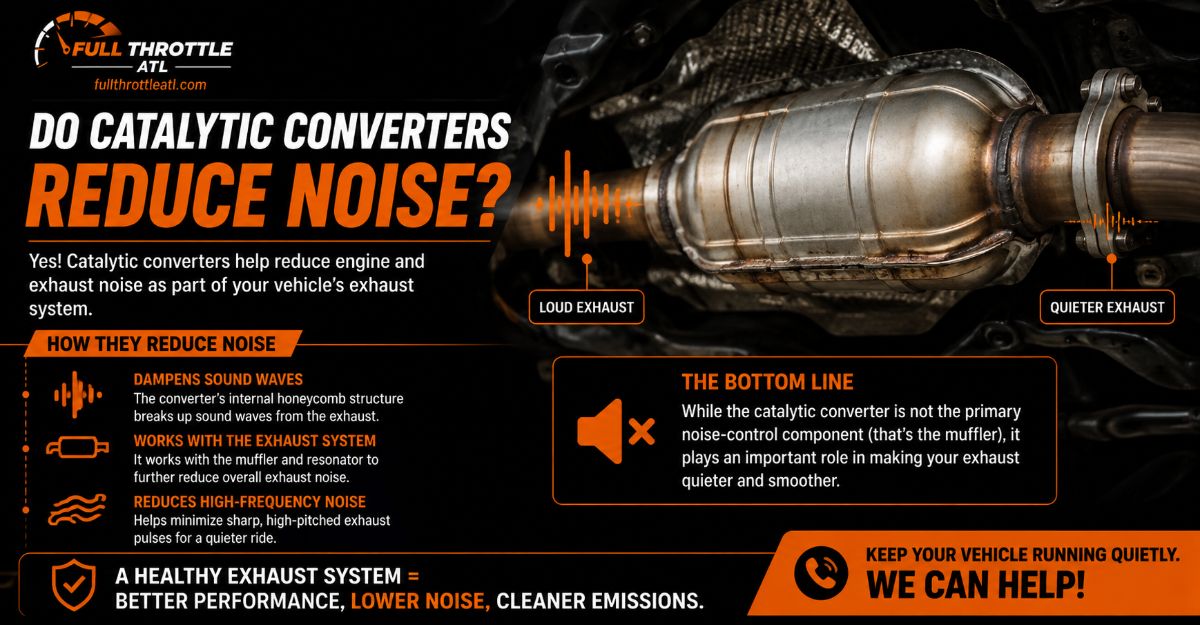
Catalytic converters significantly reduce exhaust noise by acting as secondary silencers. As high-velocity exhaust gases pass through the converter’s dense internal ceramic honeycomb structure, sound waves reflect, collide, and lose energy. Removing a catalytic converter increases overall exhaust volume by 10% to 30% (roughly 10 to 15 decibels) and introduces harsh, high-pitched metallic rasp.
At a Glance
- Volume Suppression: Catalytic converters reduce overall exhaust volume by 10 to 15 decibels across most engine configurations.
- Tone Control: Internal ceramic substrate channels filter out high-frequency metallic rasp and low-frequency cabin resonance.
- Engine Type Variance: Turbocharged and modern diesel engines experience less volume increase upon cat removal than naturally aspirated engines.
- Performance Impact: Removing a catalytic converter on a stock ECU calibration reduces low-end torque due to altered exhaust scavenging velocity.
- Legal and Diagnostic Risks: Operating a vehicle without a catalytic converter triggers permanent OBD-II diagnostic fault codes (P0420) and violates federal emissions laws.
How Much Noise Does a Catalytic Converter Reduce in Decibels?
A functional catalytic converter reduces vehicle exhaust noise levels by approximately 10 to 15 decibels (dB), which represents a 10% to 30% reduction in perceived audible loudness. Sound suppression varies based on engine displacement, exhaust pipe diameter, and whether the engine utilizes forced induction.
The sound intensity and acoustic character change significantly across common exhaust configurations:
| Exhaust System Setup | Average Sound Level (dB) | Perceived Loudness | Primary Acoustic Character |
| Stock OEM System | 70–75 dB | Baseline | Muted, refined engine note; zero cabin drone. |
| High-Flow Converter (200-Cell) | 80–85 dB | ~20% Louder | Deeper tone, subtle turbo spooling, controlled rasp. |
| Cat Delete (Stock Muffler) | 85–90 dB | ~35% Louder | Metallic rasp under load, sharp cold-start pop. |
| Full Straight Pipe (No Cat/Muffler) | 110–120+ dB | ~300% Louder | Harsh, ear-shattering, severe cabin drone at 2,500 RPM. |
Decibel scales are logarithmic: every 10 dB increase represents a doubling of perceived sound volume. Consequently, transitioning from a 75 dB stock exhaust to an 85 dB cat-deleted system makes the vehicle sound twice as loud to the human ear.
How Does a Catalytic Converter Dampen Exhaust Sound Waves Mechanically?
A catalytic converter dampens exhaust sound waves through physical friction, wave interference, and thermal absorption within its internal chamber. Engine combustion creates expanding pulses of high-pressure exhaust gas accompanied by intense acoustic wave energy traveling down the exhaust manifold.
Inside the catalytic converter, gases enter a dense matrix known as a monolithic substrate, typically containing 400 to 600 square micro-channels per square inch (Cells Per Square Inch, or CPSI).
[Exhaust Pulse] ---> [Narrow Ceramic Channels] ---> [Friction & Reflection] ---> [Smoothed Acoustic Output]
This dense internal structure dampens sound energy through three primary mechanical processes:
- Acoustic Friction: Gas molecules drag against the microscopic walls of the ceramic or metallic micro-channels, converting sound wave kinetic energy into minimal thermal energy.
- Phase Interference: Acoustic waves break into thousands of micro-currents within individual cells. When these divided waves recombine at the converter outlet, opposing sound frequencies cancel each other out.
- Pulse Diffusion: The sudden expansion from narrow exhaust piping into the larger converter body breaks peak pressure pulses, flattening the sudden sound spikes produced by cylinder firing events.
How Does Removing a Catalytic Converter Change Exhaust Tone and Rasp?
Removing a catalytic converter changes exhaust tone from a smooth, low-frequency hum into a high-pitched, harsh metallic noise known as exhaust rasp. The catalytic converter filters out undesirable high-frequency sound waves above 1,000 Hz; without this filtration, high-frequency sound pulses echo off thin-walled exhaust piping.
Exhaust rasp sounds like metallic rattling or a hollow tin can under hard acceleration, particularly between 3,000 RPM and 4,500 RPM. Automotive enthusiasts frequently compare the unrefined sound of a cat-deleted four-cylinder engine to a harsh “fart can” exhaust note. Beyond volume gains, removing the catalytic converter strips away the rich, refined resonance of the exhaust note, exposing raw engine combustion noise.
Does Deleting a Catalytic Converter Cause Cabin Drone at Highway Speeds?
Deleting a catalytic converter almost always causes severe cabin drone at steady cruising speeds between 2,000 RPM and 3,000 RPM. Cabin drone occurs when specific acoustic frequencies produced by an uninhibited exhaust match the natural structural resonance frequency of the vehicle frame and interior trim.
Unlike external volume spikes under wide-open throttle, highway cabin drone generates a continuous low-frequency hum that physical interior insulation cannot easily absorb. This continuous acoustic vibration causes driver fatigue, interior plastic rattles, and difficulty holding conversations during extended highway trips. Installing heavy-duty sound-deadening mats inside the trunk reduces floorboard vibrations but cannot eliminate acoustic drone caused by removing the primary catalytic substrate.
How Does Catalytic Converter Removal Affect Turbocharged vs. Naturally Aspirated Engines?
Removing a catalytic converter affects turbocharged engines far less in volume increase than naturally aspirated engines because the turbocharger turbine wheel acts as an acoustic silencer.
- Turbocharged Engines: The rotating turbine wheel inside a turbocharger housing actively chops up expanding exhaust gas pulses before they reach the downpipe. Deleting a catalytic converter on a turbocharged engine typically increases volume by only 5% to 10%, while distinctly exposing turbocharger spooling whistles and blow-off valve acoustics.
- Naturally Aspirated Engines: On naturally aspirated V6 or V8 engines, combustion pulses travel unrestricted from the exhaust manifold into the exhaust piping. Deleting the catalytic converter on these setups produces an immediate 20% to 30% jump in overall sound volume, accompanied by sharp acoustic spikes during downshifts.
Does Removing a Catalytic Converter Sound Different on Diesel Engines?
Removing a catalytic converter on modern diesel engines produces minimal sound change if the Diesel Particulate Filter (DPF) and Selective Catalytic Reduction (SCR) systems remain installed. Modern diesel exhaust architecture relies on multiple downstream emission components that collectively absorb acoustic energy.
A modern diesel engine exhaust features a complex emissions stack:
- Diesel Oxidation Catalyst (DOC): Filters unburnt hydrocarbons and provides mild acoustic dampening.
- Diesel Particulate Filter (DPF): Uses a dense wall-flow ceramic substrate that traps soot while absorbing substantial exhaust noise.
- SCR System: Injects DEF fluid across a secondary catalyst brick, further diffusing sound waves.
If an owner removes only the Diesel Oxidation Catalyst (DOC) while retaining the DPF, exhaust volume increases by less than 3 dB. Massive volume increases and deep diesel exhaust roars only occur when performing a full emissions system delete—removing the DOC, DPF, and muffler simultaneously.
Why Is a Car’s Cold Start So Loud Without a Catalytic Converter?
A car cold start is exceptionally loud without a catalytic converter because modern Engine Control Units (ECUs) intentionally dump extra fuel and retard ignition timing during the first 30 to 60 seconds of operation. This automated process, known as the catalyst heating cycle, raises exhaust gas temperatures above 750°F (400°C) as rapidly as possible to activate the catalyst internal precious metals.
During this warm-up routine, unburnt fuel ignites late in the combustion stroke, sending mini-explosions directly into the exhaust manifold. A factory catalytic converter absorbs these harsh pressure waves and thermal spikes. Without a converter, these raw combustion pulses exit the exhaust tip uninhibited, causing cold-start noise levels to spike past 100 dB in garage spaces.
What Does a Failing or Broken Catalytic Converter Sound Like?
A failing catalytic converter produces a distinct metallic rattling sound at idle or during sudden engine acceleration, sounding similar to a box of loose marbles shaking inside a metal container. This noise occurs when the internal ceramic substrate fractures due to thermal shock, road impact, or chronic engine misfires, allowing broken catalyst chunks to bounce against the outer steel housing.
In contrast, a clogged or melted catalytic converter does not rattle; instead, it causes a choked, high-pitched hissing sound near the engine bay under heavy acceleration. This hissing occurs as high-pressure exhaust gas forces its way past degraded exhaust manifold gaskets or split converter seams due to severe exhaust backpressure blockages.
How Does a High-Flow Catalytic Converter Compare to Stock Cats and Cat Deletes?
A high-flow catalytic converter provides an ideal acoustic compromise, offering a slightly aggressive exhaust note without the harsh rasp, cabin drone, or fuel odors associated with a complete cat delete.
Standard OEM catalytic converters use dense 400 to 600 CPSI ceramic bricks that prioritize maximum emissions reduction and noise dampening. High-flow converters utilize 200 to 300 CPSI metallic matrix substrates that reduce backpressure while maintaining sufficient gas filtration.
Stock Cat (400–600 CPSI)  ---> High Sound Suppression / High Backpressure
High-Flow Cat (200 CPSI)  ---> Balanced Acoustics / Moderate Flow
Cat Delete (0 CPSI)        ---> Loudest Volume / High Rasp / High Smell
A 200-cell high-flow converter increases exhaust volume by 5 to 8 dB over stock—producing a deeper exhaust tone and slight rumble—while keeping highway cabin drone and high-frequency rasp completely under control.
What Is the Acoustic Difference Between a Catalytic Converter, Resonator, and Muffler?
The catalytic converter, resonator, and muffler each target distinct acoustic frequencies and physical sound mechanisms within a vehicle’s exhaust system.
- Catalytic Converter: Positioned closest to the engine manifold, its primary function is emissions reduction, but its dense honeycomb matrix acts as a high-frequency dampener that eliminates sharp metallic rasp.
- Resonator: A hollow expansion chamber tuned to specific target wavelengths. It uses Helmholtz resonance or pass-through perforated cores to cancel targeted drone frequencies (typically 200–400 Hz) without significantly reducing overall decibel volume.
- Muffler: Positioned near the exhaust tailpipe, it serves as the primary decibel reducer. Utilizing internal baffles, sound-absorbing fiberglass packing, or chambered walls, the muffler reduces overall sound volume across the entire audio spectrum.
Why Does Removing a Catalytic Converter Reduce Low-End Torque on Stock Engines?
Removing a catalytic converter on a modern stock engine often reduces low-end torque because it alters exhaust gas velocity and scavenges exhaust pulses inefficiently when running factory ECU fuel maps. Modern naturally aspirated engines rely on controlled exhaust piping diameter to maintain high exhaust gas velocity at low engine speeds (1,500 to 3,000 RPM).
High exhaust velocity creates a scavenging effect—a low-pressure vacuum wave that pulls remaining burned gases out of the combustion chamber during valve overlap. Removing the catalytic converter dramatically increases piping volume, causing exhaust gas to expand, cool, and slow down upon exiting the manifold. Without an ECU recalibration to adjust fuel delivery and valve timing, this drop in gas velocity reduces cylinder filling efficiency at low RPMs, making the vehicle feel sluggish off the line.
How Can You Eliminate Exhaust Rasp and Drone After a Cat Delete?
You can eliminate post-cat-delete exhaust rasp and cabin drone without reinstalling a factory catalyst by adding an aftermarket resonator or a high-density glasspack silencer to the mid-pipe section.
To restore acoustic balance to a rasp-heavy exhaust system, follow these targeted mechanical solutions:
- Install an In-Line Louvered Resonator: Welded into the mid-pipe section, a quality resonator (such as a Vibrant Performance or MagnaFlow unit) absorbs harsh 1,000+ Hz frequencies without restricting exhaust flow.
- Add a Helmholtz Resonator Pipe: A capped, side-branch pipe calculated to matching acoustic lengths reflects sound waves back into the main exhaust stream 180 degrees out of phase, completely cancelling specific highway drone RPM frequencies.
- Upgrade to a Chambered Muffler: Swap straight-through perforated mufflers for multi-chambered mufflers engineered to reflect and breakup residual acoustic spikes.
Will Removing a Catalytic Converter Trigger a Check Engine Light and Legal Penalties?
Removing a catalytic converter immediately triggers an On-Board Diagnostics (OBD-II) check engine light displaying error code P0420 (Catalyst System Efficiency Below Threshold). Modern vehicles use a downstream oxygen sensor positioned after the converter specifically to monitor catalyst chemical efficiency. Without a functional converter, post-cat sensor readings mimic pre-cat readings, forcing the Engine Control Unit to throw a fault code.
Operating a vehicle on public roads without a catalytic converter violates federal clean air regulations in the United States and Europe. Civil fines for removing catalytic converters exceed $10,000 per violation for commercial repair shops and up to $4,500 for individual vehicle owners under U.S. EPA enforcement guidelines. Furthermore, vehicles missing catalytic converters fail state emissions inspections and cannot be legally sold to commercial dealerships.
The Bottom Line
Catalytic converters play an essential role in managing vehicle exhaust noise, reducing overall decibel levels by 10 to 15 dB while actively filtering out high-frequency metallic rasp and cabin drone. While removing a catalytic converter increases raw volume, it damages sound quality, risks low-end torque loss on stock calibrations, and causes severe highway drone. For automotive owners seeking improved exhaust sound without illegal emission modifications or unpleasant cabin noise, a 200-cell high-flow catalytic converter offers the ideal balance of performance, tone control, and compliance.