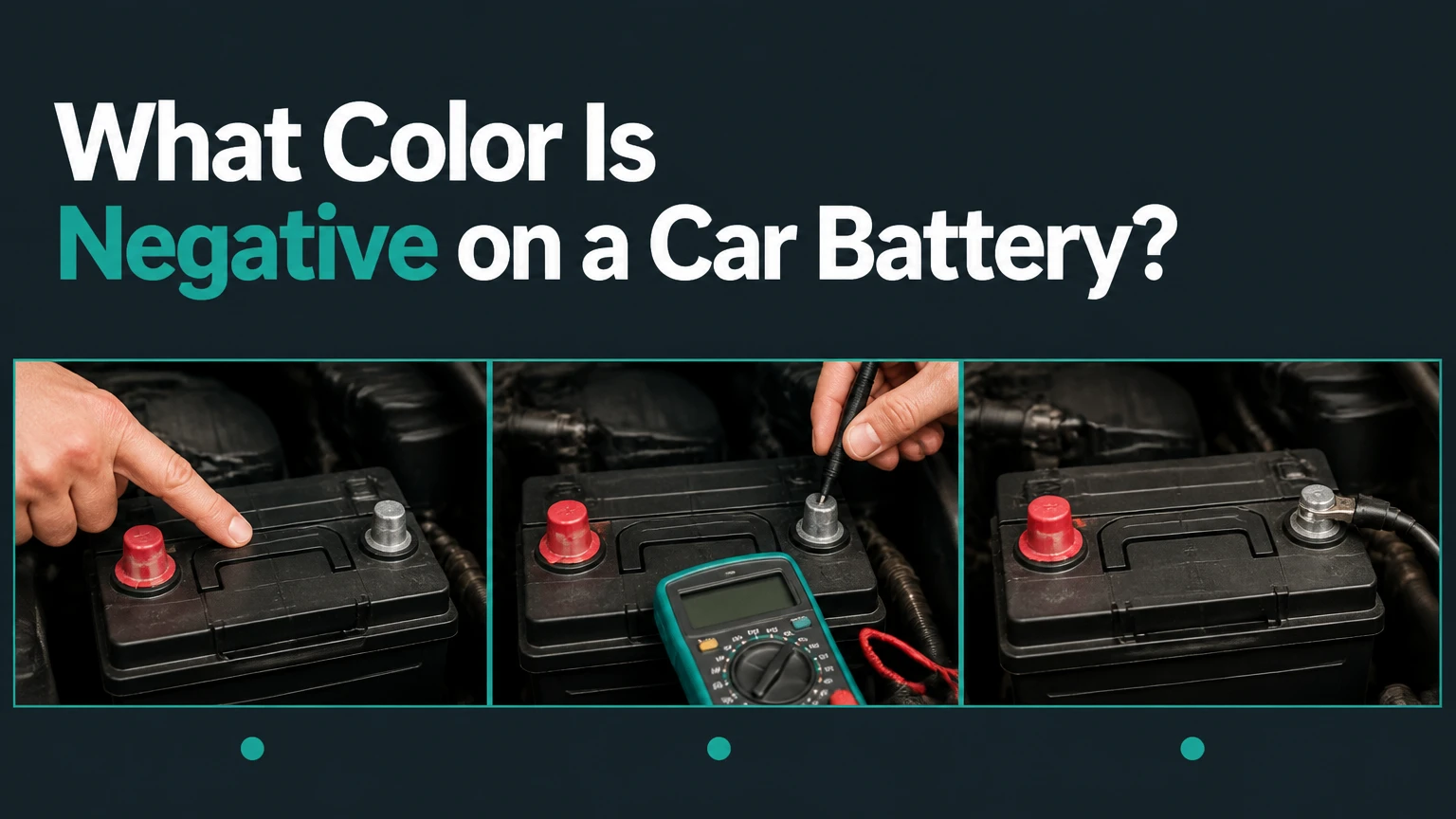
The negative terminal on a standard 12-volt car battery is black. The negative battery cable is also black, and the casing near the terminal post is stamped with a minus sign (–) or the abbreviation NEG. In contrast, the positive terminal is red and marked with a plus sign (+).
At a Glance
- Standard Color: Black represents the negative terminal; red represents the positive terminal.
- Primary Markings: The minus sign (–) stamped into the lead post or plastic casing is the most reliable identifier.
- Terminal Size: The negative post is smaller ($\sim$15.9 mm / 5/8 in) than the positive post ($\sim$17.5 mm / 11/16 in).
- Grounding: The negative terminal connects directly to the vehicle’s metal chassis or engine block.
- Safety Rule: Never rely on cable color alone—always verify the stamped symbol before connecting cables.
How Do You Identify Car Battery Terminals Without Relying on Color?
To identify car battery terminals accurately when colors are faded or missing, inspect the physical stamped markings on the battery casing, measure the post diameter, or trace the cable destination.
- Check for Stamped Symbols: Locate the minus sign (–) or NEG molded into the top plastic casing next to the negative post. Locate the plus sign (+) or POS near the positive post.
- Compare Terminal Diameters: Automobile batteries use tapered lead posts engineered to different sizes to prevent incorrect hookups. The negative terminal post has a smaller diameter of approximately 15.9 mm (5/8 inch), whereas the positive terminal post measures approximately 17.5 mm (11/16 inch).
- Trace the Cable Destination: Follow the attached cable from the terminal to its end point. The negative cable terminates at a nearby metal bolt on the car frame or engine block (ground). The positive cable routes toward the starter motor and main fuse box.
       TYPICAL 12V BATTERY LAYOUT
  +------------------------------------+
  |  [ POS / + ]        [ NEG / - ]    |
  |  (Red Cable)        (Black Cable)  |
  |   Dia: ~17.5mm       Dia: ~15.9mm  |
  |    |                  |            |
  +----+------------------+------------+
       |                  |
       v                  v
  Starter/Fuses       Car Frame (Ground)
Why Does Relying Only on Battery Cable Color Fail?
Relying exclusively on cable color fails because aftermarket modifications, physical corrosion, international manufacturing variations, and vintage electrical designs frequently alter or obscure factory color coding.
- Aftermarket Modifications: Custom audio installations, high-output alternators, and off-road winches often utilize custom power cables. Installers frequently use clear, silver, blue, or braided wire for grounding circuits, discarding factory black insulation.
- Corrosion Accumulation: Lead-acid batteries release hydrogen gas that reacts with atmospheric moisture to form white, green, or teal copper-sulfate corrosion. This crust builds up around terminal clamps, completely masking red or black plastic collar rings.
- Vintage Vehicles: Classic vehicles (particularly pre-1970 British automobiles) often utilize a “positive ground” or “positive earth” electrical architecture, where the positive terminal links to the chassis rather than the negative terminal.
- Commercial and European Machinery: Heavy equipment, agricultural machinery, and older European imports often feature uniform black cables for both terminals, relying strictly on stamped symbols.
What Color Is the Ground Cable on a Car Battery?
The ground cable on a standard negative-ground automotive vehicle is black. It connects the negative lead post directly to the unpainted sheet metal of the car frame, unibody, or engine block to complete the vehicle’s 12-volt electrical circuit.
In modern vehicles, this black grounding strap ensures that the entire metal chassis acts as a return path for electrical current to the battery. While black is the factory standard, aftermarket ground straps may consist of uninsulated braided copper or silver wire.
Why Is the Positive Battery Terminal Physically Larger Than the Negative Terminal?
The positive battery terminal is larger than the negative terminal as a mechanical safety feature known as poka-yoke (mistake-proofing), designed to prevent accidental reverse-polarity installation.
Because the positive post measures ~17.5 mm in diameter and the negative post measures ~15.9 mm, a positive cable terminal clamp will sit visibly loose on a negative post, making it impossible to tighten securely. Conversely, a negative clamp will not slide down far enough on a positive post without force, preventing drivers from easily tightening the wrong connections.
What Happens if You Connect Jumper Cables Backward?
Connecting jumper cables backward (reverse polarity) causes an immediate high-current short circuit that generates violent electrical arcing, destroys sensitive electronic control units (ECUs), blows high-amperage main fuses, and creates a risk of battery explosion.
| Component | Damage Mechanism | Repair / Result |
| Fuses & Links | High surge instantly melts the main battery fuse (typically 80A–150A). | Requires main fuse block replacement; leaves car completely powerless. |
| ECU / Modules | Reverse voltage bypasses diode protection, frying computer chips. | Multi-thousand dollar engine controller replacement. |
| Alternator | Internal rectifier diodes fail from reverse current flow. | Alternator replacement required; battery won’t charge. |
| Battery Casing | High current causes rapid heating and hydrogen gas accumulation. | Spark can ignite gas, rupturing plastic casing and spraying sulfuric acid. |
Which Cable Do You Disconnect First When Removing a Battery?
Always disconnect the negative (black) cable first when removing a car battery.
REMOVAL SEQUENCE:      1. Disconnect NEG (-)  ==>  2. Disconnect POS (+)
INSTALLATION SEQUENCE: 1. Connect POS (+)     ==>  2. Connect NEG (-)
When you unbolt the negative terminal first, you break the connection between the battery and the vehicle’s metal frame. If your metal wrench accidentally slips while loosening the negative bolt and touches any exposed metal on the engine or body, no short circuit occurs because the wrench and frame are at the exact same electrical potential.
If you were to remove the positive cable first while the negative cable was still connected, touching the chassis with your wrench would short the battery directly to ground. This produces intense electrical arcing, welding the wrench to the body and potentially rupturing the battery.
Which Cable Do You Connect First When Installing a Battery?
Always connect the positive (red) cable first when installing a new car battery, followed by the negative (black) cable.
Connecting the positive lead first ensures that while you are tightening the live terminal clamp, the metal body of the vehicle is not yet connected to the battery’s negative terminal. This means accidental wrench contact with adjacent sheet metal will not produce a spark or short circuit. Once the positive clamp is secure and insulated by its cover, you safely bolt down the negative clamp.
Where Do You Clamp the Negative Jumper Cable on a Dead Car?
Clamp the negative (black) jumper cable to an unpainted, solid metal bolt or bracket on the dead vehicle’s engine block or chassis frame, positioned away from the battery itself. Never attach the negative jumper clamp directly to the dead battery’s negative terminal post.
              JUMPER CABLE CONNECTION TOPOLOGY
  [ GOOD BATTERY ]                        [ DEAD BATTERY ]
  (+) Red Cable  ----------------------->  (+) Red Cable
  (-) Black Cable ---------------------->  (-) Black Cable
                                                |
                                                v
                                  Unpainted Engine Ground
                                  (Away from dead battery)
During dead battery jumper connections, the final clamp attachment completes the electrical circuit, which almost always generates a small spark. Lead-acid batteries emit flammable hydrogen gas during discharging and charging cycles. Placing the final negative clamp on a remote engine ground ensures that any spark occurs far from where hydrogen gas collects, eliminating the risk of a battery explosion.
What Color Are Negative Jumper Cables Compared to Installed Battery Cables?
Negative jumper cables are black, matching the standard color of installed negative battery cables. Standard booster cable sets consist of paired, color-coded clamps: red for positive (+) and black for negative (–).
When jumping a car, the red clamp links the positive terminal of the good battery to the positive terminal of the dead battery. The black clamp links the negative terminal of the good battery to an engine ground on the dead car.
How Do You Tell Positive From Negative on a Battery if Markings Are Faded?
If battery markings are fully faded, corroded, or painted over, use a digital multimeter set to DC Voltage to definitively identify terminal polarity.
- Turn on your digital multimeter and set the dial to DC Volts (V=) on the 20V scale.
- Touch the red multimeter probe to one terminal post and the black probe to the other terminal post.
- Observe the digital display reading:
- Positive Voltage (e.g., +12.6V): The red probe is touching the positive terminal, and the black probe is touching the negative terminal.
- Negative Voltage (e.g., -12.6V): The red probe is touching the negative terminal, and the black probe is touching the positive terminal.
How Do You Safely Clean Corrosion to Reveal Hidden Terminal Markings?
To clean battery corrosion safely and reveal obscured polarity markings, apply a mixture of baking soda and water to neutralize the acidic buildup before wiping the casing clean.
- Put on Safety Gear: Wear safety goggles and nitrile gloves to protect your eyes and skin from sulfuric acid residue.
- Apply Neutralizer: Mix 1 tablespoon of baking soda into 1 cup of warm water. Pour or brush the mixture directly onto the corroded terminals. The solution will fizz vigorously as it neutralizes the acid.
- Scrub and Wipe: Scrub the terminal area with a stiff wire battery brush or old toothbrush until the white or green crust is gone. Wipe the surface clean with paper towels to uncover the molded + and – casing symbols.
Can a Blown Main Fuse From a Reverse Jumper Connection Be Repaired at Home?
Yes, a blown main fuse caused by a reverse jumper connection can be replaced at home, but it requires buying a dedicated high-amp fuse block or bolt-in fuse link rather than a standard plug-in blade fuse.
In most modern vehicles, the main battery fuse is a large 80-amp to 150-amp slow-blow link located inside the underhood fuse box or mounted directly on the positive battery clamp assembly. Unlike small push-in fuses, main fuses are typically bolted into place with 8mm or 10mm nuts to handle high current.
To replace it, disconnect the battery, unbolt the damaged fuse link from the power distribution box, install the correct OEM replacement rating, and tighten the mounting hardware to spec.
The Bottom Line
The negative terminal on a car battery is black and marked with a minus sign (–). However, relying solely on cable color causes dangerous mistakes due to aftermarket modifications, dirt, and corrosion. Always verify polarity by checking the stamped casing symbols, comparing terminal post sizes, or using a multimeter before making any connections. When working on a battery, remember to remove the negative cable first during removal and connect it last during installation to keep your vehicle’s electrical system protected.