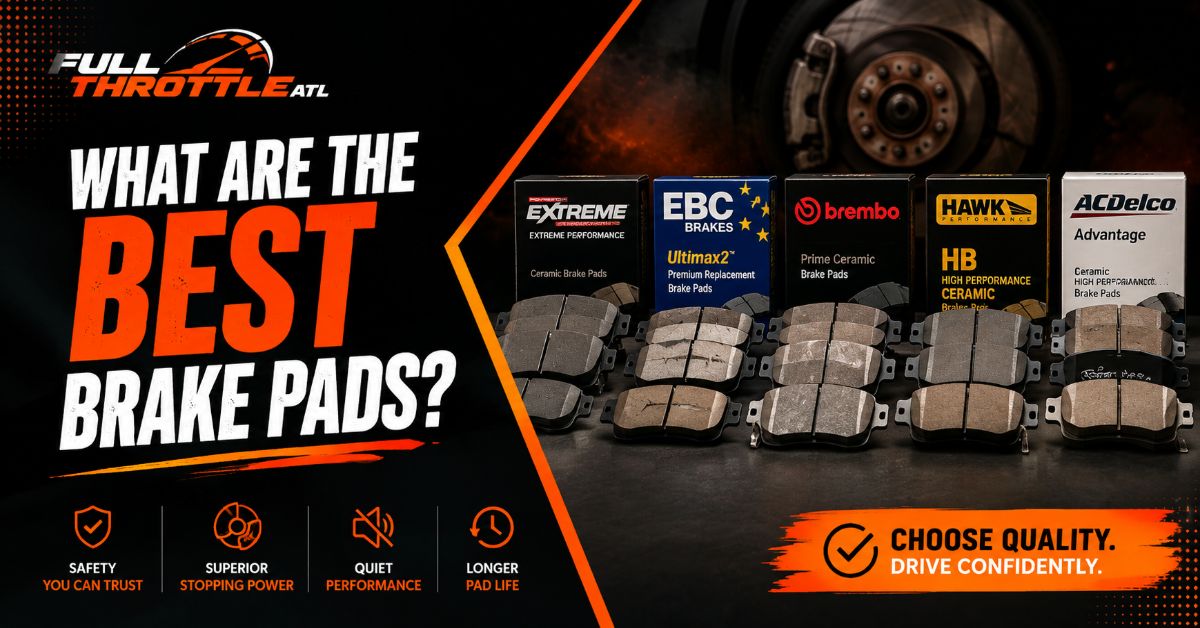
The best brake pads depend on your vehicle type and driving conditions, as no single formulation excels in all environments. Ceramic brake pads are best for daily commuting due to low dust and quiet operation. Semi-metallic brake pads are best for towing, mountain driving, and track performance due to superior heat dissipation. Organic (NAO) brake pads suit budget-conscious drivers operating light commuter vehicles in mild climates.
At a Glance
- Ceramic pads offer the longest average lifespan (50,000–75,000 miles) and produce non-abrasive, light grey dust.
- Semi-metallic pads deliver the highest coefficient of friction ($\mu = 0.38\text{–}0.50$) and withstand temperatures up to $1,300^\circ\text{F}\ (704^\circ\text{C})$.
- Organic (NAO) pads provide quiet, smooth engagement at low temperatures but fade rapidly above $700^\circ\text{F}\ (371^\circ\text{C})$.
- Towing and heavy hauling require semi-metallic pads to prevent extreme thermal fade under sustained heavy loads.
- Track-spec pads require high operating temperatures and perform poorly during cold morning street stops.
How Do Ceramic, Semi-Metallic, and Organic Brake Pads Compare?
Brake pads are divided into three primary material formulations: Ceramic, Semi-Metallic, and Non-Asbestos Organic (NAO). Each material balances stopping power, thermal tolerance, dust output, rotor wear, and noise levels differently.
| Metric | Ceramic Brake Pads | Semi-Metallic Brake Pads | Organic (NAO) Brake Pads |
| Optimal Temp Range | $32^\circ\text{F to } 1,000^\circ\text{F}$ ($0^\circ\text{C to } 538^\circ\text{C}$) | $32^\circ\text{F to } 1,300^\circ\text{F}$ ($0^\circ\text{C to } 704^\circ\text{C}$) | $32^\circ\text{F to } 700^\circ\text{F}$ ($0^\circ\text{C to } 371^\circ\text{C}$) |
| Friction Coefficient ($\mu$) | 0.35 to 0.45 | 0.38 to 0.50 | 0.28 to 0.38 |
| Brake Dust Level | Extremely Low (Light Grey) | High (Dark Metallic) | Medium (Dark Brown) |
| Average Lifespan | 50,000 to 75,000 miles | 30,000 to 50,000 miles | 25,000 to 40,000 miles |
| Rotor Wear Rate | Very Low | High | Low |
| Cold Bite Performance | Moderate to High | Low to Moderate (Race spec = Poor) | High |
Ceramic pads blend dense ceramic compounds with fine copper or synthetic fibers. Semi-metallic formulations contain 30% to 65% steel wool, iron, or copper by weight. Organic pads use glass, rubber, carbon, and Kevlar bound in high-temperature resins.
Which Brake Pads Are Best for Daily Commuting?
Ceramic brake pads are the best choice for daily commuting, suburban driving, and luxury passenger vehicles. They deliver predictable, whisper-quiet stopping power across standard urban temperature windows while generating minimal dust.
Daily driving rarely generates braking temperatures above $500^\circ\text{F}\ (260^\circ\text{C})$. Ceramic materials maintain a consistent friction coefficient ($\mu = 0.35\text{–}0.45$) within this operating range without requiring a warmup period. The fine dust emitted by ceramic compounds is light grey and non-adhesive, making it far easier to clean off alloy wheels than the corrosive metallic dust produced by semi-metallic options.
Furthermore, ceramic compounds cause minimal abrasive wear on iron rotors, extending the service life of the entire braking assembly. For standard sedans, crossovers, and unladen light trucks, premium ceramic formulations (such as Akebono ProACT or Bosch QuietCast) represent the ideal balance of longevity, cleanliness, and driver comfort.
Which Brake Pads Are Best for Towing, Hauling, and Mountain Driving?
Semi-metallic brake pads are mandatory for heavy towing, truck payloads, and steep downhill mountain driving. Ceramic pads fail under heavy loads because sustained braking pushes temperatures past $1,000^\circ\text{F}\ (538^\circ\text{C})$, causing severe thermal fade, a spongy brake pedal, and dangerous stopping distances.
When a vehicle hauls a heavy trailer down a mountain grade, friction converts kinetic energy into continuous, intense thermal energy. Semi-metallic formulations contain a high percentage of metallic elements (iron, steel, and copper) that act as a thermal conductor, drawing heat away from the friction interface and distributing it into the caliper structure.
[Heavy Load Downhill] ──> [Temps > 1,000°F] ──┬──> [Ceramic Pads] ──> Resin Gasification ──> Thermal Fade / Pedal Sponginess
                                              └──> [Semi-Metallic] ──> Metallic Heat Conduction ──> Stable Friction (μ = 0.38–0.50)
While semi-metallic pads produce noticeable dark dust and accelerate rotor wear, their higher friction coefficient ($\mu = 0.38\text{–}0.50$) remains stable up to $1,300^\circ\text{F}\ (704^\circ\text{C})$. For trucks like the Ford F-150, Chevy Silverado, or RAM 1500 used for towing, heavy-duty semi-metallic friction materials (such as Hawk LTS or EBC Extra Duty) are necessary for safety.
Which Brake Pads Are Best for Track Days and High-Performance Driving?
High-friction semi-metallic or dedicated track-spec compound pads are required for circuit driving, autocross, and aggressive high-performance applications. Commercial street ceramic pads disintegrate on a racetrack due to rapid thermal degradation of their binding resins.
Dedicated race pads feature high friction coefficients ($\mu = 0.45\text{–}0.60$) engineered to withstand continuous operating temperatures exceeding $1,400^\circ\text{F}\ (760^\circ\text{C})$. However, using race-spec pads on public roads creates a severe safety hazard:
- Lack of Cold Bite: Race compounds require a minimum operating temperature (often $200^\circ\text{F}\text{–}300^\circ\text{F}$) to activate their friction compound. On a cold morning commute, initial stopping distances will be significantly longer than with standard organic pads.
- Extreme Rotor Abrasion: Below their active thermal threshold, race pads operate through mechanical abrasion rather than adhesive friction, wearing down iron rotors rapidly.
- Loud Squeal: Race pads lack anti-vibration dampening layers, resulting in loud, high-pitched squealing during slow street stops.
For dual-duty street and track vehicles, select hybrid street/track semi-metallic compounds (such as Ferodo DS2500 or Porterfield R4-S) that offer sufficient cold bite while resisting fade during light track sessions.
Can You Put Commercial Ceramic Brake Pads on Carbon-Ceramic Rotors?
No, installing commercial aftermarket ceramic brake pads on carbon-ceramic matrix (CCM) or carbon-silicon-carbide (CSiC) rotors will permanently damage the rotors and severely compromise braking capability.
Carbon-ceramic rotors—standard on supercars like Porsche GT models, Ferrari, and Corvette Z06—require proprietary, specialized organic-matrix friction materials explicitly designated by the manufacturer (such as Pagid RSC compounds or OEM Brembo CCM pads).
Commercial ceramic brake pads are engineered strictly for cast-iron rotors. When paired with a carbon-ceramic surface, the hard abrasive fillers in standard commercial pads score the carbon-matrix surface layer, causing micro-fracturing, thermal hotspotting, and premature destruction of rotors that cost upwards of $3,000 to $5,000 each to replace.
How Long Do Different Types of Brake Pads Last on Average?
Brake pads last between 25,000 and 75,000 miles on average, depending on material compound, driving style, vehicle weight, and road conditions.
- Ceramic Pads: 50,000 to 75,000 miles. Their resilient structural matrix resists mechanical wear under normal operating temperatures.
- Semi-Metallic Pads: 30,000 to 50,000 miles. Their metallic structure wears down faster through mechanical friction and subjects rotors to higher wear.
- Organic (NAO) Pads: 25,000 to 40,000 miles. Their soft binding resins wear down rapidly, especially under frequent stop-and-go driving.
Aggressive driving, city stop-and-go traffic, mountain terrain, and heavy vehicle payloads can cut these baseline lifespan figures by up to 50%.
How Much Does a Full Brake Pad Replacement Cost?
A professional brake pad replacement costs between $150 and $300 per axle for standard vehicles using organic or ceramic pads. Total costs for a complete four-wheel brake job—including pad and rotor replacement—range from $350 to $800+.
[Total Brake Replacement Cost]
 ├── Parts (Per Axle)
 │    ├── Premium Pads: $40 - $100
 │    └── New Rotors (Pair): $80 - $200
 └── Professional Labor (Per Axle): $100 - $200
- DIY Parts Cost: Premium ceramic or semi-metallic pad sets cost $40 to $100 per axle. Replacement cast-iron rotors cost $40 to $100 each.
- Professional Labor: Independent repair shops charge $100 to $200 in labor per axle, while dealership service centers range from $150 to $300 per axle.
- Heavy-Duty & Performance Surcharges: Heavy-duty truck pads or European high-performance braking systems increase total axle replacement costs to $400–$900 per axle due to specialized hardware and higher component costs.
Should You Replace Rotors Every Time You Change Brake Pads?
You do not need to replace rotors at every pad change, provided the rotors exceed their minimum stamped thickness specification and show no structural damage, deep grooves, or severe thermal warping. However, resurfacing (machining) or replacing rotors is recommended to ensure proper bedding and full braking efficiency.
- Measure Minimum Thickness: Use a micrometer to check rotor thickness against the “Min Thick” specification stamped on the rotor hat. If thickness is at or below this limit, replace the rotor immediately.
- Inspect Surface Topography: Deep grooves (greater than 1.5 mm), heat cracks, or heavy rust lip edges require rotor replacement.
- Account for Friction Materials: Switching pad formulations (e.g., converting from semi-metallic to ceramic) requires turning or replacing the rotor to remove the old friction transfer layer. New pads cannot bed properly over an incompatible friction layer.
What Is Brake Pad Bedding and How Do You Do It Correctly?
Brake pad bedding (or burnishing) is the process of transferring an even layer of friction material from the new brake pad onto the rotor surface through controlled thermal cycles. Proper bedding prevents brake pedal pulsation, squealing, and premature pad wear.
1.Select a Safe Location:Requires clear road conditions with no trailing traffic.
Find a straight, safe stretch of open road or empty parking lot where you can perform repeated slowing maneuvers without interruption or safety hazards.
2.Perform Medium-Speed Slowdowns:Do NOT bring the vehicle to a complete stop.
Accelerate to 45 mph (72 km/h) and apply firm, steady pressure on the brake pedal to slow down rapidly to 10 mph (16 km/h). Repeat this step 4 to 5 times in quick succession.
3.Perform High-Speed Thermal Cycles:Increases pad temperature to initiate material transfer.
Accelerate to 60 mph (96 km/h) and brake hard down to 15 mph (24 km/h). Repeat this 3 to 4 times. You may notice a faint odor as the binding resins cure; this is normal.
4.Cool Down the Braking System:Prevents uneven pad deposits on hot rotors.
Drive at highway speeds for 5 to 10 minutes without using the brakes to allow airflow to cool the system. Do not hold the brake pedal at a complete stop while the rotors are hot, as this creates uneven pad material deposits that cause brake judder.
Why Do Brand-New Ceramic Brake Pads Squeak and How Do You Fix It?
Brand-new ceramic brake pads squeak because of high-frequency micro-vibrations between the back of the steel backing plate and the caliper piston or slide points—not because of friction against the rotor face.
To resolve squeaking on new ceramic installations, apply these corrective fixes:
- Apply High-Temperature Brake Grease: Apply a thin layer of silicone or ceramic-based brake grease (such as Permatex Ultra Disc Brake Caliper Lube) to the metal-on-metal contact points: the back of the steel backing plate, behind the dampening shims, and on the caliper bracket ears where the pad tabs slide. Never allow grease onto the friction material or rotor face.
- Install Stainless Steel Hardware: Replace worn or corroded caliper hardware clips with new stainless steel guide clips to ensure proper pad movement and isolation.
- Verify Anti-Squeal Shims: Ensure vulcanized rubber or metal anti-squeal shims are properly clipped to the back of the brake pads.
How Do You Tell When Your Brake Pads Need to Be Replaced?
Brake pads must be replaced when the friction material thickness wears down to 3 millimeters (1/8 inch) or less. Standard new brake pads typically start with 10 to 12 millimeters of friction depth.
- Mechanical Wear Indicator (Squealing): A small steel spring tab on the pad contacts the rotor when pad material drops to 2 mm–3 mm, emitting a high-pitched metallic squeal during driving or braking.
- Audible Grinding Noise: A deep, harsh metallic grinding sound indicates the friction pad material is completely worn away, allowing the steel backing plate to grind directly against the iron rotor. Stop driving immediately to prevent complete brake failure.
- Brake Pedal Vibration or Judder: Pulsation in the brake pedal during braking indicates uneven rotor wear or severe pad material deposits (often misdiagnosed as “warped” rotors).
- Visual Inspection through the Wheel: Look through the wheel spokes to inspect the pad’s outer block against the rotor. If the friction lining appears thinner than the steel backing plate, schedule a replacement.
What Do Brake Pad Friction Codes (EE, FF, GG, HH) Mean?
Brake pad friction codes are a two-letter SAE grading system (J661 standard) stamped on the edge of the backing plate. They define the pad’s coefficient of friction ($\mu$) at normal operating temperatures ($200^\circ\text{F}$) and hot operating temperatures ($600^\circ\text{F}$).
Format: [First Letter = Normal Temp (200°F)] [Second Letter = Hot Temp (600°F)]
Example: "GH" ──> Normal Temp = Grade G (μ 0.45–0.55) | Hot Temp = Grade H (μ > 0.55)
| Friction Code Letter | Coefficient of Friction (μ) Range |
| C | Less than 0.15 |
| D | 0.15 to 0.25 |
| E | 0.25 to 0.35 |
| F | 0.35 to 0.45 |
| G | 0.45 to 0.55 |
| H | Over 0.55 |
Most standard passenger ceramic pads carry an FF rating ($\mu = 0.35\text{–}0.45$ both cold and hot). High-performance street semi-metallic pads are typically rated FG or GG, while high-end truck or race pads carry an HH rating ($\mu > 0.55$), delivering aggressive initial bite and high resistance to thermal fade.
The Bottom Line
Matching your brake pad compound to your specific vehicle usage is the single most critical factor in braking safety and performance. Choose ceramic pads for silent, low-dust daily commuting; opt for semi-metallic pads if you haul heavy trailers, drive in steep terrain, or demand high-friction track capability; and reserve specialized organic matrices for carbon-ceramic rotors. Always bed in new pads and replace friction linings before they drop below 3 millimeters of total thickness.