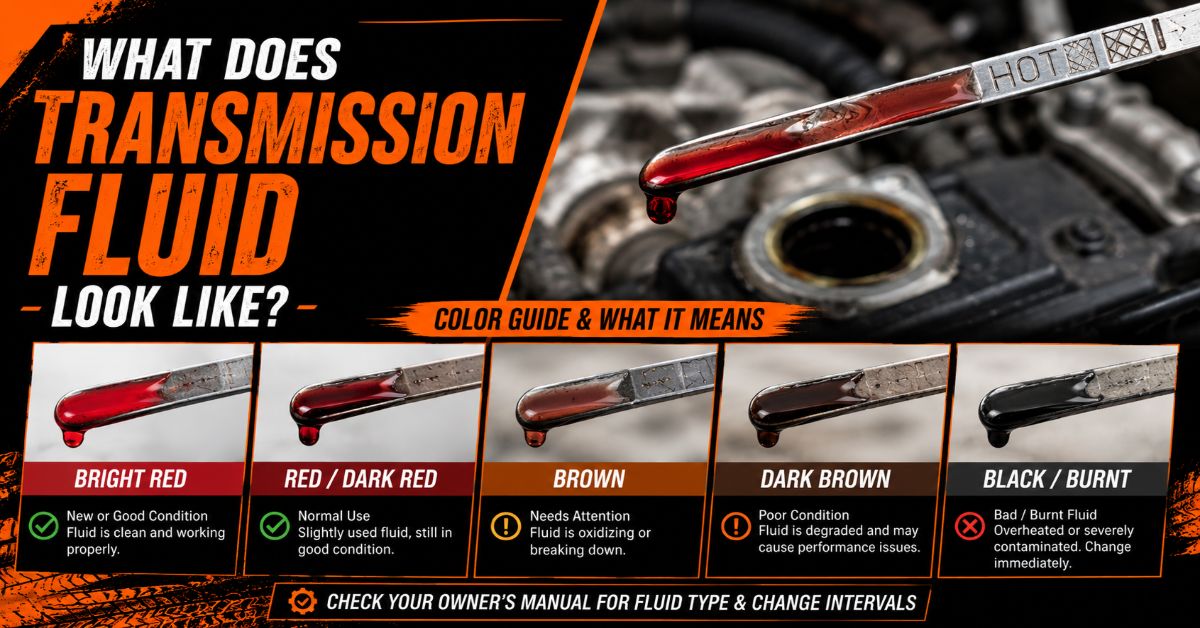
Healthy automatic transmission fluid (ATF) is a translucent, bright cherry-red liquid with a smooth, oily texture and a faint petroleum or sweet scent. As transmission fluid ages, oxidizes, and absorbs friction debris, its color degrades from bright red to light brown, dark brown, and eventually opaque black.
At a Glance
- New / Healthy Fluid: Translucent cherry red or pinkish; smooth with no debris.
- Worn Fluid: Dark brown or semi-translucent red; requires routine maintenance soon.
- Severe Contamination: Pink and milky (“strawberry milkshake”) indicates catastrophic engine coolant contamination.
- Burnt / Degraded Fluid: Opaque black with a acrid, burnt smell; signals extreme wear or clutch overheating.
- Factory Variations: CVTs, European cars, and specific Ford or GM transmissions may use clear, green, blue, or amber fluid from the factory.
How Does Transmission Fluid Color Change by Mileage?
Transmission fluid undergoes predictable visual degradation over time due to heat cycle exposure, shearing forces, and clutch disc wear.
| Mileage Range | Visual Appearance | Fluid Condition | Action Required |
| 0 – 30,000 miles | Bright translucent red / pink | Brand new or fresh | None; perform visual checks during oil changes. |
| 30,000 – 60,000 miles | Semi-translucent light brown / dark red | Marginally worn | Schedule a routine drain-and-fill per owner manual interval. |
| 60,000 – 100,000 miles | Dark brown to deep reddish-black | Heavily oxidized | Perform fluid exchange; inspect pan for metal shavings. |
| 100,000+ miles (unserviced) | Opaque pitch-black | Severe degradation / burnt | Do not power flush; consult a mechanic for drain-and-fill options. |
How Do You Perform the Paper Towel Test on ATF?
The paper towel test measures fluid clarity and suspended particulate matter by placing a single drop of transmission fluid onto a clean, white paper towel and observing how the fluid absorbs.
+--------------------------------------------------------------+
|                    THE PAPER TOWEL TEST                      |
+--------------------------------------------------------------+
| 1. Pull dipstick and drip 1 drop onto clean white towel.      |
| 2. Observe dispersion pattern over 30 seconds.               |
|                                                              |
| [ Healthy Drop ]            [ Heavily Worn Drop ]            |
| - Spreads quickly           - Spreads slowly                 |
| - Red/pink center           - Dark brown/black center        |
| - Clear outer ring          - Gritty, visible dark ring      |
| - Markings visible through  - Completely opaque              |
+--------------------------------------------------------------+
- Drip the fluid: Pull the dipstick and place one drop onto a white paper towel.
- Observe the spread: Fresh fluid immediately absorbs into the paper towel, spreading outward in an even pink or light red circle. You should easily read dipstick markings or print through the saturated spot.
- Inspect the center: Worn fluid leaves a dark brown or black ring in the center of the spot where heavy friction particles collect rather than dispersing evenly.
What Color Is Factory Fluid in CVTs and European Cars?
Not all healthy transmission fluid is red. Modern vehicles often use original equipment manufacturer (OEM) fluids dyed non-traditional colors to differentiate specific chemical compositions and friction coefficients.
- Continuously Variable Transmissions (CVTs): OEM CVT fluid is commonly light green, pale amber, or clear.
- European Imports (BMW, Mercedes-Benz, Audi, VW): Often utilize proprietary fluids ranging from pale straw color to dark blue or emerald green.
- Toyota / Lexus WS Fluid: Appears a darker purplish-red out of the bottle, which can easily be mistaken for aged fluid.
- Ford & GM Hybrids/CVTs: Frequently spec blue or green specialized synthetic fluids.
Why Does My Transmission Fluid Look Like a Strawberry Milkshake?
Transmission fluid that appears opaque, frothy, and pinkish-white—commonly called a “strawberry milkshake”—indicates that engine coolant has leaked into the transmission circuit.
This condition occurs when the internal walls of the transmission fluid cooler (housed inside the engine radiator) rupture or corrode. Coolant mixes directly with hot ATF under hydraulic pressure, forming a thick emulsion.
  +----------------------+             +----------------------+
  |    Engine Radiator   |             | Transmission System  |
  |  [ Coolant Circuit ] |             |   [ ATF Circuit ]    |
  +----------+-----------+             +----------+-----------+
             |                                    |
             +-------------> RUPTURED <-----------+
                             COOLER TUBE
                                  |
                                  v
                   +------------------------------+
                   |  "STRAWBERRY MILKSHAKE"      |
                   |  Opaque pink / milky fluid   |
                   |  (Destroys clutch linings)   |
                   +------------------------------+
When engine coolant contacts internal clutch plates, it dissolves the organic glue holding the friction material to the steel plates. If driven in this condition, total transmission failure occurs within miles. Fixing this requires replacing the radiator, performing a comprehensive transmission overhaul or replacement, and thoroughly flushing the cooling lines.
Why Are There Foam or Bubbles on the Dipstick?
Foam or aeration on the dipstick indicates that air is being whipped into the hydraulic fluid, caused by either severe overfilling or critical underfilling.
- Overfilled Fluid: Excess fluid fills the transmission pan up to the rotating internal gear assemblies. Spinning gear sets strike the oil pool, churning the liquid into a thick foam.
- Underfilled Fluid: Low liquid volume causes the hydraulic fluid pump to pull air alongside fluid, aerating the line pressure.
Air is highly compressible, whereas hydraulic fluid is non-compressible. Churned, foamy fluid fails to maintain hydraulic pressure, causing severe clutch slippage, delayed gear engagement, overheating, and rapid valve body wear.
What Does Burnt Transmission Fluid Smell Like?
Burnt transmission fluid smells like sharp, acrid, burnt toast mixed with heavy chemical sulfur.
While healthy ATF carries a distinct, mild petroleum scent with a slightly sweet or tart undertone, heat-degraded fluid smells intensely bitter and pungent. The burnt odor is caused by internal fluid temperatures exceeding 240°F (115°C), which bakes the additive package and scorches the organic friction plates. If your fluid smells burnt and looks dark brown or black, internal mechanical slippage has already occurred.
How Do You Distinguish Engine Oil Leaks From ATF Leaks?
You can distinguish engine oil from automatic transmission fluid by analyzing fluid color, drop location, and tactile texture on a clean piece of white cardboard placed under the vehicle.
+------------------+---------------------------+---------------------------+
| Attribute        | Automatic Transmission    | Engine Oil                |
+------------------+---------------------------+---------------------------+
| Fresh Color      | Bright Cherry Red / Pink  | Translucent Honey / Amber |
| Aged Color       | Dark Brown to Black       | Dark Brown to Opaque Black|
| Smell            | Sweet petroleum / burnt   | Heavy mechanical oil      |
| Tactile Texture  | Slick, thin, petroleum    | Thick, viscous, greasy    |
| Typical Leak Spot| Center-front to mid-car   | Direct front beneath sump |
+------------------+---------------------------+---------------------------+
To confirm the leak source, slide clean cardboard under the parked engine bay overnight. ATF droplets leave a bright red or translucent brownish stain near the middle of the engine compartment (where the transmission bell housing mates to the engine). Engine oil leaves a thicker, darker amber or black stain directly below the oil pan plug near the front axle.
Why Is Flushing High-Mileage Black Fluid Dangerous?
Flushing an unserviced, high-mileage transmission with pitch-black fluid can cause complete clutch slippage and immediate transmission failure due to the removal of suspended friction debris.
In neglected transmissions (150,000+ miles without fluid changes), internal clutch friction linings wear away completely. The microscopic friction material remains suspended inside the thick, old fluid, providing the grit required for worn clutches to grip.
If a high-pressure mechanical flush introduces fresh, high-detergent fluid, it strips away those suspended friction solids. The smooth, new fluid causes worn clutches to slip instantly. On neglected, black-fluid transmissions, experienced mechanics perform a gentle, single-quart “drain-and-fill” or leave the fluid unchanged rather than performing a high-pressure flush.
How Do You Accurately Check Transmission Fluid Level?
Checking automatic transmission fluid level accurately requires warming the fluid to operating temperature, cycling through gear positions, and inspecting the dipstick while the engine idles on a flat surface.
1.Bring Fluid to Operating Temperature:Drive 5-10 miles first.
Drive the vehicle for 5 to 10 minutes until the transmission reaches its normal operating temperature (typically 160°F–175°F). Park on a flat, level surface.
2.Cycle the Gear Selector:Fills the hydraulic valve body.
With your foot on the brake pedal, move the shift lever through every gear position (P-R-N-D-2-1), pausing for 2 seconds in each gear. Return the selector to Park (P).
3.Check the Dipstick with Engine Idling:Engine must remain running.
Leave the engine idling. Open the hood, remove the ATF dipstick, wipe it clean on a lint-free rag, reinsert it fully, and pull it out to read the level against the “HOT” indicator markings.
Note: Always consult your vehicle’s service manual before checking. Certain manufacturers (such as Honda) require fluid level checks within 60 seconds of turning the engine OFF.
How Do You Check a Sealed Transmission Without a Dipstick?
Checking fluid on a sealed transmission requires raising the vehicle level on a lift, accessing the transmission check-plug from underneath, and monitoring fluid temperature with a diagnostic scan tool.
                  [ SEALED TRANSMISSION CHECK PLUG ]

        +-----------------------------------------------+
        |                                               |
        |               TRANSMISSION CASING             |
        |                                               |
        |      [Fill Plug]                              |
        |           o                                   |
        |                                               |
        |                        [Fluid Level] -------- | <--- Ideal level
        |                                               |      at 100°F - 120°F
        |                        [Check Plug]           |
        |                             o                 |
        |                             |                 |
        +-----------------------------|-----------------+
                                      v
                             (Slight trickle = OK)
- Raise and Level the Vehicle: Secure the car on a hydraulic lift or four jack stands to ensure the vehicle is perfectly horizontal.
- Monitor Fluid Temperature: Connect an OBD-II scan tool to monitor live Transmission Fluid Temperature (TFT). Most sealed transmissions require checking between 95°F and 122°F (35°C–50°C).
- Open the Fluid Level Check Plug: Remove the dedicated level-check plug on the side or bottom overflow tube of the transmission pan.
- Evaluate Fluid Flow: If fluid trickles out in a thin, steady stream, the fluid level is correct. If no fluid comes out, fluid must be added through the fill port above.
What Is the Difference Between a Transmission Flush and a Drain-and-Fill?
A transmission drain-and-fill replaces 30% to 50% of total fluid volume by gravity draining the pan, while a mechanical flush exchanges 100% of fluid across the entire cooling and torque converter circuit using external pump pressure.
| Attribute | Drain & Fill | Machine Flush |
| Fluid Replaced | 30% – 50% (Pan capacity only) | 95% – 100% (Pan + torque converter + cooler) |
| Pressure Applied | Gravity drain (Safe) | Low-to-medium pump force |
| Filter Replacement | Yes (Pan is removed) | Rarely (External fluid hookup only) |
| High-Mileage Risk | Low (Preserves clutch friction) | High (Can dislodge varnish and debris) |
| Typical Cost | $100 – $200 | $250 – $450 |
Can You Top Off Transmission Fluid With Any Red ATF?
No, topping off transmission fluid with an incorrect ATF specification—even if it is red—can ruin internal clutches and destroy rubber seals.
Automatic transmission fluids are engineered with unique viscosity profiles, detergent loads, and static/dynamic friction coefficients. Mixing incompatible specs (such as putting Ford MERCON V into a GM DEXRON VI system, or multi-vehicle ATF into a dedicated Toyota WS system) alters hydraulic pressure and clutch engagement times. This causes severe shift shudder, slipping clutches, and premature mechanical breakdown. Always match the exact spec stamped on the dipstick or listed in your owner’s manual.
How Often Should You Replace Automatic Transmission Fluid?
Automatic transmission fluid should be replaced every 30,000 to 60,000 miles for standard passenger driving, or every 15,000 to 30,000 miles for severe driving conditions like towing.
- Normal Service Interval: 30,000 – 60,000 miles (Drain-and-fill service).
- Severe Service Interval: 15,000 – 30,000 miles (Frequent stop-and-go driving, heavy towing, mountain driving, or extreme hot/cold climates).
- “Lifetime” Fluids: Modern OEM lifetime fluid claims assume normal operating lifespans (typically 100,000 miles). Professional transmission builders recommend replacing “lifetime” fluid by 60,000 to 80,000 miles to prevent valve body wear.
How Much Does a Transmission Fluid Service Cost?
A standard transmission fluid service costs between $100 and $450, depending on vehicle make, fluid type, and service method.
- Drain and Fill (Standard Shop): $100 – $200 (Includes 4–6 quarts of fluid and a new pan gasket/filter).
- Complete Transmission Flush: $250 – $450 (Includes 12–16 quarts of synthetic ATF and machine service).
- DIY Drain and Fill: $40 – $90 (Cost of OEM-certified fluid and replacement filter kit).
The Bottom Line
Healthy transmission fluid is translucent cherry-red, oily, and free of debris. Color changes from red to light brown represent normal wear, but dark brown, pitch-black, or milky-pink fluid indicates immediate service needs or mechanical failure. Always verify your vehicle’s specific ATF spec and check method before topping off or performing service.